Electrical Excel Tools


Excel base Programs (Electrical Engineering):       Designed by: Jignesh.Parmar

Cable Designing Program

FREE DOWNLOAD

  • Calculate Voltage drop of Cable.
  • Calculate  Size of Cable.
  • Calculate Current Capacity of Cable.

Conduit Size Selection Program

FREE DOWNLOAD

  • Calculate Size of Conduit for LT Cable/CAT-5 Cable/Fiber Optical Cable.

Selection of  MCCB,ELCB  For Main /Branch Circuit.

FREE DOWNLOAD

  • Calculate  Size and Type of Main MCCB/RCCB/ELCB for Continious and Non Continious Load
  • Calculate  Sensitivity of MCCB/RCCB/ELCB.
  • Calculate Size of  Cable.
  • Calculate Size and Type of Sub Circuit MCCB/MCB for Continious and Non Continious Load
  • Calculate Total Load .
  • Calculate Main and Branch Circuit Current.

Selection of Fuses

FREE DOWNLOAD

  • Calculate Size of Fuse for Electrical Circuit.

Size of Capacitor  For Power Factor Improvements

FREE DOWNLOAD

  • Calculate Size of Capacitor for Power Factor Improvements.
  • Calculate Annual Saving by selection of  Capacitor.
  • Calculate Active and Reactive Power.

Short Circuit Current Calculation at Various Point of Electrical Curcuits(Isc).

FREE DOWNLOAD

  • Calculate Short Circuit Current  at Substation.
  • Calculate Short Circuit Current at Distribution point.
  • Calculate Short Circuit Current at Transformer.
  • Calculate Short Circuit Current at Main Panel.
  • Calculate Short Circuit Current at Sub Distribution Board.

Circuit Breaker Tripping Settings.

FREE DOWNLOAD

  • Calculate  Tripping Setting of Circuit Breaker.
  • 

Motor Specifications

FREE DOWNLOAD

  • Calculate Various Specification of Motor.
  • 

Calculate  Home Electrical Load & Electrical Bill.

FREE DOWNLOAD

  • Calculate Electrical Bill of Home
  • Calculate Size of MCCB/MCB for Domestic Load
  • Calculate Electrical Load of Home.

Calculate Insulation Resistance Value and PI value

FREE DOWNLOAD

  • Calculate minimum Insulation Resistance Value for Various Electrical Equipments.
  • Calculate IR Value of Electrical Equipments.
  • Graph of  IR Value
  • Calculate Polarization Index Value with Graph
  • Calculate Earth Resistivity.

Calculate Electrical Load and Energy Consumption of Panel.

FREE DOWNLOAD

  • Calculate Continuous and non Continuous Electrical Load of Panel.
  • Calculate total Energy Consumption(KWH) in Daily/Monthly of Panel.
  • Calculate Size of MCB of each branch circuit of Panel.
  • Calculate Voltage / Voltage Difference of Each Phase
  • Calculate Unbalanced Load in Neutral Wire.
  • Calculate Expected Temperature rise in Each Phase.
  • Calculate Load in Each Phase.
  • Calculate Starting/Full Load/Continuous/Non Continuous Load
  • Calculate Size/Type/Tripping setting of Main MCCB.
  • 

Calculate Electrical Load of Panel.

FREE DOWNLOAD

  • Calculate Voltage / Voltage Difference of Each Phase
  • Calculate Unbalanced Load in Neutral Wire.
  • Calculate Expected Temperature rise in Each Phase.
  • Calculate Load in Each Phase and Outgoing Feeders.
  • Calculate Starting/Full Load/Continuous/Non Continuous Load
  • Calculate Size of Cables for Each Outgoing Feeder.

Calculate Size of Battery Bank and Inverter.

FREE DOWNLOAD

  • Calculate Total Demand Load
  • Calculate Size of Battery Bank in Amp.Hr.
  • Select Type of Connection of Batteries in Battery Bank
  • Select Rating of Each Battery in Battery Bank
  • Calculate Size of Inverter.
  • Calculate Size/Type/Tripping setting of Main MCCB.

Calculate Size of Solar Panel / Battery Bank / Inverter.

FREE DOWNLOAD

  • Calculate Total Demand Load
  • Calculate Size of Solar Panel.
  • Select Type of Connection of Solar Panel.
  • Select Rating of Each Solar Panel.
  • Calculate Energy from Solar Panel as per Daily Sun lights.
  • Calculate Size Battery Bank.
  • Select Type of connection of Batteries in Battery Bank
  • Calculate size of Inverter

Calculate No of Lighting Fittings and Lumen Output.

FREE DOWNLOAD

  • Calculate Total Lumen Output for particular Area.
  • Calculate Total No of Lighting Lamps.
  • Calculate Total No of Lighting Fixtures.
  • Calculate No of Fittings along with the Length and Width of Room.

Calculate Bus Bar Size and Voltage Drop.

FREE DOWNLOAD

  • Calculate Voltage Drop for  Bus Bar.
  • Select Size of Bus Bar for particular Load.
  • Enter Your Sub Panel Details like Load,Line Length.

Design of Earthing Mat for Sub-Station:

FREE DOWNLOAD

  • Program is design as per ANSI/IEEE 80-1986 Code.
  • Calculate Step Potential of Switch yard.
  • Calculate Touch Potential of Switch yard.
  • Calculate Total Length of Earthing Mat Conductor.
  • Calculate Size of Earthing Mat Conductor.
  • Calculate Total No of Earthing Rods.

Calculate Touch Voltage and Ground Current.

FREE DOWNLOAD

  • Calculate Resistance of Each Phase.
  • Calculate  Resistance of neutral/Ground.
  • Calculate Neutral Current and Load.
  • Calculate Touch Voltage for Metal part to Earth.
  • Calculate Body Resistance and Body Current.

Importance of Reactive Power for System


Introduction:

  • We always in practice to reduce reactive power to improve system efficiency .This are acceptable at some level. If system is purely resistively or capacitance it make cause some problem in Electrical system. Alternating systems supply or consume two kind of power: real power and reactive power.
  • Real power accomplishes useful work while reactive power supports the voltage that must be controlled for system reliability. Reactive power has a profound effect on the security of power systems because it affects voltages throughout the system.
  • Find important discussion regarding importance about Reactive Power and how it is useful to maintain System voltage healthy

 Importance of Reactive Power:

  • Voltage control in an electrical power system is important for proper operation for electrical power equipment to prevent damage such as overheating of generators and motors, to reduce transmission losses and to maintain the ability of the system to withstand and prevent voltage collapse.
  • Decreasing reactive power causing voltage to fall while increasing it causing voltage to rise. A voltage collapse may be occurs when the system try to serve much more load than the voltage can support.
  • When reactive power supply lower voltage, as voltage drops current must increase to maintain power supplied, causing system to consume more reactive power and the voltage drops further . If the current increase too much, transmission lines go off line, overloading other lines and potentially causing cascading failures.
  • If the voltage drops too low, some generators will disconnect automatically to protect themselves. Voltage collapse occurs when an increase in load or less generation or transmission facilities causes dropping voltage, which causes a further reduction in reactive power from capacitor and line charging, and still there further voltage reductions. If voltage reduction continues, these will cause additional elements to trip, leading further reduction in voltage and loss of the load. The result in these entire progressive and uncontrollable declines in voltage is that the system unable to provide the reactive power required supplying the reactive power demands

 Necessary to Control of Voltage and Reactive Power:

  • Voltage control and reactive power management are two aspects of a single activity that both supports reliability and facilitates commercial transactions across transmission networks.
  • On an alternating current (AC) power system, voltage is controlled by managing production and absorption of reactive power.
  • There are three reasons why it is necessary to manage reactive power and control voltage.
  • First, both customer and power system equipment are designed to operate within a range of voltages, usually within±5% of the nominal voltage. At low voltages, many types of equipment perform poorly, light bulbs provide less illumination, induction motors can overheat and be damaged, and some electronic equipment will not operate at. High voltages can damage equipment and shorten their lifetimes.
  • Second, reactive power consumes transmission and generation resources. To maximize the amount of real power that can be transferred across a congested transmission interface, reactive power flows must be minimized. Similarly, reactive power production can limit a generator’s real power capability.
  • Third, moving reactive power on the transmission system incurs real power losses. Both capacity and energy must be supplied to replace these losses.
  • Voltage control is complicated by two additional factors.
  • First, the transmission system itself is a nonlinear consumer of reactive power, depending on system loading. At very light loading the system generates reactive power that must be absorbed, while at heavy loading the system consumes a large amount of reactive power that must be replaced. The system’s reactive power requirements also depend on the generation and transmission configuration.
  • Consequently, system reactive requirements vary in time as load levels and load and generation patterns change. The bulk power system is composed of many pieces of equipment, any one of which can fail at any time. Therefore, the system is designed to withstand the loss of any single piece of equipment and to continue operating without impacting any customers. That is, the system is designed to withstand a single contingency. The loss of a generator or a major transmission line can have the compounding effect of reducing the reactive supply and, at the same time, reconfiguring flows such that the system is consuming additional reactive power.
  • At least a portion of the reactive supply must be capable of responding quickly to changing reactive power demands and to maintain acceptable voltages throughout the system. Thus, just as an electrical system requires real power reserves to respond to contingencies, so too it must maintain reactive-power reserves.
  • Loads can also be both real and reactive. The reactive portion of the load could be served from the transmission system. Reactive loads incur more voltage drop and reactive losses in the transmission system than do similar size (MVA) real loads.
  • System operation has three objectives when managing reactive power and voltages.
  • First, it must maintain adequate voltages throughout the transmission and distribution system for both current and contingency conditions.
  • Second, it seeks to minimize congestion of real power flows.
  • Third, it seeks to minimize real power losses.

 Basic concept of Reactive Power

 1)    Why We Need Reactive Power:

  • Active power is the energy supplied to run a motor, heat a home, or illuminate an electric light bulb. Reactive power provides the important function of regulating voltage.
  • If voltage on the system is not high enough, active power cannot be supplied.
  • Reactive power is used to provide the voltage levels necessary for active power to do useful work.
  • Reactive power is essential to move active power through the transmission and distribution system to the customer .Reactive power is required to maintain the voltage to deliver active power (watts) through transmission lines.
  • Motor loads and other loads require reactive power to convert the flow of electrons into useful work.
  • When there is not enough reactive power, the voltage sags down and it is not possible to push the power demanded by loads through the lines.”

2)    Reactive Power is a Byproduct of AC Systems

  • Transformers, Transmission lines, and motors require reactive power. Electric motors need reactive power to produce magnetic fields for their operation.
  • Transformers and transmission lines introduce inductance as well as resistance
  1. Both oppose the flow of current
  2. Must raise the voltage higher to push the power through the inductance of the lines
  3. Unless capacitance is introduced to offset inductance

3)    How Voltages Controlled by Reactive Power:

  • Voltages are controlled by providing sufficient reactive power control margin to supply needs through
  1. Shunt capacitor and reactor compensations
  2. Dynamic compensation
  3. Proper voltage schedule of generation.
  • Voltages are controlled by predicting and correcting reactive power demand from loads

4)    Reactive Power and Power Factor

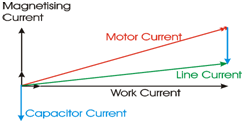
  • Reactive power is present when the voltage and current are not in phase
  1. One waveform leads the other
  2. Phase angle not equal to 0°
  3. Power factor less than unity
  • Measured in volt-ampere reactive (VAR)
  • Produced when the current waveform leads voltage waveform (Leading power factor)
  • Vice verse, consumed when the current waveform lags voltage (lagging power factor)

5)    Reactive Power Limitations:

  • Reactive power does not travel very far.
  • Usually necessary to produce it close to the location where it is needed
  • A supplier/source close to the location of the need is in a much better position to provide reactive power versus one that is located far from the location of the need
  • Reactive power supplies are closely tied to the ability to deliver real or active power.

 Reactive Power Caused Absence of Electricity -A Blackout

  • The quality of the electrical energy supply can be evaluated basing on a number of parameters. However, the most important will be always the presence of electrical energy and the number and duration of interrupts.
  • When consumption of electrical energy is high, the demand on inductive reactive power increases at the same proportion. In this moment, the transmission lines (that are well loaded) introduce an extra inductive reactive power. The local sources of capacitive reactive power become insufficient. It is necessary to deliver more of the reactive power from generators of power plants.
  • It might happen that they are already fully loaded and the reactive power will have to be delivered from more distant places. Transmission of reactive power will load more the lines, which in turn will introduce more reactive power. The voltage on customer side will decrease further. Local control of voltage by means of auto transformers will lead to increase of current (to get the same power) and this in turn will increase voltage drops in lines. In one moment this process can go like avalanche reducing voltage to zero. In mean time most of the generators in power plants will switch off due to unacceptably low voltage what of course will deteriorate the situation.
  • Insufficient reactive power leading to voltage collapse has been a causal factor in major blackouts in the worldwide. Voltage collapse occurred in United States in the blackout of July 2, 1996, and August10, 1996 on the West Coast
  • While August 14, 2003, blackout in the United States and Canada was not due to a voltage collapse as that term has traditionally used by power system engineers, the task force final report said that” Insufficient reactive power was an issue in the blackout” and the report also “overestimation of dynamics reactive output of system generation ” as common factor among major outages in the United States.
  • Demand for reactive power was unusually high because of a large volume of long-distance transmissions streaming through Ohio to areas, including Canada, than needed to import power to meet local demand. But the supply of reactive power was low because some plants were out of service and, possibly, because other plants were not producing enough of it.”

 Problem of Reactive Power:

  • Though reactive power is needed to run many electrical devices, it can cause harmful effects on appliances and other motorized loads, as well as electrical infrastructure. Since the current flowing through electrical system is higher than that necessary to do the required work, excess power dissipates in the form of heat as the reactive current flows through resistive components like wires, switches and transformers. Keep in mind that whenever energy is expended, you pay. It makes no difference whether the energy is expended in the form of heat or useful work.
  • We can determine how much reactive power electrical devices use by measuring their power factor, the ratio between real power and true power. A power factor of 1 (i.e. 100%) ideally means that all electrical power is applied towards real work. Homes typically have overall power factors in the range of 70% to 85%, depending upon which appliances may be running. Newer homes with the latest in energy efficient appliances can have an overall power factor of 90%.
  • Electric companies correct for power factor around industrial complexes, or they will request the offending customer to do so, or they will charge for reactive power. Electric companies are not worried about residential service because the impact on their distribution grid is not as severe as in heavily industrialized areas. However, it is true that power factor correction assists the electric company by reducing demand for electricity, thereby allowing them to satisfy service needs elsewhere.
  • Power factor correction will not raise your electric bill or do harm to your electrical devices. The technology has been successfully applied throughout industry for years. When sized properly, power factor correction will enhance the electrical efficiency and longevity of inductive loads. Power factor correction can have adverse side effects (e.g. harmonics) on sensitive industrialized equipment if not handled by knowledgeable, experienced professionals. Power factor correction on residential dwellings is limited to the capacity of the electrical panel (200 amp max) and does not over compensate household inductive loads. By increasing the efficiency of electrical systems, energy demand and its environmental impact is lessened

 Effects of Reactive Power in Various elements of Power System:

 1)    Generation:

  • An electric power generator’s primary function is to convert fuel into electric power. Almost all generators also have considerable control over their terminal voltage and reactive-power output.
  • The ability of   generator to provide reactive support depends on its real power production. Like most electric equipment, generators are limited by their current carrying capability. Near rated voltage, this capability becomes an MVA limit for the armature of the generator rather than a MW limitation.
  • Production of reactive power involves increasing the magnetic field to raise the generator’s terminal voltage. Increasing the magnetic field requires increasing the current in the rotating field winding. Absorption of reactive power is limited by the magnetic-flux pattern in the stator, which results in excessive heating of the stator-end iron, the core-end heating limit.
  • The synchronizing torque is also reduced when absorbing large amounts of reactive power, which can also limit generator capability to reduce the chance of losing synchronization with the system.
  • The generator prime mover (e.g., the steam turbine) is usually designed with less capacity than the electric generator, resulting in the prime-mover limit. The designers recognize that the generator will be producing reactive power and supporting system voltage most of the time. Providing a prime mover capable of delivering all the mechanical power the generator can convert to electricity when it is neither producing nor absorbing reactive power would result in under utilization of the prime mover.
  • To produce or absorb additional VARs beyond these limits would require a reduction in the real power output of the unit. Control over the reactive output and the terminal voltage of the generator is provided by adjusting the DC current in the generator’s rotating field .Control can be automatic, continuous, and fast.
  • The inherent characteristics of the generator help maintain system voltage. At any given field setting, the generator has a specific terminal voltage it is attempting to hold. If the system voltage declines, the generator will inject reactive power into the power system, tending to raise system voltage. If the system voltage rises, the reactive output of the generator will drop, and ultimately reactive power will flow into the generator, tending to lower system voltage. The voltage regulator will accentuate this behavior by driving the field current in the appropriate direction to obtain the desired system voltage.

 2)    Synchronous Condensers:

  • Every synchronous machine (motor or generator) with a controllable field has the reactive power capabilities discussed above.
  • Synchronous motors are occasionally used to provide dynamic voltage support to the power system as they provide mechanical power to their load. Some combustion turbines and hydro units are designed to allow the generator to operate without its mechanical power source simply to provide the reactive power capability to the power system when the real power generation is unavailable or not needed. Synchronous machines that are designed exclusively to provide reactive support are called synchronous condensers.
  • Synchronous condensers have all of the response speed and controllability advantages of generators without the need to construct the rest of the power plant (e.g., fuel-handling equipment and boilers). Because they are rotating machines with moving parts and auxiliary systems, they may require significantly more maintenance than static alternatives. They also consume real power equal to about 3% of the machine’s reactive-power rating.

 3)    Capacitors & Inductors:

  • Capacitors and inductors (which are sometimes called reactors) are passive devices that generate or absorb reactive power. They accomplish this without significant real power losses or operating expense.
  • The output of capacitors and inductors is proportional to the square of the voltage. Thus, a capacitor bank (or inductor) rated at 100 MVAR will produce (or absorb) only 90 MVAR when the voltage dips to 0.95 pu but it will produce (or absorb) 110 MVAR when the voltage rises to 1.05 pu. This relationship is helpful when inductors are employed to hold voltages down.
  •  The inductor absorbs more when voltages are highest and the device is needed most. The relationship is unfortunate for the more common case where capacitors are employed to support voltages. In the extreme case, voltages fall, and capacitors contribute less, resulting in a further degradation in voltage and even less support from the capacitors; ultimately, voltage collapses and outages occur.
  • Inductors are discrete devices designed to absorb a specific amount of reactive power at a specific voltage. They can be switched on or off but offer no variable control.
  •  Capacitor banks are composed of individual capacitor cans, typically 200 kVAR or less each. The cans are connected in series and parallel to obtain the desired capacitor bank voltage and capacity rating. Like inductors, capacitor banks are discrete devices but they are often configured with several steps to provide a limited amount of variable control which makes it a disadvantage compared to synchronous motor.

 4)    Static VAR Compensators : (SVCs)

  • An SVC combines conventional capacitors and inductors with fast switching capability. Switching takes place in the sub cycle timeframe (i.e. in less than 1/60 of a second), providing a continuous range of control. The range can be designed to span from absorbing to generating reactive power. Consequently, the controls can be designed to provide very fast and effective reactive support and voltage control.
  • Because SVCs use capacitors, they suffer from the same degradation in reactive capability as voltage drops. They also do not have the short term overload capability of generators and synchronous condensers. SVC applications usually require harmonic filters to reduce the amount of harmonics injected into the power system.

 5)     Static Synchronous Compensators : (STATCOMs)

  • The STATCOM is a solid-state shunt device that generates or absorbs reactive power and is one member of a family of devices known as flexible AC transmission system.
  • The STATCOM is similar to the SVC in response speed, control capabilities, and the use of power electronics. Rather than using conventional capacitors and inductors combined with fast switches, however, the STATCOM uses power electronics to synthesize the reactive power output. Consequently, output capability is generally symmetric, providing as much capability for production as absorption.
  •  The solid-state nature of the STATCOM means that, similar to the SVC, the controls can be designed to provide very fast and effective voltage control. While not having the short-term overload capability of generators and synchronous condensers, STATCOM capacity does not suffer as seriously as SVCs and capacitors do from degraded voltage.
  • STATCOMs are current limited so their MVAR capability responds linearly to voltage as opposed to the voltage squared relationship of SVCs and capacitors. This attribute greatly increases the usefulness of STATCOMs in preventing voltage collapse.

 6)    Distributed Generation:

  • Distributing generation resources throughout the power system can have a beneficial effect if the generation has the ability to supply reactive power. Without this ability to control reactive power output, performance of the transmission and distribution system can be degraded.
  • Induction generators were an attractive choice for small, grid-connected generation, primarily because they are relatively inexpensive. They do not require synchronizing and have mechanical characteristics that are appealing for some applications (wind, for example). They also absorb reactive power rather than generate it, and are not controllable. If the output from the generator fluctuates (as wind does), the reactive demand of the generator fluctuates as well, compounding voltage-control problems for the transmission system.
  • Induction generators can be compensated with static capacitors, but this strategy does not address the fluctuation problem or provide controlled voltage support. Many distributed generation resources are now being coupled to the grid through solid-state power electronics to allow the prime mover’s speed to vary independently of the power-system frequency. For wind, this use of solid-state electronics can improve the energy capture.
  • For gas-fired micro turbines, power electronics equipment allows them to operate at very high speeds. Photovoltaic’s generate direct current and require inverters to couple them to the power system. Energy-storage devices (e.g., batteries, flywheels, and superconducting magnetic-energy storage devices) are often distributed as well and require solid-state inverters to interface with the grid. This increased use of a solid-state interface between the devices and the power system has the added benefit of providing full reactive-power control, similar to that of a STATCOM.
  • In fact, most devices do not have to be providing active power for the full range of reactive control to be available. The generation prime mover, e.g. turbine, can be out of service while the reactive component is fully functional. This technological development (solid-state power electronics) has turned a potential problem into a benefit, allowing distributed resources to contribute to voltage control.

 7)    Transmission Side:

  • Unavoidable consequence of loads operation is presence of reactive power, associated with phase shifting between voltage and current.
  • Some portion of this power is compensated on customer side, while the rest is loading the network. The supply contracts do not require a cosφ equal to one. The reactive power is also used by the transmission lines owner for controlling the voltages.
  • Reactive component of current adds to the loads current and increases the voltage drops across network impedance. Adjusting the reactive power flow the operator change voltage drops in lines and in this way the voltage at customer connection point.
  • The voltage on customer side depends on everything what happens on the way from generator to customer loads. All nodes, connection points of other transmission lines, distribution station and other equipment contribute to reactive power flow.
  • A transmission line itself is also a source of reactive power. A line that is open on the other end (without load) is like a capacitor and is a source of capacitive (leading) reactive power. The lengthwise inductances without current are not magnetized and do not introduce any reactive components.  On the other hand, when a line is conducting high current, the contribution of the lengthwise inductances is prevalent and the line itself becomes a source of inductive (lagging) reactive power. For each line can be calculated a characteristic value of power flow.
  •  If the transmitted power is more than pre define Value, the line will introduce additionally inductive reactive power, and if it is below pre define Value, the line will introduce capacitive reactive power. The pre define Value depends on the voltage: for 400 kV line is about 32% of the nominal transmission power, for 220 kV line is about 28% and for 110 kV line is about 22%. The percentage will vary accordingly to construction parameters.
  • The reactive power introduced by the lines themselves is really a nuisance for the transmission system operator. In the night, when the demand is low it is necessary to connect parallel reactors for consuming the additional capacitive reactive power of the lines. Sometimes it is necessary to switch off a low-loaded line (what definitely affect the system reliability). In peak hours not only the customer loads cause big voltage drops but also the inductive reactive power of the lines adds to the total power flow and causes further voltage drops.
  • The voltage and reactive power control has some limitations. A big part of reactive power is generated in power plant unites. The generators can deliver smoothly adjustable leading and lagging reactive power without any fuel costs.
  • However, the reactive power occupies the generation capacity and reduces the active power production. Furthermore, it is not worth to transmit reactive power for long distance (because of active power losses). Control provided “on the way” in transmission line, connation nodes, distribution station and other points requires installation of capacitors or\and reactors.
  • They are often used with transformer tap changing system. The range of voltage control depends on their size. The control may consist e.g. in setting the transformer voltage higher and then reducing it by reactive currents flow.
  •  If the transformer voltage reaches the highest value and all capacitors are in operation, the voltage on customer side cannot be further increase. On the other hand when a reduction is required the limit is set by maximal reactive power of reactors and the lowest tap of transformer.

Assessment Practices to control Voltage & Reactive Power:

  • Transmission and Distribution planners must determine in advance the required type and location of reactive correction.

1)    Static vs. Dynamic Voltage Support

  • The type of reactive compensation required is based on the time needed for voltage recovery.
  • Static Compensation is ideal for second and minute responses. (Capacitors, reactors, tap changes).
  • Dynamic Compensation is ideal for instantaneous responses. (condensers, generators)
  • A proper balance of static and dynamic voltage support is needed to maintain voltage levels within an acceptable range.

2)    Reactive Reserves during Varying Operating Conditions

  • The system capacitors, reactors, and condensers should be operated to supply the normal reactive load. As the load increases or following a contingency, additional capacitors should be switched on or reactors removed to maintain acceptable system voltages.
  • The reactive capability of the generators should be largely reserved for contingencies on the EHV system or to support voltages during extreme system operating conditions.
  • Load shedding schemes must be implemented if a desired voltage is unattainable threw reactive power reserves

3)    Voltage Coordination

  • The reactive sources must be coordinated to ensure that adequate voltages are maintained everywhere on the interconnected system during all possible system conditions. Maintaining acceptable system voltages involves the coordination of sources and sinks which include:
  1. Plant voltage schedules
  2. Transformer tap settings
  3. Reactive device settings
  4. Load shedding schemes.
  • The consequences of uncoordinated of above operations would include:
  1. Increased reactive power losses
  2. A reduction in reactive margin available for contingencies and extreme light load conditions
  3. Excessive switching of shunt capacitors or reactors
  4. Increased probability of voltage collapse conditions.
  • Plant Voltage Schedule :Each power plant is requested to maintain a particular voltage on the system bus to which the plant is connected. The assigned schedule will permit the generating unit to typically operate:
  1. In the middle of its reactive capability range during normal conditions
  2. At the high end of its reactive capability range during contingencies
  3. “Under excited” or absorb reactive power under extreme light load conditions.
  • Transformer Tap Settings :Transformer taps must be coordinated with each other and with nearby generating station voltage schedules.
  • The transformer taps should be selected so that secondary voltages remain below equipment limits during light load conditions.
  • Reactive Device Settings :Capacitors on the low voltage networks should be set to switch “on” to maintain voltages during peak and contingency conditions. And “Off” when no longer required supporting voltage levels.
  • Load Shedding Schemes: Load shedding schemes must be implemented as a “last resort” to maintain acceptable voltages.

4)    Voltage and Reactive Power Control

  • Requires the coordination work of all Transmission and Distribution disciplines.
  • Transmission needs to:
  1. Forecast the reactive demand and required reserve margin
  2. Plan, engineer, and install the required type and location of reactive correction
  3. Maintain reactive devices for proper compensation
  4. Maintain meters to ensure accurate data
  5.  Recommend the proper load shedding scheme if necessary.
  • Distribution needs to:
  1. Fully compensate distribution loads before Transmission reactive compensation is considered
  2. Maintain reactive devices for proper compensation
  3. Maintain meters to ensure accurate data
  4. Install and test automatic under voltage load shedding schemes

References:

  1. Samir Aganoviş,
  2.  Zoran Gajiş,
  3. Grzegorz Blajszczak- Warsaw, Poland,
  4. Gianfranco Chicco
  5. Robert P. O’Connell-Williams Power Company
  6. Harry L. Terhune-American Transmission Company,
  7. Abraham Lomi, Fernando Alvarado, Blagoy Borissov, Laurence D. Kirsch
  8. Robert Thomas,
  9. OAK RIDGE NATIONAL LABORATORY


Electrical Energy Saving Tips


How to save  Electrical energy at Home

In our home we use lot of electrical equipment like Tv, Freeze, Washing machine,Mp3 player. music system, computer laptop. But we have not adequate knowledge for how to use this electrical equipment in proper way Due to this ignorance we are paying more electricity Bill which we are not actually use.

Do you know in actual we are consuming more electricity or paying more amounts what we actually not use it?

According to the energy auditors we can easily save between 5 and 10% of their energy consumption (and costs) by changing our behavior such as switching electrical equipment off at the mains rather than leaving it on standby, turning off lights when they’re not being used

By saving Electrical energy will directly reflected to saving money so it is very necessary to under stood ghost unit or amount which we are paying without using the appliances.

The major appliances in your home — refrigerators, clothes washers, dishwashers — account for a big chunk of your monthly utility bill. And if your refrigerator or washing machine is more than a decade old, you’re spending a lot more on energy than you need to.

Today’s major appliances don’t hog energy the way older models do because they must meet minimum federal energy efficiency standards. These standards have been tightened over the years, so any new appliance you buy today has to use less energy than the model you’re replacing. For instance, if you buy one of today’s most energy-efficient refrigerators, it will use less than half the energy of a model that’s 12 years old or older.

Lighting

  • Get into the habit of turning lights off when you leave a room. —-Saving Energy 0.5 %
  • Use task lighting (table and desktop lamps) instead of room lighting.
  • Take advantage of daylight
  • De-dust lighting fixtures to maintain illumination—–Saving Energy 1 %
  • Compact fluorescent bulbs (CFL):
  1. CFL use 75% less energy than Normal bulbs.
  2. CFL are four times more energy efficient than Normal bulbs.
  3. CFL can last up to ten times longer than a normal bulb.
  • Use electronic chokes. in place of conventional copper chokes.—-Saving Energy 2 %
  • Get into the habit of turning lights off when you leave a room.
  • Use only one bulb for light fittings with more than one light bulb, or replace additional bulbs with a lower wattage version.
  • Use energy-saving light bulbs that can last up to ten times longer than a normal bulb and use significantly less energy. A single 20- to 25-watt energy-saving bulb provides as much light as a 100-watt ordinary bulb.
  • Use tungsten halogen bulbs for spotlights—they last longer and are up to 100% more efficient.
  • Fit external lights with a motion sensor.
  • Use high frequency fittings for fluorescent tubes because they cut flicker and are even more efficient than energy-saving light bulbs. They are suitable for kitchens, halls, workshops and garages.

Save on Your Fridge & Freezer:

  • Defrost your fridge regularly.
  • Check that the door seals are strong and intact.
  • Don’t stand Freezer’s Back Side too near the Wall.
  • Avoid putting warm or hot food in the fridge or freezer—it   requires more energy to cool it down.
  • Clean condenser coils twice a year.
  • Get rid of old refrigerators!  They use twice the energy as new Energy Star® models.
  • Keep refrigerators full but not overcrowded.
  • Defrost your fridge regularly. When ice builds up, your freezer uses more electricity. If it frosts up again quickly, check that the door seals are strong and intact.
  • Do not stand the fridge next to the oven or other hot appliances if you can help it. Also ensure there is plenty of ventilation space behind and above it.
  • Keep the fridge at 40°F and the freezer at 0°F. Empty and then turn your fridge off if you go on a long vacation (but make sure you leave the door open).
  • Aim to keep your fridge at least three-quarters full to maintain maximum efficiency. A full fridge is a healthy fridge.
  • Avoid putting warm or hot food in the fridge or freezer—it requires more energy to cool it down.

AIR CONDITION UNIT

  • For Home Purpose use Window unit Instead Of Split Unit.
  • For Office and Commercial Purpose Use Split AC instead of Window unit.
  • Consider installing a programmable t. Just set the times and temperatures to match your schedule and you will save money and be comfortably cool when you return home.
  • Get air conditioner maintenance each year.
  • Checks the condenser coils, the evaporator coils, the blower wheel, the filter, the lubrication and the electrical   contacts.
  • Replace worn and dirty equipment for maximum efficiency.
  • Replace air conditioner filters every month.
  • Turn off central air conditioning 30 minutes before leaving your home.
  • Consider using ceiling or portable fans to circulate and cool the air.
  • Try increasing your air conditioner temperature. Even 1 degree higher could mean significant savings, and you will probably not notice the difference.
  • Keep central air conditioner usage to a minimum—or even turn the unit off—if you plan to go away.
  • Consider installing a programmable thermostat. Just set the times and temperatures to match your schedule, and you will save money and be comfortably cool when you return home.
  • Get air conditioner maintenance each year—ensure your service person checks the condenser coils, the evaporator coils, the blower wheel, the filter, the lubrication and the electrical contacts. Replace worn and dirty equipment for maximum efficiency.
  • Replace air conditioner filters every month.
  • Buy the proper size equipment to meet your family’s needs—an oversized air conditioner unit will waste energy.
  • If you have a furnace, replace it at the same time as your air conditioner system. Why? Because it is your furnace fan that blows cool air around your home, and a newer furnace fan provides improved air circulation all year round, plus saves energy costs.

Water Heater:

  • Check your hot water temperature. It does not need to be any higher than 140°F for washing purposes.
  • Plug the basin or bath when you run any hot water.
  • Use a timer to make sure the heating and hot water are only on when needed.
  • Insulate your hot water pipes to prevent heat loss, and your water will stay hotter for longer. Plus, you will also use less energy to heat it. And simply fitting a jacket onto your hot water tank can cut waste by up to three quarters.
  • Take showers—a bath consumes 5 times more hot water. Buy a low-flow showerhead for more efficiency and it will pay for itself in no time.
  • Avoid washing dishes under hot running water, and do not pre-rinse before using the dishwasher.
  • Repair dripping hot water taps immediately
  • Make sure hot water taps are always turned off properly.

Washing Machine:

  • Wash full loads of Washing Machine—you will use your machine less often, saving time, and it is more energy-efficient.
  • Wash at a lower temperature or the economy setting to save even more.
  • Use the spin cycle, and then hang washing out rather than tumble drying—your clothes and linens will smell fresher!
  • If you need to tumble dry, try a lower temperature setting.
  • Use your dryer for consecutive loads, because the built-up heat between loads will use less energy.

Oven/Electrical Cooker:

  • Make sure your oven door closes tightly.
  • Use a microwave rather than conventional oven, when possible.
  • Keep the center of the pan over the element, and keep the lid on when cooking on the stovetop.
  • Only boil the amount of water that you need—just ensure there is enough water to cover the heating element. Turn the element or electric kettle down as soon as it reaches the boiling point.

COMPUTER / LAPTOP

  • Buy a laptop instead of a desktop, if practical. —-Saving Energy 5 %.
  • If you buy a desktop, get an LCD screen instead of an outdated CRT.
  • Use sleep-mode when not in use helps cut  energy costs by approx  40%.
  • Turn off the monitor; this device alone uses more than half  the system’s  energy.
  • Screen savers save computer screens, not energy.
  • Use separate  On/Off switch Socket Instead of One.
  • Laser printers use more electricity than inkjet printers.

FAN:

  • A ceiling fan in operation through out night will gobble up 22 units in a month.
  • There is a wrong notion that fan at more speed would consume more current.
  • Fan running at slow speed would waste energy as heat in the regulator.
  • The ordinary regulator would take 20 watts extra at low speed.
  • The energy loss can be compensated by using  electronic   regulator

Buy efficient electric appliances:

  • They use two to 10 times less electricity for the same functionality, and are mostly higher quality products that last longer than the less efficient ones. In short, efficient appliances save you lots of energy and money.
  • In many countries, efficiency rating labels are mandatory on most appliances. Look Energy Star label is used.
  • The label gives you information on the annual electricity consumption. In the paragraphs below, we provide some indication of the consumption of the most efficient appliances to use as a rough guide when shopping. Lists of brands and models and where to find them are country-specific and so cannot be listed here, but check the links on this page for more detailed information.
  • Average consumption of electric appliances in different regions in the world, compared with the high efficient models on the market

Ghost consumers:

  • Identify the “ghost consumers” which consume power – not because they are in use, but because they are   plugged in and are in stand-by mode.
  • The TV consumes 10 watt power When It’s is in Stand by Mode.

Ex.  TV is in stand-by-mode  for 10 hours a Day.

Energy Consumption  /  Day= 10 X 10 = 100 Watts. = 0.1 KWH.

Energy consumption /  Month= 1X100X30=3000 Watts=3KWH ( Unit) .

Energy Consumption in Rupees. = 3 X 4 = 12 Rs/Month.

  • The TV consumes 5 watt power when we  don’t  plug out from switch Board.

Ex.  TV is in un Plug Mode for 10 hours a Day.

Energy Consumption  /  Day= 5 X 10 = 50 Watts. = 0.05 KWH.

Energy consumption /  Month= 1X50X30= 1500 Watts=1.5 KWH ( Unit) .

Energy Consumption in Rupees. = 1.5 X 4 = 6 Rs/Month.

  • The cell phone charger uses 3 watt per hour when plugged.
  • Mosquito mats consume 5 watts per hour.
  • If you use an electric geyser, do not leave it in thermostat mode, for it causes standing losses of 1-1.5 units.

Different Type of Lamps for Luminous


Introduction:

  • Artificial luminous radiation can be produced from electrical energy according to two principles:
  • Incandescence: It is the production of light via temperature elevation. The most common example is a filament heated to white state by the circulation of an electrical current. The energy supplied is transformed into heat by the Joule effect and into luminous flux.
  • Luminescence: It is the phenomenon of emission by a material of visible or almost visible luminous radiation. A gas (or vapours) subjected to an electrical discharge emits luminous radiation (Electroluminescence of gases). Since this gas does not conduct at normal temperature and pressure, the discharge is produced by generating charged particles which permit ionization of the gas.
  • The nature, pressure and temperature of the gas determine the light spectrum. Photoluminescence is the luminescence of a material exposed to visible or almost visible radiation (ultraviolet, infrared).When the substance absorbs ultraviolet radiation and emits visible radiation which stops a short time after energization, this is fluorescence.

Incandescent lamps:

  • Incandescent lamps are historically the oldest and the most often found in common use. They are based on the principle of a filament rendered incandescent in a vacuum or neutral atmosphere which prevents combustion.
    A distinction is made between:
  • Standard Incandescent bulbs
  • These contain a tungsten filament and are filled with an inert gas (nitrogen and argon or krypton).
  • Halogen Incandescent bulbs
  • These also contain a tungsten filament, but are filled with a halogen compound and an inert gas (krypton or xenon). This halogen compound is responsible for the phenomenon of filament regeneration, which increases the service life of the lamps and avoids them blackening. It also enables a higher filament temperature and therefore greater luminosity in smaller-size bulbs.
    The main disadvantage of incandescent lamps is their significant heat dissipation, resulting in poor luminous efficiency.

 Fluorescent lamps

  • This family covers fluorescent tubes and compact fluorescent lamps. Their technology is usually known as “low-pressure mercury”.
  • In fluorescent tubes, an electrical discharge causes electrons to collide with ions of mercury vapor, resulting in ultraviolet radiation due to energization of the mercury atoms.
  • The fluorescent material, which covers the inside of the tubes, then transforms this radiation into visible light.
    Fluorescent tubes dissipate less heat and have a longer service life than incandescent lamps, but they do need an ignition device called a “starter” and a device to limit the current in the arc after ignition. This device called “ballast” is usually a choke placed in series with the arc.
  • Compact fluorescent lamps are based on the same principle as a fluorescent tube. The starter and ballast functions are provided by an electronic circuit (integrated in the lamp) which enables the use of smaller tubes folded back on themselves.
  1. Fluorescent tube
  2. HP mercury vapour
  3. High-pressure sodium
  4. Low-pressure sodium
  5. Metal halide
  6. LED

 Applications of Bulbs:

Type Application Advantage Disadvantage
Standard Incandescent bulbs – Domestic use
– Localized decorative lighting
– Direct connection without intermediate switchgear
– Reasonable purchase price
– Compact size
– Instantaneous lighting
– Good color rendering
– Low luminous efficiency and high electricity consumption
– Significant heat dissipation
– Short service life
Halogen Incandescent  bulbs – Spot lighting
– Intense lighting
– Direct connection
– Instantaneous efficiency
– Excellent color rendering
-Average luminous efficiency
Fluorescent tube – Shops, offices, workshops
– Outdoors
– High luminous efficiency
– Average color rendering
– Low light intensity of single unit
– Sensitive to extreme temperatures
HP mercury vapor – Workshops, halls, hangars- Factory floors – Good luminous efficiency
– Acceptable color rendering
– Compact size
– Long service life
– Lighting and relighting time
of a few minutes
High-pressure sodium -Outdoors
– Large halls
– Very good luminous efficiency – Lighting and relighting time
of a few minutes
Low-pressure sodium – Outdoors
– Emergency lighting
– Good visibility in foggy weather
– Economical to use
– Long lighting time (5 min.)
– Mediocre color rendering
Metal halide – Large areas
– Halls with high ceilings
– Good luminous efficiency
– Good color rendering
– Long service life
– Lighting and relighting time
of a few minutes
LED – Signaling (3-color traffic lights, “exit” signs and emergency lighting) – Insensitive to the number of switching
operations
– Low energy consumption
– Low temperature
– Limited number of colors
– Low brightness of single
unit

Type of HID (High Intensity Discharge) Lamp:

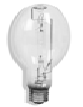
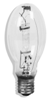
  • The term High Intensity Discharge or HID describes lighting systems that produce light through an electrical discharge which typically occurs inside a pressurized arc tube between two electrodes. In general, these systems feature long life, high light output for the size of the lamp and increased efficiency compared to fluorescent and incandescent technologies. HID lamps are named by the type of gas and metal contained within the arc tube. There are five different families of HID: Mercury Vapor, High Pressure Sodium, Quartz Metal Halide, Pulse Start Quartz Metal Halide, and Ceramic Metal Halide.
  • HID lamps require a ballast to operate. Typically, the HID ballast (sometimes with the addition of a capacitor and igniters) serves to start and operate the lamp in a controlled manner.
  • HID lamps take several minutes to warm-up. Full light output is reached after the arc tube temperature rises and the metal vapours reach final operating pressure. A power interruption or voltage drop will cause the lamp to extinguish. Before the lamp will re-light, it must cool to the point where the lamp’s arc will re strike.
  • There are four basic types of lamps considered as HID light sources:
  1. Mercury vapour,
  2. Low pressure sodium,
  3. High pressure sodium and
  4. Metal halide.
  • All are arc discharge lamps. Light is produced by an arc discharge between two electrodes at opposite ends of the arc tube within the lamp.
  • Each HID lamp type has its own characteristics that must be individually considered for any lighting application.

(1) High Pressure Sodium

  • Efficacy: 80 to 140 lumens per watt.
  • Life: A long lamp life of 20,000 to 24,000 hours, and the best lumen maintenance of all HID sources.
  • Wattages: 35W to 1000W and the warm-up time is from 2 to 4 minutes.
  • Re-strike time: Approximately 1 minute.
  • Applications: Roadway lighting
  • High pressure sodium and metal halide lamps comprise the majority of HID lighting applications.
  • The biggest drawback of high pressure sodium is the yellowish colour light output, but it is acceptable for use in many industrial and outdoor applications (e.g. Roadway lighting).

(2) Low Pressure Sodium

  • Low pressure sodium (LPS) lamps are grouped with HID lamps, but in fact do not have a compact, high intensity arc. They are more like a fluorescent lamp with a long stretched-out arc.
  • Colour: LPS lamps have no colour rendering index as the colour output is monochromatic yellow.
  • Efficacy: 100 to 185 lumens per watt
  • Wattages: 18W to 180W
  • Life: Average 14,000 to 18,000 hour lifetimes.
  • Re-strike time: shortest re-strike time among HID sources only 3 to 12 seconds.
  • Applications: LPS has few viable applications beyond street, parking lot and tunnel lighting.
  • They have excellent lumen maintenance but the longest warm up times, from 7 to 15 minutes.

(3) Metal Halide


  • Efficiency: Efficacy of 60 to 110 lumens per watt
  • Warm-up Time:  2 to 5 minutes.
  • Re-strike time: 10 to 20 Minutes.
  • Wattages: 20W to 1000W
  • Life:  6,000 to 20,000 hours.
  • Applications:  This technology is ideal for Lamp applications requiring truer colour as in fruit, vegetable, Clothing and other accent lighting in retail displays.
  • Wattages from 1500W to 2000W are specialty lamps used for sports lighting, and have lamp life ratings of only 3000 to 5000 hours.
  • Advantages: The advantage of metal halide lighting is its bright crisp, white light output suitable for commercial, retail, and industrial installations where light quality is important. However, lumen maintenance over the life of the lamps is less than optimal relative to other HID sources.
  • The arc tube material for metal halide lamps was quartz until 1995 when ceramic arc tube technology was developed.
  • Ceramic arc tubes are now predominantly used in low wattage (20W to 150W) lamps, though new designs up to 400W have emerged in recent years.
  • Ceramic arc tubes provide improved Colon consistency over lamp life.

How Lamp starts:

  • In cold state mercury vapor and halides are in non-ionized state. Impedance between two electrodes are very high. To overcome this impedance we need to ionize the mercury vapor. A high amplitude pulse in the order of 3.5 KV or more with sufficient energy that can create an initial arc. Minimum limit for amplitude has been specified in IEC60926/927 specification.
  • Ignitor pulses continue to support ionization till current through the lamp becomes 90 percent of the rated value or voltage across the lamp 110 percent of rated value. Declared life of lamp is based on one switching per 24 hours.
  • In many parts of Asia frequent power supply interruption is very common. For example in eastern India average 5 to 6 power supply interruption observed per 12 hours burning of the lamp per day. So the lamps are also switched on/off 5 to 6 times during their 12 hours burning (Average) per day.
  • This causes repeated dissolution /erosion of thorium coated tungsten electrode. This phenomenon is also observed in indoor sports stadium where lamps are repeatedly switched on/off according to sports fixture. to save energy. So we find there are two parameters, which determine the life of Metal Halide and other HID lamp
  • (i) Ageing- No of burning hours.
  • (ii) Switching- No of switching on/off cycle.
  • Till date, data supplied by lamp manufacturer for successful ignition is
  • (a)Minimum amplitude of ignitior pulses
  • (b) Pulse duration.
  • Maximum energy content of ignitor pulse is unrestricted, it has been also not specified in IEC60926/927 specification. Field report from luminaries manufacturers say
  • (a) Lamp failures in 18 meter tower(lighting Mast) are less than 6 meter tower ,where as components such as    pulse ignitor (internationally certified) ,ballast and lamps and luminaries are same( control gear for the luminaries are at the bottom of the tower)
  • (b) 30 percent of Metal Halide Lamps in street light fails in 6 months or early when pulse ignitors used  compare to superimposed ignitor( ignitor which can ignite lamp at short distance).
  • Metal Halide lamp with long distance ignitor used inbuilt into the luminaries has more failure than ignitor which can ignite lamp at short distance.

What is Dragon Kink:

  • Maximum energy which lamp can be successfully subjected is termed as critical energy (Le) Typically 0.75 mJ (may vary depending on discharge tube parameter).
  • High amplitude high energy ignition pulses greater than critical energy(Le) causes dissolution / erosion of electrode of Metal Halide(M.H) and Sodium vapor (SON) lamp, this results in increase in minimum ignition energy required to ignite a Metal Halide(M.H) /Sodium vapor (SON) lamp with increase in number of switching ON/OFF operation .
  • Higher the energy content of high amplitude pulses of ignitor, rapid is the increase in minimum ignition energy at which HID lamp ignites for subsequent switching on.
  • This phenomena of increase in minimum ignition energy required to start Metal Halide(M.H) and Sodium vapor (SON) lamp with increase in no of switching on/off due to impact of high energy pulses of Ignitor is named as “Dragon Kink” effect. This phenomena is more prominent in Metal Halide lamp.
  • This phenomenon of increase of ignition energy with no of switching on/off determines switching life of the lamp. However this increase of ignition energy which can start a lamp with increase in no of switching on/off cycles could be almost arrested if lamps are ignited with ignitor pulses reaching lamp has energy content less than critical energy(Le).
  • In the summary we can say that we need to develop an ignitor system that takes care of ‘Dragon Kink’effect
  • (I) Energy content of igniter pulses across the lamp are adequate for stating but below critical limit (Le) as need to be declared by lamp manufacturer/IEC specification for ensuring availability of total useful life by preventing early switching life failure.
  • (II) Useful minimum and maximum distance marked on the ignitor to take into account of Dragon Kink effect so that full switching life of Metal Halide Lamp/other HID lamp is available

GENERAL BALLAST DESCRIPTION:

  • HID lamps provide light from an electric discharge or arc and have a negative resistance characteristic that would cause them to draw excessive current leading to instant lamp destruction if operated directly from line voltage.
  • The ballast is a power supply for arc discharge lamps. Its purpose in HID lighting is to provide the proper starting voltage to initiate and maintain the lamp arc and to sustain and control lamp current once the arc is established.
  • Ballasts and lamps are designed to meet standards for interchange ability between lamps and ballasts of the same type and wattage. A lamp must be operated by the ballast designed for that lamp, as improper matching of lamp and ballast may cause damage to the lamp or ballast or both.
  • For many years all HID ballasts were magnetic ballasts operating at the power line frequency of 50 or 60 Hertz to provide proper lamp operation.
  • In the past few years electronic ballasts have been developed, primarily for metal halide lamps, using integrated circuits that monitor and control lamp operation. Electronic ballast circuits sense lamp operation characteristics and regulate lamp current to operate the lamp at constant wattage, thus providing a more uniform light output and color rendition throughout lamp life.
  • They also sense lamp end of life and other circuit conditions and shut down the ballast when the lamp operating characteristics fail to meet operating specifications

Type of HID (High Intensity Discharge) Ballast:

  •  HID lamps, like fluorescent lamps require a ballast to provide the proper starting voltage for the lamp and limit the operating current once the lamp is ignited. HID lamps have negative impedance, which means that the lamp draws more current than is required for it to operate. Without ballast, running in this negative impedance condition, the lamp would self-destruct in a very short period of time.
  • HID ballasts are classified by the type of circuit they use
  • Electromagnetic Ballast (EM):
  1. Reactor (R).
  2. High Reactance Autotransformer (HX).
  3. Constant wattage Autotransformer (CWA)
  4. Magnetic Regulator.
  • Electronic Ballast.
  • Further HID ballasts are classified by the type of Power Factor
  1. High Power Factor (HPF)
  2. Normal Power Factor (NPF).

(A) Electromagnetic Ballasts (EM)

  • Electromagnetic Ballasts use magnetic components to start and regulate the operation of a lamp. Inductors are used as the current limiting component in EM ballasts. Although the inductor is very good at regulating current, it causes a phase shift input of the current waveform creating a non-ideal power factor. Often times a Capacitor is used in Electromagnetic Ballasts to correct

(1) Reactor (R):

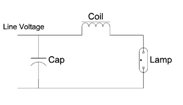
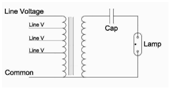
  • Single coil ballast can be used when the input voltage to a fixture meets the starting and operating voltage requirements of an HID lamp. In this situation, the reactor ballast performs only the current-limiting function since the voltage necessary to initiate the ignitor pulses, and start and sustain the lamp comes directly from the input voltage to the fixture.
  • The reactor ballast is electrically in series with the lamp.
  • There is no capacitor involved with the operation of the lamp. Because of that, the lamp current crest factor is desirably low, in the 1.4 to 1.5 range.
  • Without a capacitor, the reactor ballasts are inherently normal power factor devices (50%). When desired to reduce the ballast input current required during lamp operation, a capacitor may be utilized across the input line to provide high power factor (90%) operation, but the addition of the capacitor will not affect how the ballast operates the lamp.

(2) High Reactance Autotransformer (HX):

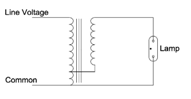
  • When the input voltage does not meet the starting and operating voltage requirements of the HID lamp, a high reactant auto transformer ballast can be used. In addition to limiting the current to the lamp, an HX ballast transforms the input voltage to the lamp’s required level.
  • Two coils, called the primary and secondary, are employed within the ballast. The operating characteristics, such as lamp wattage regulation are similar to the reactor.
  • The high reactance auto transformer ballast is also inherently a normal power factor (50%) ballast but can be corrected to a high power factor (90%) with the addition of a capacitor across the primary coil. As with the reactor ballast, the addition of this capacitor does not affect the lamp’s operation.
  • Both reactor and high reactance ballasts provide the same degree of lamp wattage regulation. For example, a simple 5% change in line voltage results in a 10-12% change in lamp operating wattage. However, this fair degree of lamp regulation is acceptable for many applications.
  • ADVANTAGES
  • Slightly higher in cost than reactors, but
  • less than regulated type ballasts
  • Lower ballast losses than regulator types
  • Provides good wattage regulation when line voltage is controlled within ± 5%
  • Can be used with 120V, 208V, 240V, 277V,and 480V supply.
  • DISADVANTAGES
  • High operating current
  • Higher starting current
  • Poor regulation

(3) Constant Wattage Autotransformer (CWA), “Peak Lead Autotransformer”:

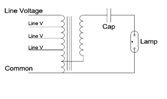
  • To correct the higher input current associated with reactor and high reactance ballasts, and to provide a greater level of lamp wattage regulation, the 2-coil CWA ballast was developed.
  • It is the most commonly used ballast circuit for medium and high wattage (175W – 2000W) applications and typically represents the best compromise between cost and performance.
  • The CWA is a high power factor ballast utilizing a capacitor in series with the lamp rather than across the input. The capacitor works with the core-and-coil to set and regulate the lamp current to the prescribed level.
  • The CWA ballast provides greatly improved lamp wattage regulation over reactor and high reactance circuits. A ± 10% line voltage variation will result in a ± 10% change in lamp wattage for metal halide.
  • The metal halide and high pressure sodium ballasts also incorporate wave shaping of the open circuit voltage to provide a higher peak voltage than a normal sine wave.
  • This peak voltage (along with a high voltage ignition pulse when an ignitor is used) starts the lamp and contributes to the lamp current crest factor (typically 1.60 -1.65).
  • With the CWA ballast, input current during lamp starting or open circuit conditions does not exceed the input current when the lamp is normally operating. CWA ballasts are engineered to tolerate 25-30% drops in line voltage before the lamp extinguishes (lamp dropout), thus reducing accidental lamp outages.

(4) Constant Wattage Isolated (CWI):

  • The CWI ballast is a two-coil ballast similar to the CWA ballast except that its secondary coil is electrically isolated from the primary coil.
  • This isolated design permits the socket screw shell to be grounded for phase-to-phase input voltage applications such as 208, 240 and 480 volt inputs.
  • ADVANTAGES
  • High power factor (over 90%) and low operating current
  • Good regulation–permits and responds favorably to line voltage
  • Slightly larger in size and weight thanvariations of up to +5% or –10% Reactor Ballast
  • Starting current is even lower than operating current
  • Costs less than magnetic regulator
  • Provides good regulation of lamp wattage, especially in nominal and below normal systems
  • Ballast losses are less than for magnetic regulator.
  • DISADVANTAGES
  • More expensive than Reactor type ballast
  • Available for all standard voltages

(5) Magnetic Regulator

  • Magnetically Regulated (Mag Reg) and Regulated Lag (Reg Lag) are another type of EM ballasts. They utilize a magnetic with three separate coils. One coil connects to a capacitor for increased Power Factor and to regulate current into the lamp coil. The lamp coil is isolated from the power supply. This circuit provides very good control over light output. In some ballast designs, large changes in voltage cause very small changes in lamp wattage
  • ADVANTAGES
  • High power factor (over 90%)
  • Excellent line voltage regulation, it is responsive to systems that operate
  • normally in extremely high or extremely low line voltage situations–in the “near to ± 10%” range
  • Low operating current and lower starting current
  • Isolated secondary reduces danger of electrical shock
  • At nominal voltage, its volts/watts trace is quite like the performance of a Reactor Ballast
  • Provides better lamp regulation.
  • DISADVANTAGES
  • Most expensive of all types of ballasts
  • Heavier and larger than other ballasts

(2) Electronic HID (e HID) Ballasts:

  • There are two basic designs for electronic HID ballasts:
  1. Low frequency square wave (typically used for low-wattage lamps or with ceramic arc tube lamps in the 250W-400W range) and
  2. High frequency (for medium wattage lamps in the 250W to 400W range).
  • Both make use of integrated circuit technology to provide closer regulation and control of lamp operation over a variety of input voltage and lamp aging conditions.
  • The integrated circuits in both types of ballasts continuously monitor input line voltage and lamp conditions and regulate lamp power to the rated wattage. If any power line or lamp circuit condition exists that will cause the lamp or ballast to operate beyond their specified limits the ballast shuts down (removes power from the lamp) to prevent improper operation.
  • Electronic HID ballasts improve lamp life, lamp lumen maintenance, and system efficiency.
  • Integrated circuit control allows most electronic ballasts to operate at multiple input line voltages and, in some cases, operate more than one lamp wattage. The lamps are operated with constant lamp power that provides better light output regulation and more consistent light color over the life of the lamp.
  • Some electronic HID ballasts also offer a continuous dimming function that will dim the lamp to 50% (minimum) lamp power using 0-10V (DC) dimming control voltage.
  • All functions required to correct power factor, line current harmonics, and to start and control lamp operation are inherent in the ballast.
  • The lamp socket must be pulse rated (dependant on lamp type) because there is an ignition pulse supplied to start the lamp.

Component if HID (High Intensity Discharge):

(1) Ballast:

  • All HID lamps are negative resistance light sources (this means that once the arc is initiated, the lamp’s resistance continually decreases as current increases; for all practical purposes, the lamp becomes a short circuit). They require a support device (ballast), that limits the lamp and line current when voltage is applied, to prevent the lamp from being destroyed.
  • In addition, the ballast provides the lamp with proper voltage to reliably start and operate the lamp throughout its rated service life. If a transformer is integral to the ballast circuit, it modifies the available supply voltage to provide the voltage required for the lamp.
  • A distinction must be made between lag circuit and lead circuit ballasts. The lamp current control element of a lag circuit ballast consists of an inductive reactance in series with the lamp. The current control element in lead circuit ballasts consists of both inductive and capacitive reactance in series with the lamp; however, the net reactance of such a circuit is capacitive in mercury and metal halide ballasts, and inductive in high pressure sodium ballasts.
  • High pressure sodium (HPS) lamps are greatly different than the mercury or metal halide lamps. Mercury and metal halide lamps maintain a relatively stable voltage drop across the arc tube throughout its life (wattage is also essentially constant) with aging being reflected only in lamp lumen depreciation, decreasing light output.
  • The HPS lamp is a dynamic device with performance changing as the lamp ages. The arc tube voltage rises with usage; therefore, the wattage and lumen output change with age.

(2) Capacitors

  • All high power factor (HPF) Reactor (R) and High Reactance (HX) ballasts, as well as all Constant Wattage Autotransformer (CWA), Constant Wattage Isolated (CWI) and Regulated Lag ballasts require a capacitor.
  • With core and coil and encapsulated core-and-coil units the capacitor is a separate component and must be properly connected electrically.
  • The capacitor for outdoor weatherproof, indoor enclosed-can and postline types is already properly connected within the assembly.
  • Two types of capacitors are currently in use:
  1. Dry metalized film and
  2. Oil-filled.
  • Present capacitor technology has allowed all but a few capacitor applications to be dry film. Oil-filled capacitors are used only when dry film technology cannot satisfy capacitor voltage requirements.

Dry Metalized Film Capacitors:

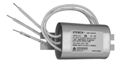
  • Available to fill almost all needs for HID ballast applications.
  • Advance dry film capacitors typically require only half the space used by oil filled capacitor and do not require additional spacing for safety.
  • The compact, light weight, cylindrical non-conductive case and two insulated wires or terminals reduce the required mounting space as compared with oil-filled capacitors.
  • The discharge resistors (when required) are installed within the capacitor case. Dry film capacitors are UL Recognized and contain no PCB material.
  • The maximum allowed dry film capacitor case temperature is 105°C.

Oil-Filled capacitors:

  • Contain non-PCB oil and are a UL-Recognized component. Oil-filled capacitors are only supplied with ballasts where the capacitor operating voltage cannot be satisfied by dry film capacitors.
  • When required, the capacitor discharge resistor is connected across the capacitor terminals.
  • Additional precautions must be taken when an oil filled capacitor is installed.
  • Underwriters Laboratories, Inc. (UL) requires clearance of at least 3/8 inch above the terminals to allow for expansion of the capacitor in the event of failure.
  • The maximum case temperature for oil-filled capacitors is 90°C.

(3) Ignitors (Starters):

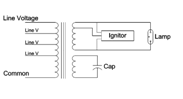
  • An ignitor is an electronic component that must be included in the circuitry of all high pressure sodium, low wattage metal halide (35W to 150W) and pulse start metal halide (175W to 1000W) lighting systems. The ignitor provides a pulse of at least 2500 volts peak to initiate the lamp arc.
  • When the lighting system is energized, the ignitor provides the required high voltage pulse until the lamp arc is established and automatically stops pulsing once the lamp has started.
  • It also furnishes the pulse continuously when the lamp has failed or the socket is empty.
  • Ballasts that include an ignitor to start the HID lamp are limited in the distance they may be mounted remotely from the lamp because the ignitor pulse attenuates as the wire length between the ballast and lamp increases.
  • For most of these ballast/ignitor combinations, the typical maximum ballast- to-lamp distance is listed in the Atlas as 2 feet. When this distance is exceeded the lamp may not start reliably and a long range ignitor is required.
  • Some lighting applications require instant restarting of lamps after a momentary loss of power to the fixtures. When an HID lamp is hot after operation and power is removed and reapplied, it will not restart with a standard ignitor until the lamp sufficiently cools.
  • When instant re strike of a hot lamp is required, a special ignitor is necessary that will provide a pulse with much greater peak voltage.
  • Some ballast designs require ignitors to start the lamp. Ignitors create a glow discharge in the lamp by providing a voltage high enough to ionize the gas. This glow discharge is created by a 2500 volt pulse. Once the lamp is started, the ignitor stops pulsating automatically.
  • Ignitors are designed to last thousands of hours. However, if the lamp has failed, or if the socket is empty, the ignitor will continue pulsing. In these situations, it is important to replace the lamp or turn off the HID fixture to preserve the ignitor’s life.
  • Standard Ignitors are supplied with all High Pressure Sodium, Pulse Arc, and Metal Halide ballast requiring ignitors. These ballasts are supplied with the appropriate external ignitor and are to be wired within two feet of the lamp. Sometimes the ignitors can be permanently attached to or built into the ballast.
  • Long range Ignitors are used in situations where an ignitor must be mounted further from the lamp than is recommended for a standard ignitor. The maximum lamp to ignitor distance for these ignitors is 50 feet, which may vary depending on the type of lamp, ballast, fixture, and wiring.
  • Instant Restrike Ignitors generate multiple pulses to restrike lamp arc without a cool down time, after a brief power interruption has extinguished it. This requires a special lamp and is still subject to warm-up time.
  • Automatic Shutoff Ignitors will apply pulses for 10 to 12 minutes and then deactivate if a lamp arc cannot be initiated. This saves the on ignitor life because a standard ignitor will continue to pulse. Resetting the Automatic Shutoff ignitor is accomplished by momentarily interrupting the power to the ballast. They should not be used on unswitched circuits that cannot be reset.
  • Shutoff Devices is an Ignitor Accessory that can be used to convert a Standard Ignitor into an Automatic Shutoff Ignitor. The catalog lists all the different Ignitors and accessories.
  • It is important to note that ignitors are specifically designed to operate properly with specific ballasts and cannot be interchanged with other ignitors or different brands of ignitors and ballasts.
  • The ignitor should always be mounted near the ballast but not on the ballast.

Installation & Testing of HID (High Intensity Discharge):

  • Only the input to HID lighting systems is a sine wave. Once the voltage and current is processed through the ballast and lamp, it is changed and is no longer a perfect sine wave. As a result of this transformation, only TRUE RMS volt and amp meters will give proper readings.
  • TRUE RMS clamp-on current meters are also available and are most convenient when reading lamp current.
  • There are many brands of test meters available. Some indicate RMS and some indicate TRUE RMS on the meter. They are not the same. Only those that have TRUE RMS will read non-sinusoidal waveforms accurately. The RMS meters will give readings 10 to 20% low depending on the shape of the voltage or current waveform.

 1)    Normal End of Lamp Life

  • Most fixtures fail to light properly due to lamps that have reached end of life. Normal end of life indications are low light output, failure to start or lamps cycling off and on these problems can be eliminated by replacing the lamp.

 2)    Supply Input Measurement:

  • Measure the line voltage at input to the fixture to determine if the power supply conforms to the requirements of the lighting system. For constant wattage ballasts (CWA, CWI), the measured line voltage should be within ±10 % of the nameplate rating. For reactor (R) or high reactance (HX) ballasts, the line voltage should be within ±5 % of the nameplate rating.
  • Check breakers, fixture fuses, photocells and switches when no voltage reading can be measured. High, low or variable voltage readings may be due to load fluctuations.
  • The supply voltage should be measured with the defective fixture connected to the line and power applied to help determine possible voltage supply problems.

 3)    Open Circuit & Short Circuit Voltage:

  •  If the proper input voltage is measured, most HID fixture problems can be determined by measuring open circuit voltage and short circuit current.

a)    Measuring Open Circuit Voltage

  • To determine if the ballast is supplying proper starting voltage to the lamp, an open circuit voltage test is required. The proper test procedure is:
  • (1) Measure input voltage (V1) to verify rated input voltage is being applied to the ballast.
  • (2) If the ballast has an ignitor [HPS, low wattage MH (35W to 150W) or pulse start MH], the ignitor must be disconnected or disabled with a capacitor (1000 pF or larger) across the voltmeter input to protect the meter from the high voltage ignitor pulse.
  • Some ballasts have an integral or built in ignitor. If you are not sure if an ignitor is used put a capacitor across the meter for all open circuit voltage measurements.
  • (3) With the lamp out of the socket and the voltage applied to the ballast or the proper tap of the ballast with multiple voltage inputs, read the voltage (V2) between the lamp socket center pin and shell. Some lamp socket shells are split. Make sure connection is being made to the active part. Open circuit voltage must be measured with a TRUE RMS voltmeter to provide an accurate reading.
  • (4) Constant wattage (CWA, CWI) ballasts have a capacitor in series with the lamp. If the capacitor is open there will be no open circuit voltage. Measure the voltage on both sides of the capacitor. If the voltage exists on the ballast side but not on the lamp side,
  • Change the capacitor and re-measure the open circuit voltage at the lamp socket. If there is still no voltage disconnect the lamp socket from the ballast and measure open circuit voltage again. Once a voltage is measured test the lamp socket for shorts with an Ohm-meter or replace the lamp socket. An ohm-meter test is not conclusive as the test is at low voltage and the failure may be due to the open-circuit voltage.

 b)    Short Circuit Lamp Current Test

  • Do not be concerned about momentarily shorting a magnetic HID ballast output. They will not instantly burn up. An HID ballast is designed to limit current at the specified value range.
  • To assure that the ballast is delivering the proper current under lamp starting conditions, a measurement may be taken by connecting an ammeter between the lamp socket center pin and the socket shell with rated voltage applied to the ballast. If available, a lamp socket adapter may be used as described in the open circuit voltage test.
  • (1) Energize ballast with proper rated input voltage.
  • (2) Measure current with ammeter at A1 and A2 as shown in the diagram shown below.
  • (3) Readings must be within test limits. A clamp-on TRUE RMS ammeter may also be used to perform this test by placing an 18 gauge wire between the lamp and common leads of the ballast. When using a clamp-on ammeter for this measurement, be certain the meter is not near the ballast magnetic field or any steel object that may affect the reading.
  • The short circuit current test will also determine a defective capacitor in constant wattage circuits. A shorted capacitor will result in high short circuit current, while an open capacitor or low value capacitor will result in no or low short circuit current.

 4)    Capacitor Testing and Ballast Performance

  • Disconnect the capacitor from the circuit and discharge it by shorting the terminals or wires together.
  • Check the capacitor with an ohmmeter set to the highest resistance scale
  • If the meter indicates a very low resistance then gradually increases, the capacitor does not require replacement.
  • If the meter indicates a very high initial resistance that does not change, it is open and should be replaced
  • If the meter indicates a very low resistance that does not increase, the capacitor is shorted and should be replaced.

  • The ohmmeter method of testing capacitors will only determine open or shorted capacitors. The capacitance value can be tested by many available portable TRUE RMS meters having that capability, though a test using a dedicated capacitance meter is more conclusive.
  • The capacitance value will affect lamp performance of Constant Wattage ballasts in ways that cannot be determined by the ohmmeter method.
  • A capacitor may look good visually, but should be tested for capacitance value or replaced.
  • The capacitor in a reactor or high reactance ballast circuits will only affect the ballast power factor and not ballast operation.
  • Capacitor failure in these circuits will cause line supply current changes possibly causing circuit breakers to activate or fixture fuse failures.

 5)    Ballast Continuity Checks

  • Continuity of Primary Coil

1)     Disconnect the ballast from power source and discharge the capacitor by shorting its terminals or wires together.

2)     Check for continuity of ballast primary coil between the voltage input leads.

  • Continuity of Secondary Coil

1)     Disconnect the ballast from power source and discharge the capacitor by shorting its terminals or wires together.

2)     Check for continuity of ballast secondary coil between lamp and common leads

 6)    Ignitor Testing

  • Ignitors are used as a lamp starting aid with all high pressure sodium; low wattage metal halide and pulse start lamps.
  • Measurement of the starting pulse characteristics of an ignitor is beyond the capability of instruments available in the field. In laboratory tests, an oscilloscope equipped with a high voltage probe is used to measure pulse height and width. In the field, some simple tests may be performed to determine if the ignitor is operable.
  • It is first assumed that the lamp has already been replaced with a known operable lamp.
  • Replace the ignitor with a known operable ignitor. If the lamp starts, the previous ignitor was either mis-wired or Inoperative.
  • If the lamp does not light check the open circuit voltage and short circuit secondary current

 7)    Further Magnetic Ballast Checks

  • Probable Causes of Inoperable Ballasts
  1. Normal ballast end-of-life failure
  2.  Operating incorrect lamps. Use of higher or lower wattage lamps than rated for the ballast may cause premature ballast end-of-life.
  3.  Overheating due to heat from the fixture or high ambient temperatures causing the ballast temperature to exceed the Specified temperature.
  4. Voltage surge from lightening or power source malfunction.
  5. Mis-wired, pinched or shorted wires.
  6. Shorted or open capacitor.
  7. Incorrect capacitor for the ballast.
  • Capacitor not connected to the ballast correctly.
  • Probable Causes of Shorted or Open Capacitors

1)     Normal capacitor end-of-life failure.

2)     Overheated due to heat in the fixture or ambient temperature.

3)     Capacitor mounted too close to ballast.

4)     Incorrect voltage or capacitor value for ballast.

5)     Mechanical damage such as over-tightened capacitor clamp.

  • Electronic HID Ballasts
  • Electronic HID ballasts present special troubleshooting challenges. The previously discussed procedures cannot be used to test electronic HID circuits. Electronic integrated circuit control limits reliable testing that can be performed in the field.
  • An energized electronic HID ballast will attempt lamp ignition by producing high voltage pulses for a specified time period, usually between 10 and 30 minutes. Consult the ballast label for specific times.
  • Unlike magnetic HID ballasts, momentary shorting either output lead of an electronic HID ballast to ground or each other.

  Fluorescent Ballast / Lamp Troubleshooting:

Problem

Action

Lamps will not operate.

Check if there is power to the fixture.
Be sure lamp is properly seated in socket.
Replace lamp.
Reseat or change starter (preheat only)
Check wiring connections.

Slow or erratic Starting


Check ground (fixture must be grounded for reliable starting)
Check ballast label for correct lamp.
Check wiring connections.
Check for low supply voltage.
Be sure lamp is properly seated in socket.
Test ballast

Excessive Noise


Tighten loose components.
Install ballasts of the proper sound rating.
Replace faulty ballast(s). Normal operation should resume.
Note: All fluorescent ballasts emit some noise

Lamp flickering and or swirling


New lamps with less than 100 hours of service can exhibit this
Defective starters
Lamp to cold
Defective lamp
Improper voltage
Defective ballast

Stroking /Blinking


Improper fixture design or ballast application
High circuit voltage
Improper wiring or installation
Defective ballast
Poor lamp maintenance
Incorrect type of lamps
Incorrect number of lamps
High ambient temperature

 
 HID Ballast / Lamp Troubleshooting

 1)    Normal End of Lamp Life

  • Normal end of life is important to understand for troubleshooting. It occurs when the lamp has aged to the point that the arc can no longer be sustained. End of life can be induced prematurely when lamps are operated at improper voltages, temperatures and positions.
  • Mercury and metal halide lamps tend to emit low light output at end of life and starting will become intermittent. There will also be significant blackening on the arc tube located at the center of the lamp. High pressure sodium lamps retain their light output at the end of life, however, starting becomes intermittent at first and then impossible.
  • There will be some blackening on the end of the arc tube located in the center of the lamp.
  • Verify average rated lamp life as published by the lamp manufacturer and compare it to the actual life of the lamps in the system. Remember that the average rated life is not the same as the minimum life expectancy. The average rated life means that for a population of lamps, the average lamp lasted this long. When a system of lamps installed at the same time reaches the average rated life, we can expect half of the population of lamps to have failed. It is always important to be aware of the operation of the system when evaluating lamp life. For example, is the system operated round the clock either intentionally or as the result of faulty controls?

2)    Lamps Will Not Start

  • Check to see if lamp is loose in the socket. Check for arcing (blackening) at the center contact button and retighten lamp until it is properly seated. Tightening too much may cause lamp breakage.
  • Check to see if lamp has failed or is damaged. Visually inspect for loose, broken internal parts or broken bulb wall.
  • Visually inspect for separation of the lamp base. Check for looseness or for significant discoloration of the bulb wall near the base.
  • Test the lamp in an adjacent fixture that is operating properly.
  • Check to assure that the voltage at the fixture is not too low.
  • Check the nameplate rating for the ballast. The voltage should be within 5% for reactor and high reactance ballasts, and within 10% for all others

3)     Lamp Cycling (starting and shutting off repeatedly)

  • Lamp cycling is a common end of life failure mode for high pressure sodium lamps.
  • Check the capacitor: Verify the capacitor has the correct microfarad (uF) value as specified on the ballast. Inspect the capacitor for a swollen or ruptured case. Disconnect the capacitor and discharge it by shorting across its terminals with a piece of insulated wire. Use an If the resistance starts low and gradually increases, the capacitor is good. Any other reading indicates either an open or short circuit condition and the capacitor is bad.
  • Check the ballast: If it is an older system, it could be simply the normal end of ballast life. Replace the ballast, capacitor (if present) and ignitor (if present). If the ballast is located in an extremely high ambient temperature, it can overheat the ballast or other parts. Check for discoloration of the ballast or other parts. Also check for failed capacitor (see above).Check the ballast open circuit voltage.

4)    Short Lamp Life

  • Verify the correct ballast type and wattage, and correct capacitor value.
  • Check the input voltage and verify that it does not exceed 10% ballast input voltage shown on the label.
  • Inspect the capacitor for a swollen or ruptured case.
  • Check the lamp specification for “base up” or “base down” position specifics. Use the specified lamp only in the current orientation.
  • Replace with a known good lamp.

5)    Fuses Blow or Circuit Breakers or Circuit Breakers Open On Lamp Start Up

  • Overloaded Circuit – Rewire to accommodate starting current of lamp/ballast combination.
  • High Momentary Transient Current – Can be caused by reactor or autotransformer ballasts which draw high initial currents. Use current protective devices incorporating time delay elements. If these fail, change ballast as its characteristics will affect lamp life.

 5 Step Guide to Fault Finding in Reactor Type Circuits:

  1.  If metal halide, disconnect neutral wire from ignitor.
  2. Check all electrical connections.
  3. Remove lamp.
  4. Check voltage at choke output is equal to mains.
  5. If no voltage, check the continuity of choke by measuring resistance against a known good choke. Depending upon wattage, this reading should be from 2-50Ω.
  6. If reading is infinity, choke is faulty. Replace.
  7. Check voltage at lamp holder. Must equal mains voltage.
  8. If OK, replace neutral wire in ignitor and replace lamp. If lamp does not fire – faulty ignitor. Replace.

Ballast-Ignitor-Capacitor-Lamp Connection Diagram:

Untitled

Overhead Conductors


Types of Overhead Conductors  

Properties of Overhead Bare Conductors:

Current Carrying Capacity

  • Strength
  • Weight
  • Diameter
  • Corrosion Resistance
  • Creep Rate
  • Thermal Coefficient of Expansion
  • Fatigue Strength
  • Operating Temperature
  • Short Circuit Current/Temperature
  • Thermal Stability
  • Cost

Categories of Overhead Conductors:

Homogeneous Conductors:

  • Copper
  • AAC( All Aluminum Conductor)
  • AAAC (All Aluminum Alloy Conductor)
  • The core consists of a single strand identical to the outer strands. Since all the strands are the same diameter, one can show that the innermost layer always consists of 6 strands, the second layer of 12 strands, etc., making conductors having 1, 7, 19, 37, 61, 91, or 128 strands.

Non Homogeneous Conductors:

  • ACAR (Aluminum Conductor Alloy Reinforced)
  • ACSR (Aluminum Conductor Steel Reinforced)
  • ACSS (Aluminum Conductor Steel Supported)
  • AACSR (Aluminum Alloy Conductor Steel Reinforced.
  • the strands in the core may or may not be of the same diameter. In a 30/7
  • ACSR conductor the aluminum and steel strands are of the same diameter. In a 30/19
  • ACSR they are not. Within the core or within the outer layers, however, the number of strands always increases by 6 in each succeeding layer. Thus, in 26/7 ACSR, the number of layers in the inner layer of aluminum is 10 and in the outer layer 16

Categories of Overhead Conductors

  • VR (Vibration Resistance)
  • Non-Specular
  • ACSR / SD• (Self Damping)

Choices of overhead depend upon:

Power Delivery Requirements

  • Current Carrying Capacity
  • Electrical Losses

Line Design Requirements

  • Distances to be Spanned
  • Sag and Clearance Requirements

Environmental Considerations

  • Ice and Wind Loading
  • Ambient Temperatures

(1) AAC (All Aluminum Conductors)

  • AAC is made up of one or more strands of hard drawn 1350 Aluminum Alloy.
    • AAC has had limited use in transmission lines and rural distribution because of the long spans utilized.
    • Good Conductivity -61.2% IACS
    • Good Corrosion Resistance
    • High Conductivity to Weight Ratio.
    • Moderate Strength

Typical Application

  • Short spans where maximum current transfer is required.
  • The excellent corrosion resistance of aluminum has made AAC a conductor of choice in coastal areas.
    • Because of its relatively poor strength-to-weight ratio, AAC has seen extensive use in urban areas where spans are usually short but high conductivity is required.
    • These conductors are used in low, medium and high voltage overhead lines.

(2) AAAC (All Aluminum Alloy Conductors)

  • AAAC are made out of high strength Aluminum-Magnesium-Silicon alloy.
  • AAAC with different variants of electrical grade Alloys type 6101 and 6201.
  • These conductors are designed to get better strength to weight ratio and offers improved electrical characteristics, excellent sag-tension characteristics and superior corrosion resistance when compared with ACSR.
  • Equivalent aluminum alloy conductors have approximately the same ampacity and strength as their ACSR counterparts with a much improved strength-to-weight ratio, and also exhibit substantially better electrical loss characteristics than their equivalent single layer ACSR constructions. The thermal coefficient of expansion is greater than that of ACSR.
  • As compared to conventional ACSR, lighter weight, comparable strength & current carrying capacity, lower electrical losses and superior corrosion resistance have given AAAC a wide acceptance in the distribution and transmission lines.

Features

  • High strength to weight ratio
  • Better sag characteristics
  • Improved electrical properties
  • Excellent resistance to corrosion
  • Specifications
    • Higher Tensile Strength
    • Excellent Corrosion Resistance
    • Good Strength to Weight Ratio
    • Lower Electrical Losses
    • Moderate Conductivity –52.5% IACS

Typical Application

  • Transmission and Distribution applications in corrosive environments, ACSR replacement.

(3)  ACAR (Aluminum Conductor Al. Alloy Reinforced)

  • Aluminum Conductor Alloy Reinforced (ACAR) is formed by concentrically stranded Wires of Aluminum 1350 on high strength Aluminum-Magnesium-Silicon (AlMgSi) Alloy core.
  • The number of wires of Aluminum 1350 & AlMgSi alloy depends on the cable design.
  • Even though the general design comprises a stranded core of AlMgSi alloy strands, in certain cable constructions the wires of AlMgSi Alloy strands can be distributed in layers throughout the Aluminum 1350 strands.
  • ACAR has got a better mechanical and electrical properties as compared to an equivalent conductors of ACSR,AAC or AAAC.
  • A very good balance between the mechanical and electrical properties therefore makes ACAR the best choice where the ampacity , strength , and light weight are the main consideration of the line design.
  • These conductors are extensively used in overhead transmission and distribution lines.

Features

  • Improved strength to weight ratio
  • Improved mechanical properties
  • Improved electrical properties
    • Excellent resistance to corrosion Specifications
    • Balance of Mechanical & Electrical
    • Excellent Corrosion Resistance
    • Variable Strength to Weight Ratio
    • Higher Conductivity than AAAC
    • Custom Designed, diameter equivalent to ACSR most common.

Typical Application

  • Used for both transmission and distribution circuits.

(3) AACSR Aluminum Alloy Conductor Steel Reinforced

  • AACSR is a concentrically stranded conductor composed of one or more layers of Aluminum-Magnesium-Silicon alloy wire stranded with a high-strength coated steel core.
  • The core may be single wire or stranded depending on the size. Core wire for AACSR is available with Class A, B or C galvanizing; or aluminum clad (AW).
  • Additional corrosion protection is available through the application of grease to the core or infusion of the complete cable with grease.

Features

  • Offers optimal strength for line design
  • Improved strength to weight ratio
  • Ideal for extra long spans and heavy load conditions
    • Excellent resistance to corrosion

(4) ACSS Aluminum Conductors Steel Supported.

  • ACSS is a composite concentric-lay stranded conductor with one or more layers of hard drawn and annealed 1350-0 aluminum wires on a central core of steel.
  • In an ACSS ,under normal operating conditions, the mechanical load is mainly derived from the steel core as aluminum in fully annealed stage does not contribute much towards the mechanical strength.
  • Steel core wires are protected from corrosion by selecting an appropriate coating of the wire like galvanizing, mischmetal alloy coating or aluminum clad. The type of coating is selected to suit the environment to which the conductor is exposed and operating temperature of the conductor
  • ACSS are suitable for operating at high temperature without losing the mechanical properties.
  • The final sag-tension performance is not affected by the long term creep of aluminum.

Features

  • Improved conductivity
  • High current carrying capacity
  • Very low sag at high temperature
  • High degree of immunity to vibration fatigue
  • Better self damping property

(6) ACCC Aluminum Conductor Composite Core

  • Aluminum Conductor Composite Core (ACCC) is a concentrically stranded conductor with one or more layers of trapezoidal shaped hard drawn and annealed 1350-0 aluminum wires on a central core of high strength Carbon and glass fiber composite.
  • The ACCC Conductor uses a carbon fiber core that is 25% stronger and 60% lighter than a traditional steel core.
  • This allows with the help of trapezoidal shaped strands the ability to increase the conductor’s aluminum content by over 28% without increasing the conductor’s overall diameter or weight.

Features

  • Excellent Sag properties
  • Increased current carrying capacity
  • High operating temperature
  • Excellent strength to weight ratio
  • Highly energy efficient.

(7)  ACSR (Aluminum Conductor Steel Reinforced)

  • Aluminum Conductor Steel Reinforced (ACSR) is concentrically stranded conductor with one or more layers of hard drawn 1350-H19 aluminum wire on galvanized steel wire core.
  • The core can be single wire or stranded depending on the size.
  • Steel wire core is available in Class A ,B or Class C galvanization for corrosion protection.
  • Additional corrosion protection is available through the application of grease to the core or infusion of the complete cable with grease.
  • The proportion of steel and aluminum in an ACSR conductor can be selected based on the mechanical strength and current carrying capacity demanded by each application.
  • ACSR conductors are recognized for their record of economy, dependability and favorable strength / weight ratio. ACSR conductors combine the light weight and good conductivity of aluminum with the high tensile strength and ruggedness of steel.
  • In line design, this can provide higher tensions, less sag, and longer span lengths than obtainable with most other types of overhead conductors.
  • The steel strands are added as mechanical reinforcements.
  • ACSR conductors are recognized for their record of economy, dependability and favorable strength / weight ratio.
  • ACSR conductors combine the light weight and good conductivity of aluminum with the high tensile strength and ruggedness of steel.
  • In line design, this can provide higher tensions, less sag, and longer span lengths than obtainable with most other types of overhead conductors.
  • The steel strands are added as mechanical reinforcements.
  • The cross sections above illustrate some common stranding.
  • The steel core wires are protected from corrosion by galvanizing.
  • The standard Class A zinc coating is usually adequate for ordinary environments.
  • For greater protection, Class B and C galvanized coatings may be specified.
  • The product is available with conductor corrosion resistant inhibitor treatment applied to the central steel component.

Features

  • High Tensile strength
  • Better sag properties
  • Economic design
    • Suitable for remote applications involving long spans
    • Good Ampacity
    • Good Thermal Characteristics
    • High Strength to Weight Ratio
    • Low sag
    • High Tensile Strength

Typical Application

  • Commonly used for both transmission and distribution circuits.
  • Compact Aluminum Conductors, Steel Reinforced (ACSR) are used for overhead distribution and transmission lines.

(8) Trap Wire Constructions

  • AAC/TW  (Trapezoidal Shaped 1350-H19 Aluminum Strands)
  • ACSR/TW (Trapezoidal Shaped 1350-H19 Aluminum Conductor -Galvanized –Zinc or AW Coated Steel Core Wires)
  • ACSS/TW (Trapezoidal Shaped 1350-O Aluminum Conductor-Zinc –5% Mischmetal Aluminum Alloy or AW Coated Steel Core wires)

Comparison of ACSR/TW Type Number with Equivalent Stranding of ACSR

Type Number                                        Conventional ACSR Stranding

3                                                          36/1

5                                                          42/7

6                                                          18/1

7                                                          45/7

8                                                          84/19

10                                                         22/7

13                                                         54/7

13                                                         54/49

13                                                         24/7

16                                                         26/7

  • The equivalent stranding is that stranding of conventional ACSR that has the same area of aluminum and steel as a given ACSR/TW type. The ACSR/TW type number is the approximate ratio of the area of steel to the area of aluminum in percent.

(8-a) ACSR/AS Aluminum Conductor, Aluminum Clad Steel Reinforced

  • ACSR/AS or ACSR/AWare concentrically stranded conductors with one or more layers of hard drawn 1350-H19 aluminum wires on Aluminum Clad steel wire core.
  • The core can be single wire or stranded depending on the size.
  • The mechanical properties of ACSR/AS conductors are similar to ACSR conductors but offers improved ampacity and resistance to corrosion because of the presence of aluminum clad steel wires in the core.
  • These conductors are better replacement for ACSR conductors where corrosive conditions are severe.

Features

  • Good mechanical properties
  • Improved electrical characteristics
  • Excellent corrosion resistance
    • Better Sag properties

(8-b) ACSS/AW Aluminum Conductors –Aluminum Clad Steel Supported

  • ACSS/AW or ACSS/AS is a composite concentric-lay stranded conductor with one or more layers of hard drawn and annealed 1350-0 aluminum wires on a central core of aluminum clad steel core.
  • In an ACSS/AW ,under normal operating conditions, the mechanical load is mainly derived from the steel core as aluminum in fully annealed stage does not contribute much towards the mechanical strength.
  • Aluminum Clad steel has got an excellent resistance towards corrosion.
  • ACSS/AW are can be safely operated upto 250oC continuously without losing the mechanical properties.
  • The final sag-tension performance is not affected by the long term creep of aluminum.

Features

  • Improved conductivity
  • High current carrying capacity
  • Suitable for high temperature
  • Excellent corrosion resistance
  • Very low sag at high temperature
  • High degree of immunity to vibration fatigue
    • Better self damping property

(8-c) ACSR/TW Trapezoidal Shaped 1350-H19 wire Aluminum Conductor, Steel-Reinforced

  • Shaped Wire Compact Concentric-Lay-Stranded Aluminum Conductor, Steel-Reinforced (ACSR/TW) is a concentrically stranded conductor , made with trapezoidal shaped 1350-H19 wires over a high strength steel core.
  • There are two possible design variants. In one case ACSR/TW conductors are designed to have an equal aluminum cross sectional area as that of a standard ACSR which results in a smaller conductor diameter maintaining the same ampacity level but reduced wind loading parameters.
  • In the second design, diameter of the conductor is maintained to that of a standard ACSR which results in a significantly lower conductor resistance and increased current rating with the same conductor diameter.
  • manufactures ACSR/TW with Galvanized steel ( in Class A, Class B & Class C), Zn-5Al mischmetal coated steel or Aluminum clad steel core.

Features

  • High Tensile strength
  • Better sag properties
  • Reduced drag properties
  • Low wind and ice loading parameters
  • suitable for remote applications involving long spans

(8-d) ACSS/TW Shaped Wire Aluminum Conductors Steel Supported

  • Shaped Wire Compact Concentric-Lay-Stranded Aluminum Conductor, Steel-Supported (ACSS/TW) is a concentrically stranded conductor with one or more layers of trapezoidal shaped hard drawn and annealed 1350-0 aluminum wires on a central core of steel.
  • ACSS/TW can either be designed to have an equal aluminum cross sectional area as that of a standard ACSS which results in a smaller conductor diameter maintaining the same ampacity level but reduced wind loading parameters or with diameter equal to that of a standard ACSS which results in a significantly higher aluminum area, lower conductor resistance and increased current rating.
  • ACSS/TW is designed to operate continuously at elevated temperatures, it sags less under emergency electrical loadings than ACSR/TW, excellent self-damping properties, and its final sags are not affected by long-term creep of aluminum.
  • ACSS/TW also provides many design possibilities in new line construction: i.e., reduced tower cost, decreased sag, increased self-damping properties, increased operating temperature and improved corrosion resistance.
  • The coating of steel core is selected to suit the environment to which the conductor is exposed and operating temperature of the conductor.

Features

  • High Operating temperature
  • Improved current carrying capacity
  • Better sag properties
  • Excellent self-damping properties
  • Reduced drag properties
    • Low wind and ice loading parameters

Decide Number of Conductor and Layer of Conductor:

  • If N: number of conductors [strands], d: Diameter of strands, ,X: number of layers.
    • Usually the relation between N&X take as followed.

N= 3X2-3X+1

  • If N is given we can used the above relation get X, then we can get the total Diameter of cable as

dT= (2X-1)d.

  • If Total Number of Conductor (N)=19 Than 19=3×2-3x+1. So Number of Layer (x)=3
    • Than Diameter of Cable dT = (2x-1)d =5d

What is the history behind the ACSS/TW Product?

  • In 1974, Reynolds Metals patented the ACSS conductor design. Its original name was Steel Supported Aluminum Conductor (SSAC). The original patents have expired and the product is now known as ACSS. There are currently three major North American conductor manufacturers that offer ACSS products both round wire and trapezoidal wire (TW).
  • The TW enhancement to ACSS was transferred from existing technology developed for ACSR (Aluminum Conductor Steel Reinforced) and AAC (All Aluminum Conductor) TW conductors. ACSS/TW is typically manufactured to meet the aluminum cross-sectional area of a standard round conductor, but allows the overall diameter to be reduced by approximately 10 percent. ACSS/TW can also be manufactured to meet the existing diameter of a standard conductor, incorporating 20 percent to 25 percent more aluminum cross-sectional area.

What does ACSS or ACSS/TW look like?

  • From the outside, ACSS and ACSS/TW conductors look like traditional ACSR. All are manufactured with steel cores and aluminum outer strands. The key difference is that the ACSR aluminum is made from hard drawn aluminum, while ACSS uses soft aluminum (i.e. annealed, or “O” temper). In the ACSS/TW trapezoidal conductor, the aluminum strands are not round but trapezoidal shaped.

What is so special about using annealed aluminum strands?

  • Both ACSR and ACSS conductors are made from two different metals-aluminum and steel. Consequently, the composite conductor behavior is determined by the combined electrical and mechanical properties of the two materials that make up the conductor. Although ACSR and ACSS are made with 1350 alloy aluminum, their electrical and mechanical properties are very different.
  • Electrically, the conductivity of hard drawn aluminum in ACSR is 61.2 percent; whereas, soft aluminum has a conductivity of 63 percent relative to copper (100 percent). This means that the soft aluminum in ACSS is more efficient at transporting power. Mechanically, the tensile strength (resistance to breaking) of hard drawn aluminum in ACSR is approximately three times that of soft aluminum. This means that the aluminum in ACSS conductor contributes much less to the overall strength, and the composite conductor behaves more like steel.

What are the consequences of elevated conductor temperature on ACSR?

  • When ACSR conductors are operated at temperatures in excess of approximately 93 C, the aluminum starts to anneal. The annealing weakens the conductor and can potentially cause the conductor to break under high wind or ice conditions. To prevent this from happening, utilities generally limit conductor temperatures to 75 C for an ACSR conductor.
  • ACSS/TW and ACSS conductors are manufactured using soft (annealed) aluminum, where operation at higher temperatures has no further effect on the aluminum’s tensile strength. Compared to regular ACSR, predictable installation parameters can be calculated for the ACSS/TW conductors to take into consideration the sag and tension performance at the higher temperatures.

What is the temperature rating of ACSS?

  • The original temperature limit of 200 C has been in existence for almost 30 years and has proven itself. This was based on a 245 C temperature limit established by steel core manufacturers for the galvanized coating of the steel. Operation of the ACSS product at higher temperature (e.g. 250 C) warrants the use of an enhanced type of galvanizing, which provides more durable high temperature endurance performance (Misch Metal-zinc/aluminum alloy coating). Another option for high temperatures is aluminum clad steel.

How high can the operating temperature realistically go?

  • Theoretically, the 250 C rating would provide the ability to carry more power through transmission lines. However, the question must be asked, “Is it wise to operate an electrical system at that high of a temperature?”
  • The amount of electrical current passing through the conductor combined with environmental conditions determines the operating temperature of the conductor. Electrical current causes the following:
  • A) The higher the current, the hotter the conductor and the greater the power losses. Ideally, lines are designed to minimize these power losses and keep normal day-to-day power loads well below the 200 C operating temperature limits.
  • B) The hotter the conductor, the more it will sag and to compensate, the use of larger and/or stronger structures would be required.
  • C) Electrical current also passes through the conductor joints (splices) and end fittings (dead ends), forming “weak links” that can mechanically and electrically fail because of overheating. Conductor supports and insulators also become more susceptible to failure. To sum things up, pushing the temperature limit to 250 C remains an unproven condition.

What are the best applications for use of the ACSS and ACSS/TW products?

  • System reliability issues push the need for the use of ACSS. Utilities are being pressured to demonstrate system reliability. The ACSS/TW conductor could enable a tremendous emergency load carrying capability that the utility could call upon when needed.
  • Cyclic Loads and Peak Demand can be accommodated using ACSS/TW because it can operate at temperatures higher than ACSR. ACSS/TW enables utilities to plan for future situations of increased power requirements because ACSS/TW has power carrying capacity already built into the system.
  • Utilities can also turn to ACSS products in situations where they need additional power capacity along existing right-of-ways, but are facing the environmental challenges of building new lines. The ACSS/TW reconductoring option may be the only solution available to upgrade lines with minimal changes along existing routes.

Harmonics and It’s Effects


What is Harmonics?.

  • Harmonics are sinusoidal voltages or currents having frequencies that are whole multiples of the frequency at which the supply system is designed to operate (e.g. 50Hz or 60 Hz).
  • Harmonics are simply a technique to analyze the current drawn by computers, electronic ballasts, variable frequency drives and other equipment which have modem “transformer-less” power supplies.
  • There are two important concepts to bear in mind with regard to power system harmonics.
  • The first is the nature of harmonic-current producing loads (non-linear loads) and the second is the way in which harmonic currents flow and how the resulting harmonic voltages develop.
  • There is a law in electrical engineering called Ohm’s Law. This basic law states that when a voltage is applied across a resistance, current will flow. This is how all electrical equipment operates. The voltage we apply across our equipment is a sine wave which operates 60 Hertz (cycles per second).

  • To generate this voltage sine wave. It has (relatively) constant amplitude and constant frequency.
  • Once this voltage is applied to a device, Ohm’s Law kicks in. Ohm’s Law states that current equal’s voltage divided by resistance. Expressed mathematically   I=V/R
  • Expressed graphically, the current ends up being another sine wave, since the resistance is a constant number. Ohm’s Law dictates that the frequency of the current wave is also 60 Hertz. In the real world, this is true; although the two sine waves may not align perfectly (as a power factor) the current wave will indeed be a 60 Hertz sine wave.

  • Since an applied voltage sine wave will cause a sinusoidal current to be drawn, systems which exhibit this behaviour are called linear systems. Incandescent lamps, heaters and motors are linear systems.
  • Some of our modem equipment however does not fit this category. Computers, variable frequency drives, electronic ballasts and uninterruptable power supply systems are non-linear systems. In these systems, the resistance is not a constant and in fact, varies during each sine wave. This occurs because the resistance of the device is not a constant. The resistance in fact, changes during each sine wave

Linear and non-linear loads (motors, heaters and incandescent lamps):

  • A linear element in a power system is a component in which the current is proportional to the voltage.
  • In general, this means that the current wave shape will be the same as the voltage (See Figure 1). Typical examples of linear loads include motors, heaters and incandescent lamps.

                                                                  Figure 1. Voltage and current waveforms for linear

Non-Linear System (Computers, VFDS, Electronic Ballasts):

  • As in Figure As we apply a voltage to a solid state power supply, the current drawn is (approximately) zero until a critical “firing voltage” is reached on the sine wave. At this firing voltage, the transistor (or other device) gates or allows current to be conducted.
  • This current typically increases over time until the peak of the sine wave and decreases until the critical firing voltage is reached on the “downward side” of the sine wave. The device then shuts off and current goes to zero. The same thing occurs on the negative side of the sine wave with a second negative pulse of current being drawn. The current drawn then is a series of positive and negative pulses, and not the sine wave drawn by linear systems.
  • Some systems have different shaped waveforms such as square waves. These types of systems are often called non-linear systems. The power supplies which draw this type of current are called switched mode power supplies. Once these pulse currents are formed, we have a difficult time analyzing their effect. Power engineers are taught to analyze the effects of sine waves on power systems. Analyzing the effects of these pulses is much more difficult.

                                                                      Figure 2. Voltage and current waveforms for linear

  • The current drawn by non-linear loads is not sinusoidal but it is periodic, meaning that the current wave looks the same from cycle to cycle. Periodic waveforms can be described mathematically as a series of sinusoidal waveforms that have been summed together.

Figure 3. Waveform with symmetrical harmonic components

  • The sinusoidal components are integer multiples of the fundamental where the fundamental, in the United States, is 60 Hz. The only way to measure a voltage or current that contains harmonics is to use a true-RMS reading meter. If an averaging meter is used, which is the most common type, the error can be Significant.
  • Each term in the series is referred to as a harmonic of the fundamental. The third harmonic would have a frequency of three times 60 Hz or 180 Hz. Symmetrical waves contain only odd harmonics and un-symmetrical waves contain even and odd harmonics.
  • A symmetrical wave is one in which the positive portion of the wave is identical to the negative portion of the wave. An un-symmetrical wave contains a DC component (or offset) or the load is such that the positive portion of the wave is different than the negative portion. An example of un-symmetrical wave would be a half wave rectifier.
  • Most power system elements are symmetrical. They produce only odd harmonics and have no DC offset.

Harmonic current flow

  • When a non-linear load draws current that current passes through all of the impedance that is between the load and the system source (See Figure 4). As a result of the current flow, harmonic voltages are produced by impedance in the system for each harmonic.

Figure 4 – Distorted-current induced voltage distortion

  • These voltages sum and when added to the nominal voltage produce voltage distortion. The magnitude of the voltage distortion depends on the source impedance and the harmonic voltages produced.
  • If the source impedance is low then the voltage distortion will be low. If a significant portion of the load becomes non-linear (harmonic currents increase) and/or when a resonant condition prevails (system impedance increases), the voltage can increase dramatically.

Harmonic currents can produce a number of problems:

  1. Equipment heating
  2. Equipment malfunction
  3. Equipment failure
  4. Communications interference
  5. Fuse and breaker mis-operation
  6. Process problems
  7. Conductor heating.

How harmonics are generated

  • In an ideal clean power system, the current and voltage waveforms are pure sinusoids. In practice, non-sinusoidal currents are available due to result of the current flowing in the load is not linearly related to the applied voltage.
  • In a simple circuit containing only linear circuit elements resistance, inductance and capacitance. The current which flows is proportional to the applied voltage (at a particular frequency) so that, if a sinusoidal voltage is applied, a sinusoidal current will flow. Note that where there is a reactive element there will be a phase shift between the voltage and current waveforms the power factor is reduced, but the circuit can still be linear.
  • But in The situation where the load is a simple full-wave rectifier and capacitor, such as the input stage of a typical switched mode power supply (SMPS). In this case, current flows only when the supply voltage exceeds that stored on the reservoir capacitor, i.e. close to the peak of the voltage sine wave, as shown by the shape of the load line.
  • Any cyclical waveform can be de constructed into a sinusoid at the fundamental frequency plus a number of sinusoids at harmonic frequencies. Thus the distorted current waveform in the figure can be represented by the fundamental plus a percentage of second harmonic plus a percentage of third harmonic and so on, possibly up to the thirtieth harmonic.
  • For symmetrical waveforms, i.e. where the positive and negative half cycles are the same shape and magnitude, all the even numbered harmonics is zero. Even harmonics are now relatively rare but were common when half wave rectification was widely used.
  • The frequencies we use are multiples of the fundamental frequency, 60 Hz. We call these multiple frequencies harmonics. The second harmonic is two times 60 Hertz, or 120 Hz. The third harmonic is 180 Hertz and so on. In our three phase power systems, the “even” harmonics (second, fourth, sixth, etc.) cancel, so we only need deal with the “odd” harmonics.

  • This figure shows the fundamental and the third harmonic. There are three cycles of the third harmonic for each single cycle of the fundamental. If we add these two waveforms, we get a non-sinusoidal waveform.
  • This resultant now starts to form the peaks that are indicative of the pulses drawn by switch mode power supplies. If we add in other harmonics, we can model any distorted periodic waveform, such as square waves generated by UPS of VFD systems. It is important to remember these harmonics are simply a mathematical model. The pulses or square waves, or other distorted waveforms are what we actually see if we were to put an oscilloscope on the building’s wiring systems.
  • These current pulses, because of Ohm’s Law, will also begin to distort the voltage waveforms in the building. This voltage distortion can cause premature failure of electronic devices.
  • On three phase systems, the three phases of the power system are 120’ out of phase. The current on phase B occurs 120 deg (1/3 cycle) after the current on A. Likewise, the current on phase C occurs 120’ after the current on phase B. Because of this, our 60 Hertz (fundamental) currents actually cancel on the neutral. If we have balanced 60 Hertz currents on our three phase conductors, our neutral current will be zero. It can be shown mathematically that the neutral current (assuming only 60 Hertz is present) will never exceed the highest loaded phase conductor. Thus, our over current protection on our phase conductors also protects the neutral conductor, even though we do not put an over current protective device in the neutral conductor. We protect the neutral by the mathematics. When harmonic currents are present, this math breaks down. The third harmonic of each of the three phase conductors is exactly in phase. When these harmonic currents come together on the neutral, rather than cancel, they actually add and we can have more current on the neutral conductor than on phase conductors. Our neutral conductors are no longer protected by mathematics!
  • These harmonic currents create heat. This heat over a period of time will raise the temperature of the neutral conductor. This rise in temperature can overheat the surrounding conductors and cause insulation failure. These currents also will overheat the transformer sources which supply the power system. This is the most obvious symptom of harmonics problems; overheating neutral conductors and transformers. Other symptoms include:
  1. Nuisance tripping of circuit breakers
  2. Malfunction of UPS systems and generator systems
  3. Metering problems
  4. Computer malfunctions
  5. Over voltage problems

Types of equipment that generate harmonics:

  • Harmonic load currents are generated by all non-linear loads. These include:
  • For Single phase loads, e.g.
  1. Switched mode power supplies (SMPS)
  2. Electronic fluorescent lighting ballasts
  3. Compact fluorescent lamps (CFL)
  4. Small uninterruptible power supplies (UPS) units
  • For Three phase loads, e.g.
  1. Variable speed drives
  2. Large UPS units

Single phase loads

(A)Switched mode power supplies (SMPS)

  • The majority of modern electronic units use switched mode power supplies (SMPS).
  • These differ from older units in that the traditional step-down transformer and rectifier is replaced by direct controlled rectification of the supply to charge a reservoir capacitor from which the direct current for the load is derived by a method appropriate to the output voltage and current required.
  • The advantage – to the equipment manufacturer – is that the size, cost and weight is significantly reduced and the power unit can be made in almost any required form factor.
  • The disadvantage – to everyone else – is that, rather than drawing continuous current from the supply, the power supply unit draws pulses of current which contain large amounts of third and higher harmonics and significant high frequency components .
  • A simple filter is fitted at the supply input to bypass the high frequency components from line and neutral to ground but it has no effect on the harmonic currents that flow back to the supply.

(B)Single phase UPS units exhibit very similar characteristics to SMPS.

  • For high power units there has been a recent trend towards so-called power factor corrected inputs.
  • The aim is to make the power supply load look like a resistive load so that the input current appears sinusoidal and in phase with the applied voltage. It is achieved by drawing input current as a high frequency triangular waveform that is averaged by the input filter to a sinusoid.
  • This extra level of sophistication is not yet readily applicable to the low-cost units that make up most of the load in commercial and industrial installations. It remains to be seen what problems the wide-scale application of this technology may involve!

(C)Fluorescent lighting ballast

  • Electronic lighting ballasts have become popular in recent years following claims for improved efficiency. Overall they are only a little more efficient than the best magnetic ballasts and in fact, most of the gain is attributable to the lamp being more efficient when driven at high frequency rather than to the electronic ballast itself.
  • Their chief advantage is that the light level can be maintained over an extended lifetime by feedback control of the running current – a practice that reduces the overall lifetime efficiency.
  • Their great disadvantage is that they generate harmonics in the supply current. So called power-factor corrected types are available at higher ratings that reduce the harmonic problems, but at a cost penalty. Smaller units are usually uncorrected.

(D)Compact fluorescent lamps (CFL)

  • CFL are now being sold as replacements for tungsten filament bulbs. A miniature electronic ballast, housed in the connector casing, controls a folded 8mm diameter fluorescent tube.
  • CFLs rated at 11 watt are sold as replacements for a 60 watt filament lamp and have a life expectancy of 8000 hours.
  • The harmonic current spectrum is shown in the figure. These lamps are being widely used to replace filament bulbs in domestic properties and especially in hotels where serious harmonic problems are suddenly becoming common.

Three phase loads

(A)Variable Speed Drives / UPS:

  • Variable speed controllers, UPS units and DC converters in general are usually based on the three-phase bridge, also known as the six-pulse bridge because there are six pulses per cycle (one per half cycle per phase) on the DC output.
  • The six pulse bridge produces harmonics at 6n +/- 1, i.e. at one more and one less than each multiple of six. In theory, the magnitude of each harmonic is the reciprocal of the harmonic number, so there would be 20% fifth harmonic and 9% eleventh harmonic, etc.
  • The magnitude of the harmonics is significantly reduced by the use of a twelve-pulse bridge. This is effectively two six-pulse bridges, fed from a star and a delta transformer winding, providing a 30 degrees phase shift between them.
  • The 6n harmonics are theoretically removed, but in practice, the amount of reduction depends on the matching of the converters and is typically by a factor between 20 and 50. The 12n harmonics remain unchanged. Not only is the total harmonic current reduced, but also those that remain are of a higher order making the design of the filter much easier.
  • Often the equipment manufacturer will have taken some steps to reduce the magnitudes of the harmonic currents, perhaps by the addition of a filter or series inductors. In the past this has led some manufacturers to claim that their equipment is ‘G5/3’ compliant. Since G5/3 is a planning standard applicable to a complete installation, it cannot be said to have been met without knowledge of every piece of equipment on the site.
  • A further increase in the number of pulses to 24, achieved by using two parallel twelve-pulse units with a phase shift of 15 degrees, reduces the total harmonic current to about 4.5%. The extra sophistication increases cost, of course, so this type of controller would be used only when absolutely necessary to comply with the electricity suppliers’ limits.

Problems caused by harmonics

  • Harmonic currents cause problems both on the supply system and within the installation.
  • The effects and the solutions are very different and need to be addressed separately; the measures that are appropriate to controlling the effects of harmonics within the installation may not necessarily reduce the distortion caused on the supply and vice versa.
  • Harmonic problems within the installation
  • Problems caused by harmonic currents:
  1. overloading of neutrals
  2. overheating of transformers
  3. nuisance tripping of circuit breakers
  4. over-stressing of power factor correction capacitors
  5. skin effect
  • Problems caused by harmonic voltages:
  1. voltage distortion
  2. induction motors
  3. zero-crossing noise
  4. Problems caused when harmonic currents reach the supply

Problems caused by harmonic currents

(1) Neutral conductor over-heating

  • In a three-phase system the voltage waveform from each phase to the neutral  so that, when each phase is equally loaded, the°star point is displaced by 120 combined current in the neutral is zero.
  • When the loads are not balanced only the net out of balance current flows in the neutral. In the past, installers (with the approval of the standards authorities) have taken advantage of this fact by installing half-sized neutral conductors. However, although the fundamental currents cancel out, the harmonic currents do not – in fact those that are an odd multiple of three times the fundamental, the ‘triple-N’ harmonics, add in the neutral.
  • The third°phase currents, are introduced at 120 harmonic of each phase is identical, being three times the frequency and one-third of a (fundamental) cycle offset.
  • The effective third harmonic neutral current is shown at the bottom. In this case, 70% third harmonic current in each phase results in 210% current in the neutral.
  • Case studies in commercial buildings generally show neutral currents between 150% and 210% of the phase currents, often in a half-sized conductor!
  • There is some confusion as to how designers should deal with this issue.
  • The simple solution, where single-cored cables are used, is to install a double sized neutral, either as two separate conductors or as one single large conductor.
  • The situation where multi-cored cables are used is not so simple. The ratings of multi-core cables (for example as given in IEC 60364–5-523 Table 52 and BS 7671 Appendix 4) assume that the load is balanced and the neutral conductor carries no current, in other words, only three of the four or five cores carry current and generate heat. Since the cable current carrying capacity is determined solely by the amount of heat that it can dissipate at the maximum permitted temperature, it follows that cables carrying triple-N currents must be de-rated.
  • In the example illustrated above, the cable is carrying five units of current – three in the phases and two in the neutral – while it was rated for three units. It should be de-rated to about 60% of the normal rating.
  • IEC 60364-5-523 Annex C (Informative) suggests a range of de-rating factors according to the triple-N harmonic current present. Figure 13 shows de-rating factor against triple-N harmonic content for the de-rating described in IEC 60364-5-523 Annex C and for the thermal method used above.

(2) Effects on transformers

  • Transformers are affected in two ways by harmonics.
  • Firstly, the eddy current losses, normally about 10% of the loss at full load, increase with the square of the harmonic number.
  • In practice, for a fully loaded transformer supplying a load comprising IT equipment the total transformer losses would be twice as high as for an equivalent linear load.
  • This results in a much higher operating temperature and a shorter life. In fact, under these circumstances the lifetime would reduce from around 40 years to more like 40 days! Fortunately, few transformers are fully loaded, but the effect must be taken into account when selecting plant.
  • The second effect concerns the triple-N harmonics. When reflected back to a delta winding they are all in phase, so the triple-N harmonic currents circulate in the winding.
  • The triple-N harmonics are effectively absorbed in the winding and do not propagate onto the supply, so delta wound transformers are useful as isolating transformers. Note that all other, non triple-N, harmonics pass through. The circulating current has to be taken into account when rating the transformer.

(3) Nuisance tripping of circuit breakers

  • Residual current circuit breakers (RCCB) operate by summing the current in the phase and neutral conductors and, if the result is not within the rated limit, disconnecting the power from the load. Nuisance tripping can occur in the presence of harmonics for two reasons.
  • Firstly, the RCCB, being an electromechanical device, may not sum the higher frequency components correctly and therefore trips erroneously.
  • Secondly, the kind of equipment that generates harmonics also generates switching noise that must be filtered at the equipment power connection. The filters normally used for this purpose have a capacitor from line and neutral to ground, and so leak a small current to earth.
  • This current is limited by standards to less than 3.5mA, and is usually much lower, but when equipment is connected to one circuit the leakage current can be sufficient to trip the RCCB. The situation is easily overcome by providing more circuits, each supplying fewer loads.
  • Nuisance tripping of miniature circuit breakers (MCB) is usually caused because the current flowing in the circuit is higher than that expected from calculation or simple measurement due to the presence of harmonic currents.
  • Most portable measuring instruments do not measure true RMS values and can underestimate non-sinusoidal currents by 40%.

(4) Over-stressing of power factor correction capacitors

  • Power-factor correction capacitors are provided in order to draw a current with a leading phase angle to offset lagging current drawn by an inductive load such as induction motors.
  • The effective equivalent circuit for a PFC capacitor with a non-linear load. The impedance of the PFC capacitor reduces as frequency rises, while the source impedance is generally inductive and increases with frequency. The capacitor is therefore likely to carry quite high harmonic currents and, unless it has been specifically designed to handle them, damage can result.
  • A potentially more serious problem is that the capacitor and the stray inductance of the supply system can resonate at or near one of the harmonic frequencies (which, of course, occur at 100 Hz intervals). When this happens very large voltages and currents can be generated, often leading to the catastrophic failure of the capacitor system.
  • Resonance can be avoided by adding an inductance in series with the capacitor such that the combination is just inductive at the lowest significant harmonic. This solution also limits the harmonic current that can flow in the capacitor. The physical size of the inductor can be a problem, especially when low order harmonics are present.

(5) Skin effect

  • Alternating current tends to flow on the outer surface of a conductor. This is known as skin effect and is more pronounced at high frequencies.
  • Skin effect is normally ignored because it has very little effect at power supply frequencies but above about 350 Hz, i.e. the seventh harmonic and above, skin effect will become significant, causing additional loss and heating. Where harmonic currents are present, designers should take skin effect into account and de-rate cables accordingly.
  • Multiple cable cores or laminated busbars can be used to help overcome this problem. Note also that the mounting systems of busbars must be designed to avoid mechanical resonance at harmonic frequencies.

Problems caused by harmonic voltages

(1) voltage distortion

  • Because the supply has source impedance, harmonic load currents give rise to harmonic voltage distortion on the voltage waveform (this is the origin of ‘flat topping’).
  • There are two elements to the impedance: that of the internal cabling from the point of common coupling (PCC), and that inherent in the supply at the PCC, e.g. the local supply transformer.
  • The distorted load current drawn by the non-linear load causes a distorted voltage drop in the cable impedance. The resultant distorted voltage waveform is applied to all other loads connected to the same circuit, causing harmonic currents to flow in them – even if they are linear loads.
  • Solution: The solution is to separate circuits supplying harmonic generating loads from those supplying loads which are sensitive to harmonics, as shown in Figure 16. Here separate circuits feed the linear and non-linear loads from the point of common coupling, so that the voltage distortion caused by the non-linear load does not affect the linear load.
  • When considering the magnitude of harmonic voltage distortion it should be remembered that when the load is transferred to a UPS or standby generator during a power failure the source impedance and the resulting voltage distortion will be much higher.
  • Where local transformers are installed, they should be selected to have sufficiently low output impedance and to have sufficient capacity to withstand the additional heating, in other words, by selecting an appropriately over sized transformer.
  • Note that it is not appropriate to select a transformer design in which the increase in capacity is achieved simply by forced cooling – such a unit will run at higher internal temperatures and have a reduced service life. Forced cooling should be reserved for emergency use only and never relied upon for normal running.

(2) Induction Motors

  • Harmonic voltage distortion causes increased eddy current losses in motors in the same way as in transformers. However, additional losses arise due to the generation of harmonic fields in the stator, each of which is trying to rotate the motor at a different speed either forwards or backwards. High frequency currents induced in the rotor further increase losses.
  • Where harmonic voltage distortion is present motors should be de-rated to take account of the additional losses.

(3) Zero-crossing noise

  • Many electronic controllers detect the point at which the supply voltage crosses zero volts to determine when loads should be turned on. This is done because switching inductive loads at zero voltage does not generate transients, so reducing electromagnetic interference (EMI) and stress on the semiconductor switching devices.
  • When harmonics or transients are present on the supply the rate of change of voltage at the crossing becomes faster and more difficult to identify, leading to erratic operation. There may in fact be several zero-crossings per half cycle.

(4)Harmonic problems affecting the supply

  • When a harmonic current is drawn from the supply it gives rise to a harmonic voltage drop proportional to the source impedance at the point of common coupling (PCC) and the current.
  • Since the supply network is generally inductive, the source impedance is higher at higher frequencies. Of course, the voltage at the PCC is already distorted by the harmonic currents drawn by other consumers and by the distortion inherent in transformers, and each consumer makes an additional contribution.

Remedies to Reduce Harmonic Problems:

(1) Over sizing Neutral Conductors

  • In three phase circuits with shared neutrals, it is common to oversize the neutral conductor up to 200% when the load served consists of non-linear loads. For example, most manufacturers of system furniture provide a 10 AWG conductor with 35 amp terminations for a neutral shared with the three 12 AWG phase conductors.
  • In feeders that have a large amount of non-linear load, the feeder neutral conductor and panel board bus bar should also be oversized.

(2) Using Separate Neutral Conductors

  • On three phase branch circuits, another philosophy is to not combine neutrals, but to run separate neutral conductors for each phase conductor. This increases the copper use by 33%. While this successfully eliminates the addition of the harmonic currents on the branch circuit neutrals, the panel board neutral bus and feeder neutral conductor still must be oversized.
  • Oversizing Transformers and Generators: The oversizing of equipment for increased thermal capacity should also be used for transformers and generators which serve harmonics-producing loads. The larger equipment contains more copper.

(3) Passive filters

  • Passive filters are used to provide a low impedance path for harmonic currents so that they flow in the filter and not the supply.
  • The filter may be designed for a single harmonic or for a broad band depending on requirements.
  • Simple series band stop filters are sometimes proposed, either in the phase or in the neutral. A series filter is intended to block harmonic currents rather than provide a controlled path for them so there is a large harmonic voltage drop across it.
  • This harmonic voltage appears across the supply on the load side. Since the supply voltage is heavily distorted it is no longer within the standards for which equipment was designed and warranted. Some equipment is relatively insensitive to this distortion, but some is very sensitive. Series filters can be useful in certain circumstances, but should be carefully applied; they cannot be recommended as a general purpose solution.

(4) Isolation transformers

  • As mentioned previously, triple-N currents circulate in the delta windings of transformers. Although this is a problem for transformer manufacturers and specifiers – the extra load has to be taken into account it is beneficial to systems designers because it isolates triple-N harmonics from the supply.
  • The same effect can be obtained by using a ‘zig-zag’ wound transformer. Zig-zag transformers are star configuration auto transformers with a particular phase relationship between the windings that are connected in shunt with the supply.

(5) Active Filters

  • The solutions mentioned so far have been suited only to particular harmonics, the isolating transformer being useful only for triple-N harmonics and passive filters only for their designed harmonic frequency. In some installations the harmonic content is less predictable.
  • In many IT installations for example, the equipment mix and location is constantly changing so that the harmonic culture is also constantly changing. A convenient solution is the active filter or active conditioner.
  • The active filter is a shunt device. A current transformer measures the harmonic content of the load current, and controls a current generator to produce an exact replica that is fed back onto the supply on the next cycle. Since the harmonic current is sourced from the active conditioner, only fundamental current is drawn from the supply. In practice, harmonic current magnitudes are reduced by 90%, and, because the source impedance at harmonic frequencies is reduced, voltage distortion is reduced.

(6) K-Rated Transformers

  • Special transformers have been developed to accommodate the additional heating caused by these harmonic currents. These types of transformers are now commonly specified for new computer rooms and computer lab facilities.

(7) Special Transformers

  • There are several special types of transformer connections which can cancel harmonics. For example, the traditional delta-wye transformer connection will trap all the triplen harmonics (third, ninth, fifteenth, twenty-first, etc.) in the delta.
  • Additional special winding connections can be used to cancel other harmonics on balanced loads. These systems also use more copper. These special transformers are often specified in computer rooms with well balanced harmonic producing loads such as multiple input mainframes or matched DASD peripherals.

(8) Filtering

  • While many filtersdo not work particularly well at this frequency range, special electronic tracking filters can work very well to eliminate harmonics.
  • These filters are presently relatively expensive but should be considered for thorough harmonic elimination.

(9) Special Metering

  • Standard clamp-on ammeters are only sensitive to 60 Hertz current, so they only tell part of the story. New “true RMS” meters will sense current up to the kilohertz range. These meters should be used to detect harmonic currents. The difference between a reading on an old style clamp-on ammeter and a true RMS ammeter will give you. an indication of the amount of harmonic current present.
  • The measures described above only solve the symptoms of the problem. To solve the problem we must specify low harmonic equipment. This is most easily done when specifying electronic ballasts. Several manufacturers make electronic ballasts which produce less than 15 % harmonics. These ballasts should be considered for any ballast retrofit or any new project. Until low harmonics computers are available, segregating these harmonic loads on different circuits, different panel boards or the use of transformers should be considered. This segregation of “dirty” and “clean” loads is fundamental to electrical design today. This equates to more branch circuits and more panel boards, thus more copper usage.

Automatic Power Factor Correction


What is Power Factor?

  • Power Factor Definition: Power factor is the ratio between the KW and the KVA drawn by an electrical load where the KW is the actual load power and the KVA is the apparent load power. It is a measure of how effectively the current is being converted into useful work output and more particularly is a good indicator of the effect of the load current on the efficiency of the supply system.
  • All current flow causes losses both in the supply and distribution system. A load with a power factor of 1.0 results in the most efficient loading of the supply. A load with a power factor of, say, 0.8, results in much higher losses in the supply system and a higher bill for the consumer. A comparatively small improvement in power factor can bring about a significant reduction in losses since losses are proportional to the square of the current.
  • When the power factor is less than one the ‘missing’ power is known as reactive power which unfortunately is necessary to provide a magnetizing field required by motors and other inductive loads to perform their desired functions. Reactive power can also be interpreted as wattles, magnetizing or wasted power and it represents an extra burden on the electricity supply system and on the consumer’s bill.
  • A poor power factor is usually the result of a significant phase difference between the voltage and current at the load terminals, or it can be due to a high harmonic content or a distorted current waveform.
  • A poor power factor is generally the result of an inductive load such as an induction motor, a power transformer, and ballast in a luminary, a welding set or an induction furnace. A distorted current waveform can be the result of a rectifier, an inverter, a variable speed drive, a switched mode power supply, discharge lighting or other electronic loads.
  • A poor power factor due to inductive loads can be improved by the addition of power factor correction  equipment, but a poor power factor due to a distorted current waveform requires a change in equipment    Design or the addition of harmonic filters.
  • Some inverters are quoted as having a power factor of better than 0.95 when, in reality, the true power factor is between 0.5 and 0.75. The figure of 0.95 is based on the cosine of the angle between the voltage and current but does not take into account that the current waveform is discontinuous and therefore contributes to increased losses.
  • An inductive load requires a magnetic field to operate and in creating such a magnetic field causes the current to be out of phase with the voltage (the current lags the voltage). Power factor correction is the process of compensating for the lagging current by creating a leading current by connecting capacitors to the supply.
  • P.F (Cos Ǿ)= K.W / KVA  Or
  • P.F (Cos Ǿ)=  True Power / Apparent Power.
  • KW is Working Power (also called Actual Power or Active Power or Real Power).
  • It is the power that actually powers the equipment and performs useful work.
  • KVAR is Reactive Power.
  • It is the power that magnetic equipment (transformer, motor and relay)needs to produce the magnetizing flux.
  • KVA is Apparent Power.
  • It is the “vectorial summation” of KVAR and KW.

Displacement Power Factor Correction.

An induction motor draws current from the supply that is made up of resistive components and inductive components. The resistive components are:
1) Load current.
2)  Loss current.
And the inductive components are:
3) Leakage reactance.
4)  Magnetizing current.

  • The current due to the leakage reactance is dependent on the total current drawn by the motor, but the magnetizing current is independent of the load on the motor. The magnetizing current will typically be between 20% and 60% of the rated full load current of the motor. The magnetizing current is the current that establishes the flux in the iron and is very necessary if the motor is going to operate.
  • The magnetizing current does not actually contribute to the actual work output of the motor. It is the catalyst that allows the motor to work properly. The magnetizing current and the leakage reactance can be considered passenger components of current that will not affect the power drawn by the motor, but will contribute to the power dissipated in the supply and distribution system.
  • Take for example a motor with a current draw of 100 Amps and a power factor of 0.75 The resistive component of the current is 75 Amps and this is what the KWh meter measures. The higher current will result in an increase in the distribution losses of (100 x 100) /(75 x 75) = 1.777  or a 78% increase in the supply losses.
  • In the interest of reducing the losses in the distribution system, power factor correction is added to neutralize a portion of the magnetizing current of the motor. Typically, the corrected power factor will be 0.92 – 0.95
  • Power factor correction is achieved by the addition of capacitors in parallel with the connected motor circuits and can be applied at the starter, or applied at the switchboard or distribution panel. The resulting capacitive current is leading current and is used to cancel the lagging inductive current flowing from the supply.

Displacement Static Correction (Static Compensation).

  • As a large proportion of the inductive or lagging current on the supply is due to the magnetizing current of induction motors, it is easy to correct each individual motor by connecting the correction capacitors to the motor starters.
  • With static correction, it is important that the capacitive current is less than the inductive magnetizing current of the induction motor. In many installations employing static power factor correction, the correction capacitors are connected directly in parallel with the motor windings.
  • When the motor is Off Line, the capacitors are also Off Line. When the motor is connected to the supply, the capacitors are also connected providing correction at all times that the motor is connected to the supply. This removes the requirement for any expensive power factor monitoring and control equipment.
  • In this situation, the capacitors remain connected to the motor terminals as the motor slows down. An induction motor, while connected to the supply, is driven by a rotating magnetic field in the stator which induces current into the rotor. When the motor is disconnected from the supply, there is for a period of time, a magnetic field associated with the rotor. As the motor decelerates, it generates voltage out its terminals at a frequency which is related to its speed.
  • The capacitors connected across the motor terminals, form a resonant circuit with the motor inductance. If the motor is critically corrected, (corrected to a power factor of 1.0) the inductive reactance equals the capacitive reactance at the line frequency and therefore the resonant frequency is equal to the line frequency. If the motor is over corrected, the resonant frequency will be below the line frequency. If the frequency of the voltage generated by the decelerating motor passes through the resonant frequency of the corrected motor, there will be high currents and voltages around the motor/capacitor circuit. This can result in severe damage to the capacitors and motor. It is imperative that motors are never over corrected or critically corrected when static correction is employed.
  • Static power factor correction should provide capacitive current equal to 80% of the magnetizing current, which is essentially the open shaft current of the motor.
  • The magnetizing current for induction motors can vary considerably. Typically, magnetizing currents for large two pole machines can be as low as 20% of the rated current of the motor while smaller low speed motors can have a magnetizing current as high as 60% of the rated full load current of the motor
  • Where the open shaft current cannot be measured, and the magnetizing current is not quoted, an approximate level for the maximum correction that can be applied can be calculated from the half load characteristics of the motor. It is dangerous to base correction on the full load characteristics of the motor as in some cases, motors can exhibit a high leakage reactance and correction to 0.95 at full load will result in over correction under no load, or disconnected conditions.
  • Static correction is commonly applied by using on e contactor to control both the motor and the capacitors. It is better practice to use two contactors, one for the motor and one for the capacitors. Where one contactor is employed, it should be up sized for the capacitive load. The use of a second contactor eliminates the problems of resonance between the motor and the capacitors.

How Capacitors Work

  • Induction motors, transformers and many other electrical loads require magnetizing current (kvar) as well as actual power (kW). By representing these components of apparent power (kVA) as the sides of a right triangle, we can determine the apparent power from the right triangle rule: kVA2 = kW2 + kVAR2.
  • To reduce the kva required for any given load, you must shorten the line that represents the kvar. This is precisely what capacitors do. By supplying kvar right at the load, the capacitors relieve the utility of the burden of carrying the extra kvar. This makes the utility transmission/distribution system more efficient, reducing cost for the utility and their customers. The ratio of actual power to apparent power is usually expressed in percentage and is called power factor.

What Causes Low Power Factor?

  • Since power factor is defined as the ratio of KW to KVA, we see that low power factor results when KW is small in relation to KVA. Inductive loads. Inductive loads (which are sources of Reactive Power) include:
  1. Transformers
  2. Induction motor
  3. Induction generators (wind mill generators)
  4. High intensity discharge (HID) lighting
  • These inductive loads constitute a major portion of the power consumed in industrial complexes.
  • Reactive power (KVAR) required by inductive loads increases the amount of apparent power (KVA) in your distribution system .This increase in reactive and apparent power results in a larger angle   (measured between KW and KVA).  Recall that, as   increases, cosine   (or power factor) decreases.

Why Should I Improve My Power Factor?

  • You want to improve your power factor for several different reasons.  Some of the benefits of improving your power factor include:

1) Lower utility fees by:

(a). Reducing peak KW billing demand:

  • Inductive loads, which require reactive power, caused your low power factor.  This increase in required reactive power (KVAR) causes an increase in required apparent power (KVA), which is what the utility is supplying. So, a facility’s low power factor causes the utility to have to increase its generation and transmission capacity in order to handle this extra demand.
  • By lowering your power factor, you use less KVAR.  This results in less KW, which equates to a dollar savings from the utility.

(b). Eliminating the power factor penalty:

  • Utilities usually charge customers an additional fee when their power factor is less than 0.95.  (In fact, some utilities are not obligated to deliver electricity to their customer at any time the customer’s power factor falls below 0.85.)  Thus, you can avoid this additional fee by increasing your power factor.

2) Increased system capacity and reduced system losses in your electrical system

  • By adding capacitors (KVAR generators) to the system, the power factor is improved and the KW capacity of the system is increased.
  • For example, a 1,000 KVA transformer with an 80% power factor provides 800 KW (600 KVAR) of power to the main bus.
  • By increasing the power factor to 90%, more KW can be supplied for the same amount of KVA.
  • 1000 KVA =            (900 KW)2  +  ( ?  KVAR)2
  • KVAR = 436
  • The KW capacity of the system increases to 900 KW and the utility supplies only 436 KVAR.
  • Uncorrected power factor causes power system losses in your distribution system.  By improving your power factor, these losses can be reduced.  With the current rise in the cost of energy, increased facility efficiency is very desirable.  And with lower system losses, you are also able to add additional load to your system.

3) Increased voltage level in your electrical system and cooler, more efficient motors

  • As mentioned above, uncorrected power factor causes power system losses in your distribution system.  As power losses increase, you may experience voltage drops.  Excessive voltage drops can cause overheating and premature failure of motors and other inductive equipment. So, by raising your power factor, you will minimize these voltage drops along feeder cables and avoid related problems.  Your motors will run cooler and be more efficient, with a slight increase in capacity and starting torque.

Automatic Power Factor Correction (APFC) Panel

Power Factor Improving:

  1. Please check if required kVAr of capacitors are installed.
  2. Check the type of capacitor installed is suitable for application or the capacitors are de rated.
  3. Check if the capacitors are permanently ‘ON’. The Capacitor are not switched off
  4. when the load is not working, under such condition the average power factor is found to be lower side.
  5. Check whether all the capacitors are operated in APFC depending upon the load operation.
  6. Check whether the APFC installed in the installation is working or not. Check the CT connection is taken from the main incomer side of transformer, after the fix compensation of transformer.
  7. Check if the load demand in the system is increased.
  8. Check if power transformer compensation is provided.

Thumb Rule if HP is known.

  • The compensation for motor should be calculated taking the details from the rating plate of motor Or
  • the capacitor should be rated for 1/3 of HP

Kvar Required For Transformer Compensation:

Transformer                                          Required Kva

  • <= 315 kVA  T.C                            =    5% of  KVA
  • 315kVA To 1000 kVA                    =    6% of  KVA
  • >= 1000 kVA                                  =   8% of  KVA

Where to connect capacitor:

  • Fix compensation should be provided to take care of power transformer. Power and distribution transformers, which work on the principle of electro-magnetic induction, consume reactive power for their own needs even when its secondary is not connected to any load. The power factor will be very low under such situation. To improve the power factor it is required to connect a fixed capacitor or capacitor bank at the LT side of the Transformer.  For approximate kVAr of capacitors required
  • If the installation is having various small loads with the mixture of large loads then the APFC should be recommended. Note that APFC should have minimum step rating of 10% as smaller step.
  • If loads are small then the capacitor should be connected parallel to load. The connection should be such that whenever the loads are switched on the capacitor also switches on along with the load.
  • Note that APFC panel can maintain the power factor on L.T side of transformer and it is necessary to provide fix compensation for Power transformer.
  • In case there is no transformer in the installation, then the C.T for sensing power factor should be provided at the incoming of main switch of the plant.

Calculation of required capacitor:

  • Suppose Actual P.F is 0.8, Required P.F is 0.98 and Total Load is 516KVA.
  • Power factor = kwh / kvah
  • kW = kVA x Power Factor
  • = 516 x 0.8 = 412.8
  • Required capacitor = kW x Multiplying Factor
  • = (0.8 x 516) x Multiplying Factor
  • = 412.8 x 0.547 (See Table to find Value according to P.F 0.8 to P.F of 0.98)
  • = 225.80 kVar

Multiplying factor for calculating kVAr

Target PF

0.6 0.9 0.91 0.92 0.93 0.94 0.95 0.96 0.97 0.98 0.99 1
0.6 0.849 0.878 0.907 0.938 0.970 1.005 1.042 1.083 1.130 1.191 1.333
0.61 0.815 0.843 0.873 0.904 0.936 0.970 1.007 1.048 1.096 1.157 1.299
0.62 0.781 0.810 0.839 0.870 0.903 0.937 0.974 1.015 1.062 1.123 1.265
0.63 0.748 0.777 0.807 0.837 0.870 0.904 0.941 0.982 1.030 1.090 1.233
0.64 0.716 0.745 0.775 0.805 0.838 0.872 0.909 0.950 0.998 1.058 1.201
0.65 0.685 0.714 0.743 0.774 0.806 0.840 0.877 0.919 0.966 1.027 1.169
0.66 0.654 0.683 0.712 0.743 0.775 0.810 0.847 0.888 0.935 0.996 1.138
0.67 0.624 0.652 0.682 0.713 0.745 0.779 0.816 0.857 0.905 0.966 1.108
0.68 0.594 0.623 0.652 0.683 0.715 0.750 0.787 0.828 0.875 0.936 1.078
0.69 0.565 0.593 0.623 0.654 0.686 0.720 0.757 0.798 0.846 0.907 1.049
0.7 0.536 0.565 0.594 0.625 0.657 0.692 0.729 0.770 0.817 0.878 1.020
0.71 0.508 0.536 0.566 0.597 0.629 0.663 0.700 0.741 0.789 0.849 0.992
0.72 0.480 0.508 0.538 0.569 0.601 0.635 0.672 0.713 0.761 0.821 0.964
0.73 0.452 0.481 0.510 0.541 0.573 0.608 0.645 0.686 0.733 0.794 0.936
0.74 0.425 0.453 0.483 0.514 0.546 0.580 0.617 0.658 0.706 0.766 0.909
0.75 0.398 0.426 0.456 0.487 0.519 0.553 0.590 0.631 0.679 0.739 0.882
0.76 0.371 0.400 0.429 0.460 0.492 0.526 0.563 0.605 0.652 0.713 0.855
0.77 0.344 0.373 0.403 0.433 0.466 0.500 0.537 0.578 0.626 0.686 0.829
0.78 0.318 0.347 0.376 0.407 0.439 0.474 0.511 0.552 0.599 0.660 0.802
0.79 0.292 0.320 0.350 0.381 0.413 0.447 0.484 0.525 0.573 0.634 0.776
0.8 0.266 0.294 0.324 0.355 0.387 0.421 0.458 0.499 0.547 0.608 0.750
0.81 0.240 0.268 0.298 0.329 0.361 0.395 0.432 0.473 0.521 0.581 0.724
0.82 0.214 0.242 0.272 0.303 0.335 0.369 0.406 0.447 0.495 0.556 0.698
0.83 0.188 0.216 0.246 0.277 0.309 0.343 0.380 0.421 0.469 0.530 0.672
0.84 0.162 0.190 0.220 0.251 0.283 0.317 0.354 0.395 0.443 0.503 0.646
0.85 0.135 0.164 0.194 0.225 0.257 0.291 0.328 0.369 0.417 0.477 0.620
0.86 0.109 0.138 0.167 0.198 0.230 0.265 0.302 0.343 0.390 0.451 0.593
0.87 0.082 0.111 0.141 0.172 0.204 0.238 0.275 0.316 0.364 0.424 0.567
0.88 0.055 0.084 0.114 0.145 0.177 0.211 0.248 0.289 0.337 0.397 0.540
0.89 0.028 0.057 0.086 0.117 0.149 0.184 0.221 0.262 0.309 0.370 0.512
0.9 0.029 0.058 0.089 0.121 0.156 0.193 0.234 0.281 0.342 0.484
0.91 0.030 0.060 0.093 0.127 0.164 0.205 0.253 0.313 0.456
0.92 0.031 0.063 0.097 0.134 0.175 0.223 0.284 0.426
0.93 0.032 0.067 0.104 0.145 0.192 0.253 0.395
0.94 0.034 0.071 0.112 0.160 0.220 0.363
0.95 0.037 0.078 0.126 0.186 0.329

Testing of Capacitor at Site:

Measurement of Voltage:

  • Check the voltage using multi meter at capacitor terminals.
  • Please note that the current output of 440 volt capacitor connected to a system of 415 volt will be lesser than rated value.
  • Table no -1 & 2give you the resultant kVAr output of the capacitor due to variation in supply            voltage.
  • The kVAr of capacitor will not be same if voltage applied to the capacitor and frequency changes. The example given below shows how to calculate capacitor current from the measured value at site.
  • Example :
  • 1. Name plate details – 15kVAr, 3 phases, 440v, and 50Hz capacitor.
  • Measured voltage – 425v , Measured frequency – 48.5Hz
  • Kvar = (fM / fR) x (VM / VR)2 x kvar
  • Kvar = (48.5/50) x (425 / 440)2 x 15
  • = 13.57kVAr.
  • 2. Name plate details – 15kVAr, 3 phases, 415v, and 50Hz capacitor.
  • Measured voltage – 425v, Measured frequency – 48.5Hz
  • Kvar = (fM / fR) x (VM / VR)2 x kVAr
  • Kvar = (48.5/50) x (425 / 415)2 x 15
  • = 15.26kVAr

Three Phase 440V Capacitor

kVAr 440V Line current 440V kVAr at 415V Line Current at 415V Measured capacitance across two terminals with third terminal open.(Micro farad) 440V
5 6.56 4.45 6.188 41.10
7.5 9.84 6.67 9.28 61.66
10 13.12 8.90 12.38 82.21
12.5 16.4 11.12 15.47 102.76
15 19.68 13,34 18.56 123.31
20 26.24 17.79 24.75 164.42
25 32.80 22.24 30.94 205,52

Three Phase 415V Capacitor

kVAr 415V Line current 415V kVAr at 440V Line Current at 415V Measured capacitance across two terminals with third terminal open.(Micro farad) 415V
5 6.55 5.62 7.38 46.21
7.5 10.43 8.43 11.06 69.31
10 13.91 11.24 14.75 92.41
12.5 17.39 14.05 18.44 116.51
15 20.87 16.86 22.13 138.62
20 27.82 22.48 29.50 184.82
25 34.78 38.10 36.88 231.03

Measurement of Current:

  • The capacitor current can be measured using Multi meter.
  • Make a record of measurement data of individual phase and other parameter.
  • Check whether the current measured is within the limit value with respect to supply voltage & data given in the name plate of capacitor Refer formulafor calculation
  • Formula for calculating rated current of capacitor with rated supply voltage and frequency.
  • l = kvar x 103 / ( 3 X V ) L L
  • Example:
  • 15kVAr, 3 phase, 440v, 50Hz capacitor.
  • l = kVAr x 103 / ( 3 X V ) L L
  • l = (15 x 1000) / (1.732 x 440) L
  • l = 19.68AMPs L
  • 15kVAr, 3 phases, 415v, 50Hz capacitor
  • l = kVAr x 103/ ( 3 X V ) L L
  • l = (15 x 1000) / (1.732 x 415) L
  • l = 20.87 Amps

Discharge of Capacitor:

  • L.T power capacitors are provided with discharge resistor to discharge the capacitor which is limited to one min. The resistor are provided as per clause No-7.1 of IS 13340-1993.
  • Switch off the supply to the capacitor and wait for 1 minute and then short the terminals of capacitor to ensure that the capacitor is completely discharged.
  • This shorting of terminals ensures the safety while handling the capacitor
  • Discharge of capacitor also becomes necessary for the safety of meter used for capacitance measurement.

Termination and Mounting:

  • Use suitable size lugs for connecting the cable to the terminals of capacitor.
  • Ensure that there is no loose connection: As loose connection may lead to failure of capacitor / insulation break down of cable.
  • Use proper tools for connection / tightening.
  • Ensure that the capacitor is mounted vertically.
  • The earthing of capacitor should be done before charging.
  • The applied voltage should not exceed more than 10%. Refer technical specification of capacitor.
  • The capacitor should be provided with the short circuit protection device as indicated in following Table
KVAr HRC Fuse Cable Amps
5 12 Amps 12 Amps
7.5 25 Amps 25 Amps
10 32 Amps 32 Amps
12.5 32 Amps 32 Amps
15 50 Amps 50 Amps
20 50 Amps 50 Amps
25 63 Amps 63 Amps
50 125 Amps 125 Amps
75 200 Amps 200 Amps
100 200 Amps 250 Amps

Use of capacitor in APFC panel

  • The capacitor should be provided with suitable designed inrush current limiting inductor coils or special capacitor duty contactors. Annexure d point no d-7.1 of IS 13340-1993
  • Once the capacitor is switched off it should not be switched on again within 60 seconds so that the capacitor is completely discharged. The switching time in the relay provided in the APFC panel should be set for 60 seconds for individual steps to discharge. Clause No-7.1 of IS 13340-1993
  • If the capacitor is switched manually or if you are switching capacitors connected in parallel with each other then “ON” delay timer (60sec) should be provided and in case of parallel operation once again point No 1 should be taken care. Clause No-7.1 of IS 13340-1993
  • The capacitor mounted in the panel should have min gap of 25-30 mm between the capacitor and 50 mm around the capacitor to the panel enclosure.
  • In case of banking a min gap of 25mm between the phase to phase and 19mm between the phases to earth should be maintained. Ensure that the banking bus bar is rated for 1.8 times rated current of bank.
  • The panel should have provision for cross ventilation, the louver / fan can be provided in the care Annexure d point No d-3.1 IS 13340-1993
  • For use of reactor and filter in the panel fan should be provided for cooling.
  • Short circuit protection device (HRC fuse / MCCB) should not exceed 1.8 x rated current of capacitor.
  • In case of detuned filter banks MCCB is recommended for short circuit protection.

Points should be verified before considering replacement

  • Supply voltage to capacitor should be checked for any over voltage. This can be verified of voltage stabilizers are connected in the installation, light fitting are regularly replaced, this indicates the over voltage.
  • It is generally found that i.c. base APFC relays are big in size as compared to microprocessor relays. These ic based relays are found to be malfunctioning. The capacitors are switched “OFF” & “ON” very fast without discharge of capacitor, leading to high current drawn by capacitors. Such operation leads to failure of capacitor.
  • Check the time set in APFC relays connected for the operation, as various make of relays are preset for 15-20 sec. This setting of time should be verified in presence of customer at panel with operation of relay. The switching of capacitor from one step to another should have min time gap of 60 second. This should be physically watched. No replacement shall be considered in such cases where in the time is set below 60sec.
  • The chattering of contactor can also lead to failure of capacitor. This chattering may happen due to low voltage or loose connection to contactor coils etc. If the capacitors are operated in manual mode using push button, check whether the on delay timer is provided in the individual steps. Verify whether the time set of 60sec or not. No replacement should be considered in such cases where in the timer is set below 60sec. or it is not provided.
  • Check whether capacitor duty contactor is provided or if the inrush limiting inductor coils are used. This becomes important in case the capacitors are switched ‘ON’ with the other capacitor connected in the same bus. Parallel switching of capacitor is generally found in capacitor panels having APFC and push buttons for switching “on” & “off”.
  • Check whether the harmonic is present. For this take a fresh capacitor, charge the capacitor and then calculate whether the current drawn by capacitor is within the limit. If the current is more, then it may be due to over voltage. If not then it is clear that the capacitor is drawing high current due to presence of harmonics.
  • The harmonics in the plant can be easily found If the plant has loads using power electronic components such as ups, drives and furnace. Loads such as are welding, cfl tubes and electronic controlled machines also generate harmonics. Note that neighboring plant connected to the grid may also affect the capacitors by importing the harmonic. (Harmonic voltage easily travels through the grid from one installation to another, the effect of such voltage leads to failure of capacitor).
  • Check other points given in installation guide line of capacitor.
  • In case the installation is having MD-XL capacitors with connected loads generating harmonics then the capacitor may be drawing additional 30% current. In such conditions the fuses may blow out cable will heat up and Temperature of capacitor will be also increased. Ensure that the fuse rating should not be increased. The switchgear and cable size should be suitably increased. The capacitor will continue to work but the life of capacitor may not be longer. This clearly indicates that the capacitor is over loaded and if required the reactor Should be provided for controlling the over current.
  • Check the short circuit protection device. Please note that you may come across the customer using fuses almost double the current rating of capacitors. This is generally found in the plants having harmonic problems and the installations having hired local electricians for maintenance.
  • Check the date of installation of capacitor and type of additional load being connected after installation of capacitors. As it is observed in certain cases that the type of capacitor was selected without considering future expansion of machineries in the plant. Some time these machines are found to be generating harmonic affecting the life of capacitor.
  • No replacement should be considered if capacitor is failed due to harmonics and customer has used normal capacitors without consulting Engineers.

Points should be verified before charging capacitor banks:

  • Capacitor voltage rating is equal to the max voltage recorded in the installation.
  • Capacitor is mounted vertically.
  • Earthing at two different points is done.
  • Proper lugs are used for termination.
  • Proper size of cable is used.
  • Ph- ph gap is 25mm and ph-earth is 19mm.
  • The bus bar used for banking is 1.8 x rated current of the bank.
  • Cross ventilation provision is provided in the installation area / in the panel.
  • The plant has the facility to trip the capacitor under over voltage conditions.(10%)
  • Capacitor is provided with suitable size of HRC fuse / MCCB rating for protection.
  • Suitable inrush current device is connected in series with contactor to limit the inrush current or capacitor duty contactor is used.
  • Capacitor is provided with suitable on delay timer to ensure that the capacitor is not switched on within 60sec. After it is switched off.
  • Capacitor is provided with insulating cover to ensure the safety.
  • Capacitor is installed in the area free from entry of dust, chemical fume and rain water.
  • APFC relay provided in the panel is set for 60 second. ‘On delay’ provided are also set for 60 second.
  • The filter banks are provided with MCCB for protection apart from above points.
  • The MCCB should be set for 1.3 x rated current of filter bank

Verify the following in the installation before commissioning harmonic filter banks.

  • Capacitor banks without reactor should not be permitted on the secondary size of transformer circuit which is having filter banks connected. Please remove capacitors without reactors from the same network (as IEC- 61642).
  • Filter rated voltage is equal to the max voltage recorded in the installation.
  • Capacitor used with reactors is always of special voltage recorded in the installation.
  • Earthing should be done at capacitors and reactors separately.
  • Proper lugs are used for termination.
  • Proper size of cable is used.
  • Ph- ph gap is 25mm and ph-earth is 19mm.
  • The bus bar used for banking is 1.8 x rated bank current.
  • Forced cross ventilation should be provided in the installation area.
  • The plant has the facility to trip the filter banks under over voltage conditions. Set for 10% over voltage.
  • Filter banks are provided with suitable size of MCCB rating for protection.
  • The MCCB is set for 1.3 x rated current of filter bank. MCCB are recommended.
  • Filter is provided with suitable ‘on delay’ timer to ensure that the capacitor is not switched on within 60sec. After it is switched off.
  • Filter is installed in the area free from entry of dust, chemical fumes and rain water.
  • APFC relay provided in the panel for switching filters is set for 60 second.

Vibration Damper in Transmission Line


Vibration Damper in Transmission Line:

  • Wind-induced vibration of overhead conductors is common worldwide and can cause conductor fatigue Near a hardware attachment.
  • As the need for transmission of communication signals increase, many Optical Ground Wires(OPWG) are replacing traditional ground wires.
  • In the last twenty years All Aluminum Alloy Conductors (AAAC) have been a popular choice for overhead conductors due to advantages in both electrical and mechanical characteristics. Unfortunately AAAC is known to be prone to Aeolian vibration.
  • Vibration dampers are widely used to control Aeolian vibration of the conductors and earth wires including Optical Ground Wires (OPGW).
  • In recent years, AAAC conductor has been a popular choice for transmission lines due to its high electrical carrying capacity and high mechanical tension to mass ratio. The high tension to mass ratio allows AAAC conductors to be strung at a higher tension and longer spans than traditional ACSR (Aluminum Conductor Steel Reinforced) conductors.
  • Unfortunately the self-damping of conductor decreases as tension increases. The wind power into the conductor increases with span length. Hence AAAC conductors are likely to experience more severe vibration than ACSR.

What is Aeolian Vibration?

  • Wind-induced vibration or Aeolian vibration of transmission line conductors is a common phenomenon under smooth wind conditions. The cause of vibration is that the vortexes shed alternatively from the top and bottom of the conductor at the leeward side of the conductor.
  • The vortex shedding action creates an alternating pressure imbalance, inducing the conductor to move up and down at right angles to the direction of airflow.
  • The conductor vibration results in cyclic bending of the conductor near hardware attachments, such as suspension clamps and consequently causes conductor fatigue and strand breakage.
  • When a “smooth” stream of air passes across a cylindrical shape, such as a conductor or OHSW, vortices (eddies) are formed on the back side. These vortices alternate from the top and bottom surfaces, and create alternating pressures that tend to produce movement at right angles to the direction of the air flow. This is the mechanism that causes Aeolian vibration.
  • The term “smooth” was used in the above description because unsmooth air (i.e., air with turbulence) will not generate the vortices and associated pressures. The degree of turbulence in the wind is affected both by the terrain over which it passes and the wind velocity itself.
  • It is for these reasons that Aeolian vibration is generally produced by wind velocities below 15 miles per hour (MPH). Winds higher than 15 MPH usually contain a considerable amount of turbulence, except for special cases such as open bodies of water or canyons where the effect of the terrain is minimal.
  • The frequency at which the vortices alternate from the top to bottom surfaces of conductors and shield wires can be closely approximated by the following relationship that is based on the Strouhal Number [2].
  • Vortex Frequency (Hertz) = 3.26 V / d
  • Where: V is the wind velocity component normal to the conductor or OHSW in miles per hour
  • d is the conductor or OHSW diameter in inches
  • 3.26 is an empirical aerodynamic constant.
  • One thing that is clear from the above equation is that the frequency at which the vortices alternate is inversely proportional to the diameter of the conductor or OHSW.
  • The self damping characteristics of a conductor or OHSW are basically related to the freedom of movement or “looseness” between the individual strands or layers of the overall construction.
  • In standard conductors the freedom of movement (self damping) will be reduced as the tension is increased. It is for this reason that vibration activity is most severe in the coldest months of the year when the tensions are the highest.
  • Aeolian vibrations mostly occur at steady wind velocities from 1 to 7 m/s. With increasing wind turbulence the wind power input to the conductor will decrease. The intensity to induce vibrations depends on several parameters such as type of conductors and clamps, tension, span length, topography in the surrounding, height and direction of the line as well as the frequency of occurrence of the vibration induced wind streams.
  • Hence the smaller the conductor, the higher the frequency ranges of vibration of the conductor. The vibration damper should meet the requirement of frequency or wind velocity range and also have mechanical impedance closely matched to that of the conductor. The vibration dampers also need to be installed at suitable positions to ensure effectiveness across the frequency range.

Effect of Aeolian Vibration:

  • It should be understood that the existence of Aeolian vibration on a transmission or distribution line doesn’t necessarily constitute a problem. However, if the magnitude of the vibration is high enough, damage in the form of abrasion or fatigue failures will generally occur over a period of time.
  • Abrasion is the wearing away of the surface of a conductor or OHSW and is generally associated with loose connections between the conductor or OHSW and attachment hardware or other conductor fittings.
  • Abrasion damage can occur within the span itself at spacers Fatigue failures are the direct result of bending a material back and forth a sufficient amount over a sufficient number of cycles.
  • In the case of a conductor or OHSW being subjected to Aeolian vibration, the maximum bending stresses occur at locations where the conductor or OHSW is being restrained from movement. Such restraint can occur in the span at the edge of clamps of spacers, spacer dampers and Stock bridge type dampers.
  • However, the level of restraint, and therefore the level of bending stresses, is generally highest at the supporting structures.                                       
  • When the bending stresses in a conductor or OHSW due to Aeolian vibration exceed the endurance limit, fatigue failures will occur.
  • In a circular cross-section, such as a conductor or OHSW, the bending stress is zero at the center and increases to the maximum at the top and bottom surfaces (assuming the bending is about the horizontal axis). This means that the strands in the outer layer will be subjected to the highest level of bending stress and will logically be the first to fail in fatigue.

working of Vibration Damper

  • When the damper is placed on a vibrating conductor, movement of the weights will produce bending of the steel strand. The bending of the strand causes the individual wires of the strand to rub together, thus dissipating energy. The size and shape of the weights and the overall geometry of the damper influence the amount of energy that will be dissipated for specific vibration frequencies.
  • Since, as presented earlier, a span of tensioned conductor will vibrate at a number of different resonant frequencies under the influence of a range of wind velocities, an effective damper design must have the proper response over the range of frequencies expected for a specific conductor and span parameters.

(1) VORTX/ Stock bridge Type:

  • Some dampers, such as the VORTX Damper utilize two different weights and an asymmetric placement on the strand to provide the broadest effective frequency range possible.

  • The “Stockbridge” type vibration damper is commonly used to control vibration of overhead conductors and OPGW. The vibration damper has a length of steel messenger cable. Two metallic weights are attached to the ends of the messenger cable. The centre clamp, which is attached to the messenger cable, is used to install the vibration damper onto the overhead conductor.
  • Placement programs, such as those developed by PLP for the VORTX Damper, take into account span and terrain conditions, suspension types, conductor self-damping, and other factors to provide a specific location in the span where the damper or dampers will be most effective.
  • The asymmetrical vibration damper is multi resonance system with inherent damping. The vibration energy is dissipated through inter-strand friction of the messenger cable around the resonance frequencies of the vibration damper. By increasing the number of resonances of the damper using asymmetrical design and increasing the damping capacity of the messenger cable the vibration damper is effective in reducing vibration over a wide frequency or wind velocity range.

(2) Spiral Vibration Damper:

  • For smaller diameter conductors (< 0.75”), overhead shield wires, and optical ground wires (OPGW), a different type of damper is available that is generally more effective than a Stockbridge type damper.

  • The Spiral Vibration Damper (Figure 15) has been used successfully for over 35 years to control Aeolian vibration on these smaller sizes of conductors and wires.
  • The Spiral Vibration Damper is an “impact” type damper made of a rugged non-metallic material that has a tight helix on one end that grips the conductor or wire. The remaining helixes have an inner diameter that is larger than the conductor or wire, such that they impact during Aeolian vibration activity. The impact pulses from the damper disrupt and negate the motion produced by the wind.

References:

  1. Sarah Chao Sun. Dulhunty Power (Aust.). Australia
  2. Joe Yung. Dulhunty Yangzhou Line Fittings, Canada.