Calculate Diesel Generator Protection Setting


Recommended Generator Protection are

Recommended Generator Protection

ANSI Code

Protection Function

27

Under Voltage

32

Reverse Power
37

Under Power

40

Loss of Excitation
46

Negative Phase Sequence /Un Balance Load

49T

Thermal Overload
50

Instantaneous Over Current

51

Time grade Over Current
51G

Earth Fault Time Overcurrent

50/51V

Voltage Restrained Overcurrent
59

 Over voltage

60G

 Fuse Failure Monitor
64S

Stator Earth Fault Protection

81

Under / Over Frequency
87

Three Phase Current Differential

87N

Neutral Current Differential

87G

Generator Differential Protection

24G

Over excitation (Volt/Hertz) Protection

21G

Impedance Protection
59N or 64G1

Stator EF protection (0-95%)

27TN or 64G2

Stator EF protection (100%)
50BF

Breaker Failure Protection

24G

Over excitation (Volt/Hertz) Protection

78G

Pole slip protection

Protection Setting Calculation:

(1) Under Voltage Relay (27):

  • The Under Voltage Relay measure either phase-to-phase (Ph-Ph) or phase-to-neutral (Ph-N) fundamental RMS voltage depending on the input voltage setting. If the value of measured voltages deviates from the setting values, then these relays will give a trip indication.
  • Reason:
  • An under-voltage condition in a diesel generator can occur due to several reasons, overloading the generator beyond its capacity, faulty Automatic Voltage Regulator (AVR), issues with the stator windings, problems with the voltage sampling line, loose connections, low engine speed, fuel problems, and issues with the excitation system
  • Setting:
  • The Typical under-voltage setting is usually 80 % of the normal rated voltage. If the voltage falls below this level for the set amount of time, then the tripping command is issued by the relay and hence the system is isolated. The time setting is used to avoid tripping due to any transient disturbances. the exact setting can vary depending on the specific generator and system requirements.
  • Usually, motors stall at below 80% of their rated voltage. An under-voltage element can be set to trip motor circuits once fall below 80% so that on the restoration of supply an overload is not caused by the simultaneous starting of all the motors.
  • Normally Generators are designed to operate continuously at minimum voltage of 95% of its rated voltage.
  • Two levels of tripping are provided depending on the severity of the condition, these under voltage elements are blocked from tripping when the generator breaker is open to allow for startup conditions.
  • Calculation:
  • For 415V Diesel Generator
  • Level 1 (Slow)= 80% of Rated Voltage
  • Level 1 (Slow)= 80% x 415V =332 V
  • Time Delay = 5 sec.
  • Level 2 (Fast): 70% of Rated Voltage
  • Level 2 (Fast)= 70% x 415V =290 V
  • Time Delay = 0 sec.

(2) Over Voltage Protection [59]:

  • The Over Voltage Relay measure either phase-to-phase (Ph-Ph) or phase-to-neutral (Ph-N) fundamental RMS voltage depending on the input voltage setting. If the value of measured voltages deviates from the setting values, then these relays will give a trip indication.
  • Reason:
  • System over voltages can damage the insulation of components. Over voltages occur due to sudden loss of load, improper working of tap changer, Generator AVR malfunction, Reactive component malfunctions, etc.
  • Setting:
  • The Overvoltage setting is usually 110 to 130 % of the normal operating voltage depending on the system requirement.
  • If the voltage rises above this level for the set amount of time then the tripping command issued by the relay and hence the system is isolated. The time setting is used to avoid tripping due to any transient disturbances.
  • Calculation:
  • For 415V Diesel Generator
  • Level 1 (Slow)= 110% of Rated Voltage
  • Level 1 (Slow)= 110% x 415V =456 V
  • Time Delay = 5 sec.
  • Level 2 (Fast): 130% of Rated Voltage
  • Level 2 (Fast)= 130% x 415V =539 V
  • Time Delay = 0 sec.

(3) Reverse Power Protection [32R]:

  • Reverse power relay is an electronic, microprocessors-based protection device which is used for monitoring and stopping the power supply flowing grid side to the DG side or generator running in parallel with another generator. If accidentally leakage current is received by generator, then it can start to running as motor. This situation may be very dangerous for generator set.
  • The function of the reverse power relay is to prevent a reverse power condition in which power flows from the bus bar into the generator.
  • This condition can occur when there is a failure in the prime mover such as an engine or a turbine which drives the generator.
  • Relay detects the reverse flow of power from the load back to the generator, which can occur during system faults or abnormal operating conditions. By sensing this reverse power flow, the relay triggers a protective action, typically disconnecting the generator to prevent further issues.
  • The generator are classified by their Prime Mover which determine the amount of Reverse power they can motor.
Sr. No Prime Mover Motorizing Power in % of Unit Rating
1 Gas Turbine (single shaft) 100%
2 Gas Turbine (Double Shaft) 10-15%
3 4 Cycle Diesel 15%
4 2 Cycle Diesel 25%
5 Hydraulic Turbine 2-100
6 Steam Turbine (Conventional) 1-4%
7 Steam Turbine (Cond Cooled) 0.5 to 1.0%
  • Reason:
  • When Two or more unit running in parallel
  • In LT panel if the DG supply is running then grid supply should be switched off and if the grid supply is running then DG supply should be switched off. When one source is on then second source accidentals starts to leakage current resultant a large fault may be occurred and system can be failed. So, for prevention of other source leakage the RPR relay is used.
  • Failure of Speed controller or another breakdown. When the prime mover of a generator running in a synchronized condition fails. There is a condition known as motoring, where the generator draws power from the bus bar, runs as a motor and drives the prime mover. This happens as in a synchronized condition all the generators will have the same frequency. Any drop in frequency in one generator will cause the other power sources to pump power into the generator. The flow of power in the reverse direction is known as the reverse power relay.
  • If the frequency of the machine to be synchronized is slightly lesser than the bus bar frequency and the breaker is closed, power will flow from the bus bar to the machine. Hence, during synchronization(forward), frequency of the incoming machine is kept slight higher than that of the bus bar i.e. the synchroscope is made to rotate in the “Too fast” direction. This ensures that the machine takes on load as soon as the breaker is closed.
  • Loss of excitation:
  • Failure of AVR
  • Setting:
  • A generator reverse power relay setting is typically set between 2% to 8% of the generator’s rated power, depending on the type of prime mover (like a diesel engine or steam turbine), with diesel engines generally requiring a higher setting (around 8%) compared to turbines (around 2 to 5%) to prevent unnecessary tripping during transient conditions; this setting essentially determines the threshold at which the relay will activate to protect the generator from reverse power flow, which can damage the machine if it becomes too significant. 
  • Calculation:
  • Generator capacity :500KVA ,415V,0.9 Power factor
  • Full Load Current =500×1000/(1.732*415)
  • Full Load Current =695A
  • Setting at 5%
  • Reverse Power = -5%*500*0.9 = -22.5KW
  • Relay Setting= Reverse Power / Real Power =-22.5 / 500 =-4.50%
  • Relay Setting =-4.50%
  • Time delay proposed=5 sec

(4) Negative Phase Sequence (Unbalance Phase) Relay (46):

  • The Negative Sequence Overcurrent function provides protection against possible rotor overheating and damage due to unbalanced faults or other system conditions which can cause unbalanced three phase currents in the generator.
  • Negative Phase Sequence detects imbalances in the network that does not cause energy loss out of the system.
  • Reason:
  • Generator or Motor are design to operate in balance three phase loading.
  • Generator negative phase sequence currents can result from any unbalance condition on the system including un transposed lines, single phase loads, unbalanced type line faults and open conductors. the unbalance condition leads negative sequence currents having opposite rotation that of power system in generator leads. This reversed rotating current produce double frequency current in rotor structure. This resulting over heating of rotor.
  • Setting:
  • A generator Negative Phase Sequence (NPS) relay setting is typically set between 2 to 10% of the full load current depending on the specific generator design and manufacturer’s recommendations, aiming to detect significant unbalances in the power system while avoiding unnecessary tripping due to normal load variations; this setting should be based on the generator’s maximum allowable negative sequence I² (current squared) value to prevent excessive rotor heating. 
  • Generator withstand limit against negative sequence overcurrent (K) = 10 (As per IEC-60034-1)
  • Normally Generator continuous withstand limit: 8 %
  • Calculation:
  • Generator capacity :500KVA ,415V , CT is 800/1
  • Full Load Current =500×1000/(1.732*415)
  • Full Load Current =695A
  • Setting at 10% .
  • Desired pickup current = 10% of rated current
  • Relay setting = (0.1 x Rated Current) / CT ratio 
  • Relay setting =(0.1×695) / 800
  • Relay setting =0.0868A

(5) Thermal Overload Relay (49T):

  • In general, generators can operate successfully at rated kVA, frequency, and power factor for a voltage variation of 5% above or below rated voltage. Under emergency condition, it is possible to exceed the continuous output capability for a short time.
  • The stator overload function provides protection against possible damage during overload conditions.
  • Reason:
  • A generator becomes overloaded when too many appliances or devices are plugged in and drawing power simultaneously, exceeding the generator’s rated capacity, often happening when attempting to power heavy appliances like air conditioners, heaters, or electric stoves at the same time; essentially, drawing more power than the generator can supply. 
  • Peak usage times: Running multiple high-power appliances simultaneously. 
  • Damaged components: Faulty electrical components within the generator can contribute to overload issues. 
  • Improper load management: Not prioritizing which appliances to run on the generator. 
  • Adding new equipment: Plugging in additional appliances without considering the generator’s capacity. 
  • Setting:
  • A generator thermal overload relay setting is typically based on a percentage of the motor’s full load current.
  • Common settings are:
  • For motors with Service Factor (SF) ≥ 1.15, Set to 125% of FLA.
  • For motors with Service Factor (SF) < 1.15, Set to 115% of FLA
  • As per IEEE Generator short time thermal capability for balanced three-phase loading diagram (Short time capability curve) the wining will withstand 117% rated current for 120 second.
  • Calculation:
  • Generator capacity :500KVA ,415V , CT is 800/1
  • Full Load Current =500×1000/(1.732*415)
  • Full Load Current =695A
  • Setting at 117% .
  • Desired pickup current = 117% of rated current
  • Relay setting = (1.17 x Rated Current) / CT ratio 
  • Relay setting =(1.17×695) / 800
  • Relay setting =1.016A

(6) Generator Under Frequency Protection (81 G):

  • Prevents the steam turbine and generator from exceeding the permissible operating time at reduced frequencies.
  • Ensures that the generating unit is separated from the network at a preset value of frequency.
  • Prevent over fluxing (v/f) of the generator (large over fluxing for short times).
  • The stator under frequency relay measures the frequency of the stator terminal voltage.
  • Setting Recommendations:
  • within 0.2 to 0.5Hz below the nominal frequency
  • For Alarm: 48.0 Hz, 2.0 Sec. time delay. 
  • For Trip: 47.5 Hz, 1.0 Sec. or as recommended by Generator Manufacturers.

(7) Instantaneous Over Current Relay (50):

  • Instantaneous overcurrent protection is where a protective relay initiates a breaker trip based on current exceeding a pre-programmed “pickup” value for any length of time. 
  • Setting:
  • A generator phase instantaneous overcurrent relay setting is typically set between 2 to 1.5 times the full load current (FLA) of the generator, ensuring quick tripping in case of a severe fault while avoiding unnecessary trips due to momentary current surges during starting or load fluctuations; this setting is usually referred to as the “pickup current” of the relay. 
  • This is back up protection for Generator. To avoid unnecessary trip of the generator we recommend making OFF this function in generator protection.
  • Calculation:
  • Generator full Load Current = 130A & CT is 300/5 =60
  • Setting =1.5 times of Full Load Current
  • Setting= 1.5×130 =195A
  • 51 Current Setting = Setting / CT Ratio = 195/60 =3.25A.
  • Time setting =5 Second.
  • The proposed above setting is coordinated with other O/C protection setting.

(8) Time grade Over Current Relay (51):

  • Time overcurrent protection is where a protective relay initiates a breaker trip based on the combination of overcurrent magnitude and overcurrent duration, the relay tripping sooner with greater current magnitude. This is a more sophisticated form of overcurrent protection than instantaneous.
  • Setting:
  • This is back-up protection of the generator, for better time gradings the overcurrent setting should be co-ordinate with load connected feeder overcurrent setting.
  • A generator Phase Overcurrent (51) setting is typically set between 125% and 150% of the generator’s full load current, however, the exact setting depends on the specific application and should be coordinated with other system protections.
  • Calculation:
  • Generator full Load Current = 130A & CT is 300/5 =60
  • Setting =150% of Full Load Current
  • Setting= 1.5×130 =195A
  • 51 Current Setting = Setting / CT Ratio = 195/60 =3.25A.
  • Time setting =5 Second.
  • The proposed above setting is coordinated with other O/C protection setting.

(9) Earth Fault Time Overcurrent (51G)

  • This is back-up protection in Earth Fault of generator, for better time gradings the overcurrent setting should be co-ordinate with load connected feeder setting.
  • Setting:
  • Earth Fault Relay setting shall be 10 to 20 % Full Load Current
  • Calculation:
  • Generator full Load Current = 130A & CT is 300/5 =60
  • Setting =20% of Full Load Current
  • Setting= 0.2×130 =26A
  • 51G Current Setting = Setting / CT Ratio = 26/60 =0.43A.
  • Time setting =5 Second.
  • The proposed above setting is coordinated with other O/C protection setting.

(9) Ground Differential (87 N)

  • The ground differential element (87N) that operates based on the difference between the measured neutral current and the sum of the three-phase current inputs.
  • The 87N element provides sensitive ground fault detection on resistance-grounded particularly where multiple generators are connected directly to a load bus.
  • The relay provides two definite-time delayed ground current differential elements designed to detect ground faults on resistance grounded generator.
  • The relay uses the neutral CT connected to the relay input to measure the generator neutral current. It then calculates the residual current, which is the sum of the three phase current inputs (from CTs located at generator terminals).
  • The relay adjusts the residual current by the ratio of the CTR and CTRN settings to scale the residual current in terms of the secondary neutral current. It then calculates the difference. Normally, under balanced load or external ground fault conditions, the difference current should be zero. In the event of an internal ground fault, the difference current is nonzero. If the difference current magnitude is greater than the element pickup setting, the element picks up and begins to operate the definite time-delay.
  • Setting:
  • Earth Fault Relay setting shall be 10 to 20 % Maximum Ground Fault Current
  • Calculation:
  • Generator grounded through 39.8 Ohms Resistance.
  • Generator rated Voltage=13800V, Current 130A
  • Maximum Earth Fault Current =(138000 / 1.732) / 39.8
  • Maximum Earth Fault Current =7967.4 / 39.8
  • Maximum Earth Fault Current = 200 A
  • 87N pickup current setting = 10% x 200 / CT Ratio
  • 87N pickup current setting = 20 / 60
  • 87N pickup current setting = 0.3
  • 87N Time delay =0.2s

Importance of Reactive Power for System


Introduction:

  • We always in practice to reduce reactive power to improve system efficiency .This are acceptable at some level. If system is purely resistively or capacitance it make cause some problem in Electrical system. Alternating systems supply or consume two kind of power: real power and reactive power.
  • Real power accomplishes useful work while reactive power supports the voltage that must be controlled for system reliability. Reactive power has a profound effect on the security of power systems because it affects voltages throughout the system.
  • Find important discussion regarding importance about Reactive Power and how it is useful to maintain System voltage healthy

 Importance of Reactive Power:

  • Voltage control in an electrical power system is important for proper operation for electrical power equipment to prevent damage such as overheating of generators and motors, to reduce transmission losses and to maintain the ability of the system to withstand and prevent voltage collapse.
  • Decreasing reactive power causing voltage to fall while increasing it causing voltage to rise. A voltage collapse may be occurs when the system try to serve much more load than the voltage can support.
  • When reactive power supply lower voltage, as voltage drops current must increase to maintain power supplied, causing system to consume more reactive power and the voltage drops further . If the current increase too much, transmission lines go off line, overloading other lines and potentially causing cascading failures.
  • If the voltage drops too low, some generators will disconnect automatically to protect themselves. Voltage collapse occurs when an increase in load or less generation or transmission facilities causes dropping voltage, which causes a further reduction in reactive power from capacitor and line charging, and still there further voltage reductions. If voltage reduction continues, these will cause additional elements to trip, leading further reduction in voltage and loss of the load. The result in these entire progressive and uncontrollable declines in voltage is that the system unable to provide the reactive power required supplying the reactive power demands

 Necessary to Control of Voltage and Reactive Power:

  • Voltage control and reactive power management are two aspects of a single activity that both supports reliability and facilitates commercial transactions across transmission networks.
  • On an alternating current (AC) power system, voltage is controlled by managing production and absorption of reactive power.
  • There are three reasons why it is necessary to manage reactive power and control voltage.
  • First, both customer and power system equipment are designed to operate within a range of voltages, usually within±5% of the nominal voltage. At low voltages, many types of equipment perform poorly, light bulbs provide less illumination, induction motors can overheat and be damaged, and some electronic equipment will not operate at. High voltages can damage equipment and shorten their lifetimes.
  • Second, reactive power consumes transmission and generation resources. To maximize the amount of real power that can be transferred across a congested transmission interface, reactive power flows must be minimized. Similarly, reactive power production can limit a generator’s real power capability.
  • Third, moving reactive power on the transmission system incurs real power losses. Both capacity and energy must be supplied to replace these losses.
  • Voltage control is complicated by two additional factors.
  • First, the transmission system itself is a nonlinear consumer of reactive power, depending on system loading. At very light loading the system generates reactive power that must be absorbed, while at heavy loading the system consumes a large amount of reactive power that must be replaced. The system’s reactive power requirements also depend on the generation and transmission configuration.
  • Consequently, system reactive requirements vary in time as load levels and load and generation patterns change. The bulk power system is composed of many pieces of equipment, any one of which can fail at any time. Therefore, the system is designed to withstand the loss of any single piece of equipment and to continue operating without impacting any customers. That is, the system is designed to withstand a single contingency. The loss of a generator or a major transmission line can have the compounding effect of reducing the reactive supply and, at the same time, reconfiguring flows such that the system is consuming additional reactive power.
  • At least a portion of the reactive supply must be capable of responding quickly to changing reactive power demands and to maintain acceptable voltages throughout the system. Thus, just as an electrical system requires real power reserves to respond to contingencies, so too it must maintain reactive-power reserves.
  • Loads can also be both real and reactive. The reactive portion of the load could be served from the transmission system. Reactive loads incur more voltage drop and reactive losses in the transmission system than do similar size (MVA) real loads.
  • System operation has three objectives when managing reactive power and voltages.
  • First, it must maintain adequate voltages throughout the transmission and distribution system for both current and contingency conditions.
  • Second, it seeks to minimize congestion of real power flows.
  • Third, it seeks to minimize real power losses.

 Basic concept of Reactive Power

 1)    Why We Need Reactive Power:

  • Active power is the energy supplied to run a motor, heat a home, or illuminate an electric light bulb. Reactive power provides the important function of regulating voltage.
  • If voltage on the system is not high enough, active power cannot be supplied.
  • Reactive power is used to provide the voltage levels necessary for active power to do useful work.
  • Reactive power is essential to move active power through the transmission and distribution system to the customer .Reactive power is required to maintain the voltage to deliver active power (watts) through transmission lines.
  • Motor loads and other loads require reactive power to convert the flow of electrons into useful work.
  • When there is not enough reactive power, the voltage sags down and it is not possible to push the power demanded by loads through the lines.”

2)    Reactive Power is a Byproduct of AC Systems

  • Transformers, Transmission lines, and motors require reactive power. Electric motors need reactive power to produce magnetic fields for their operation.
  • Transformers and transmission lines introduce inductance as well as resistance
  1. Both oppose the flow of current
  2. Must raise the voltage higher to push the power through the inductance of the lines
  3. Unless capacitance is introduced to offset inductance

3)    How Voltages Controlled by Reactive Power:

  • Voltages are controlled by providing sufficient reactive power control margin to supply needs through
  1. Shunt capacitor and reactor compensations
  2. Dynamic compensation
  3. Proper voltage schedule of generation.
  • Voltages are controlled by predicting and correcting reactive power demand from loads

4)    Reactive Power and Power Factor

  • Reactive power is present when the voltage and current are not in phase
  1. One waveform leads the other
  2. Phase angle not equal to 0°
  3. Power factor less than unity
  • Measured in volt-ampere reactive (VAR)
  • Produced when the current waveform leads voltage waveform (Leading power factor)
  • Vice verse, consumed when the current waveform lags voltage (lagging power factor)

5)    Reactive Power Limitations:

  • Reactive power does not travel very far.
  • Usually necessary to produce it close to the location where it is needed
  • A supplier/source close to the location of the need is in a much better position to provide reactive power versus one that is located far from the location of the need
  • Reactive power supplies are closely tied to the ability to deliver real or active power.

 Reactive Power Caused Absence of Electricity -A Blackout

  • The quality of the electrical energy supply can be evaluated basing on a number of parameters. However, the most important will be always the presence of electrical energy and the number and duration of interrupts.
  • When consumption of electrical energy is high, the demand on inductive reactive power increases at the same proportion. In this moment, the transmission lines (that are well loaded) introduce an extra inductive reactive power. The local sources of capacitive reactive power become insufficient. It is necessary to deliver more of the reactive power from generators of power plants.
  • It might happen that they are already fully loaded and the reactive power will have to be delivered from more distant places. Transmission of reactive power will load more the lines, which in turn will introduce more reactive power. The voltage on customer side will decrease further. Local control of voltage by means of auto transformers will lead to increase of current (to get the same power) and this in turn will increase voltage drops in lines. In one moment this process can go like avalanche reducing voltage to zero. In mean time most of the generators in power plants will switch off due to unacceptably low voltage what of course will deteriorate the situation.
  • Insufficient reactive power leading to voltage collapse has been a causal factor in major blackouts in the worldwide. Voltage collapse occurred in United States in the blackout of July 2, 1996, and August10, 1996 on the West Coast
  • While August 14, 2003, blackout in the United States and Canada was not due to a voltage collapse as that term has traditionally used by power system engineers, the task force final report said that” Insufficient reactive power was an issue in the blackout” and the report also “overestimation of dynamics reactive output of system generation ” as common factor among major outages in the United States.
  • Demand for reactive power was unusually high because of a large volume of long-distance transmissions streaming through Ohio to areas, including Canada, than needed to import power to meet local demand. But the supply of reactive power was low because some plants were out of service and, possibly, because other plants were not producing enough of it.”

 Problem of Reactive Power:

  • Though reactive power is needed to run many electrical devices, it can cause harmful effects on appliances and other motorized loads, as well as electrical infrastructure. Since the current flowing through electrical system is higher than that necessary to do the required work, excess power dissipates in the form of heat as the reactive current flows through resistive components like wires, switches and transformers. Keep in mind that whenever energy is expended, you pay. It makes no difference whether the energy is expended in the form of heat or useful work.
  • We can determine how much reactive power electrical devices use by measuring their power factor, the ratio between real power and true power. A power factor of 1 (i.e. 100%) ideally means that all electrical power is applied towards real work. Homes typically have overall power factors in the range of 70% to 85%, depending upon which appliances may be running. Newer homes with the latest in energy efficient appliances can have an overall power factor of 90%.
  • Electric companies correct for power factor around industrial complexes, or they will request the offending customer to do so, or they will charge for reactive power. Electric companies are not worried about residential service because the impact on their distribution grid is not as severe as in heavily industrialized areas. However, it is true that power factor correction assists the electric company by reducing demand for electricity, thereby allowing them to satisfy service needs elsewhere.
  • Power factor correction will not raise your electric bill or do harm to your electrical devices. The technology has been successfully applied throughout industry for years. When sized properly, power factor correction will enhance the electrical efficiency and longevity of inductive loads. Power factor correction can have adverse side effects (e.g. harmonics) on sensitive industrialized equipment if not handled by knowledgeable, experienced professionals. Power factor correction on residential dwellings is limited to the capacity of the electrical panel (200 amp max) and does not over compensate household inductive loads. By increasing the efficiency of electrical systems, energy demand and its environmental impact is lessened

 Effects of Reactive Power in Various elements of Power System:

 1)    Generation:

  • An electric power generator’s primary function is to convert fuel into electric power. Almost all generators also have considerable control over their terminal voltage and reactive-power output.
  • The ability of   generator to provide reactive support depends on its real power production. Like most electric equipment, generators are limited by their current carrying capability. Near rated voltage, this capability becomes an MVA limit for the armature of the generator rather than a MW limitation.
  • Production of reactive power involves increasing the magnetic field to raise the generator’s terminal voltage. Increasing the magnetic field requires increasing the current in the rotating field winding. Absorption of reactive power is limited by the magnetic-flux pattern in the stator, which results in excessive heating of the stator-end iron, the core-end heating limit.
  • The synchronizing torque is also reduced when absorbing large amounts of reactive power, which can also limit generator capability to reduce the chance of losing synchronization with the system.
  • The generator prime mover (e.g., the steam turbine) is usually designed with less capacity than the electric generator, resulting in the prime-mover limit. The designers recognize that the generator will be producing reactive power and supporting system voltage most of the time. Providing a prime mover capable of delivering all the mechanical power the generator can convert to electricity when it is neither producing nor absorbing reactive power would result in under utilization of the prime mover.
  • To produce or absorb additional VARs beyond these limits would require a reduction in the real power output of the unit. Control over the reactive output and the terminal voltage of the generator is provided by adjusting the DC current in the generator’s rotating field .Control can be automatic, continuous, and fast.
  • The inherent characteristics of the generator help maintain system voltage. At any given field setting, the generator has a specific terminal voltage it is attempting to hold. If the system voltage declines, the generator will inject reactive power into the power system, tending to raise system voltage. If the system voltage rises, the reactive output of the generator will drop, and ultimately reactive power will flow into the generator, tending to lower system voltage. The voltage regulator will accentuate this behavior by driving the field current in the appropriate direction to obtain the desired system voltage.

 2)    Synchronous Condensers:

  • Every synchronous machine (motor or generator) with a controllable field has the reactive power capabilities discussed above.
  • Synchronous motors are occasionally used to provide dynamic voltage support to the power system as they provide mechanical power to their load. Some combustion turbines and hydro units are designed to allow the generator to operate without its mechanical power source simply to provide the reactive power capability to the power system when the real power generation is unavailable or not needed. Synchronous machines that are designed exclusively to provide reactive support are called synchronous condensers.
  • Synchronous condensers have all of the response speed and controllability advantages of generators without the need to construct the rest of the power plant (e.g., fuel-handling equipment and boilers). Because they are rotating machines with moving parts and auxiliary systems, they may require significantly more maintenance than static alternatives. They also consume real power equal to about 3% of the machine’s reactive-power rating.

 3)    Capacitors & Inductors:

  • Capacitors and inductors (which are sometimes called reactors) are passive devices that generate or absorb reactive power. They accomplish this without significant real power losses or operating expense.
  • The output of capacitors and inductors is proportional to the square of the voltage. Thus, a capacitor bank (or inductor) rated at 100 MVAR will produce (or absorb) only 90 MVAR when the voltage dips to 0.95 pu but it will produce (or absorb) 110 MVAR when the voltage rises to 1.05 pu. This relationship is helpful when inductors are employed to hold voltages down.
  •  The inductor absorbs more when voltages are highest and the device is needed most. The relationship is unfortunate for the more common case where capacitors are employed to support voltages. In the extreme case, voltages fall, and capacitors contribute less, resulting in a further degradation in voltage and even less support from the capacitors; ultimately, voltage collapses and outages occur.
  • Inductors are discrete devices designed to absorb a specific amount of reactive power at a specific voltage. They can be switched on or off but offer no variable control.
  •  Capacitor banks are composed of individual capacitor cans, typically 200 kVAR or less each. The cans are connected in series and parallel to obtain the desired capacitor bank voltage and capacity rating. Like inductors, capacitor banks are discrete devices but they are often configured with several steps to provide a limited amount of variable control which makes it a disadvantage compared to synchronous motor.

 4)    Static VAR Compensators : (SVCs)

  • An SVC combines conventional capacitors and inductors with fast switching capability. Switching takes place in the sub cycle timeframe (i.e. in less than 1/60 of a second), providing a continuous range of control. The range can be designed to span from absorbing to generating reactive power. Consequently, the controls can be designed to provide very fast and effective reactive support and voltage control.
  • Because SVCs use capacitors, they suffer from the same degradation in reactive capability as voltage drops. They also do not have the short term overload capability of generators and synchronous condensers. SVC applications usually require harmonic filters to reduce the amount of harmonics injected into the power system.

 5)     Static Synchronous Compensators : (STATCOMs)

  • The STATCOM is a solid-state shunt device that generates or absorbs reactive power and is one member of a family of devices known as flexible AC transmission system.
  • The STATCOM is similar to the SVC in response speed, control capabilities, and the use of power electronics. Rather than using conventional capacitors and inductors combined with fast switches, however, the STATCOM uses power electronics to synthesize the reactive power output. Consequently, output capability is generally symmetric, providing as much capability for production as absorption.
  •  The solid-state nature of the STATCOM means that, similar to the SVC, the controls can be designed to provide very fast and effective voltage control. While not having the short-term overload capability of generators and synchronous condensers, STATCOM capacity does not suffer as seriously as SVCs and capacitors do from degraded voltage.
  • STATCOMs are current limited so their MVAR capability responds linearly to voltage as opposed to the voltage squared relationship of SVCs and capacitors. This attribute greatly increases the usefulness of STATCOMs in preventing voltage collapse.

 6)    Distributed Generation:

  • Distributing generation resources throughout the power system can have a beneficial effect if the generation has the ability to supply reactive power. Without this ability to control reactive power output, performance of the transmission and distribution system can be degraded.
  • Induction generators were an attractive choice for small, grid-connected generation, primarily because they are relatively inexpensive. They do not require synchronizing and have mechanical characteristics that are appealing for some applications (wind, for example). They also absorb reactive power rather than generate it, and are not controllable. If the output from the generator fluctuates (as wind does), the reactive demand of the generator fluctuates as well, compounding voltage-control problems for the transmission system.
  • Induction generators can be compensated with static capacitors, but this strategy does not address the fluctuation problem or provide controlled voltage support. Many distributed generation resources are now being coupled to the grid through solid-state power electronics to allow the prime mover’s speed to vary independently of the power-system frequency. For wind, this use of solid-state electronics can improve the energy capture.
  • For gas-fired micro turbines, power electronics equipment allows them to operate at very high speeds. Photovoltaic’s generate direct current and require inverters to couple them to the power system. Energy-storage devices (e.g., batteries, flywheels, and superconducting magnetic-energy storage devices) are often distributed as well and require solid-state inverters to interface with the grid. This increased use of a solid-state interface between the devices and the power system has the added benefit of providing full reactive-power control, similar to that of a STATCOM.
  • In fact, most devices do not have to be providing active power for the full range of reactive control to be available. The generation prime mover, e.g. turbine, can be out of service while the reactive component is fully functional. This technological development (solid-state power electronics) has turned a potential problem into a benefit, allowing distributed resources to contribute to voltage control.

 7)    Transmission Side:

  • Unavoidable consequence of loads operation is presence of reactive power, associated with phase shifting between voltage and current.
  • Some portion of this power is compensated on customer side, while the rest is loading the network. The supply contracts do not require a cosφ equal to one. The reactive power is also used by the transmission lines owner for controlling the voltages.
  • Reactive component of current adds to the loads current and increases the voltage drops across network impedance. Adjusting the reactive power flow the operator change voltage drops in lines and in this way the voltage at customer connection point.
  • The voltage on customer side depends on everything what happens on the way from generator to customer loads. All nodes, connection points of other transmission lines, distribution station and other equipment contribute to reactive power flow.
  • A transmission line itself is also a source of reactive power. A line that is open on the other end (without load) is like a capacitor and is a source of capacitive (leading) reactive power. The lengthwise inductances without current are not magnetized and do not introduce any reactive components.  On the other hand, when a line is conducting high current, the contribution of the lengthwise inductances is prevalent and the line itself becomes a source of inductive (lagging) reactive power. For each line can be calculated a characteristic value of power flow.
  •  If the transmitted power is more than pre define Value, the line will introduce additionally inductive reactive power, and if it is below pre define Value, the line will introduce capacitive reactive power. The pre define Value depends on the voltage: for 400 kV line is about 32% of the nominal transmission power, for 220 kV line is about 28% and for 110 kV line is about 22%. The percentage will vary accordingly to construction parameters.
  • The reactive power introduced by the lines themselves is really a nuisance for the transmission system operator. In the night, when the demand is low it is necessary to connect parallel reactors for consuming the additional capacitive reactive power of the lines. Sometimes it is necessary to switch off a low-loaded line (what definitely affect the system reliability). In peak hours not only the customer loads cause big voltage drops but also the inductive reactive power of the lines adds to the total power flow and causes further voltage drops.
  • The voltage and reactive power control has some limitations. A big part of reactive power is generated in power plant unites. The generators can deliver smoothly adjustable leading and lagging reactive power without any fuel costs.
  • However, the reactive power occupies the generation capacity and reduces the active power production. Furthermore, it is not worth to transmit reactive power for long distance (because of active power losses). Control provided “on the way” in transmission line, connation nodes, distribution station and other points requires installation of capacitors or\and reactors.
  • They are often used with transformer tap changing system. The range of voltage control depends on their size. The control may consist e.g. in setting the transformer voltage higher and then reducing it by reactive currents flow.
  •  If the transformer voltage reaches the highest value and all capacitors are in operation, the voltage on customer side cannot be further increase. On the other hand when a reduction is required the limit is set by maximal reactive power of reactors and the lowest tap of transformer.

Assessment Practices to control Voltage & Reactive Power:

  • Transmission and Distribution planners must determine in advance the required type and location of reactive correction.

1)    Static vs. Dynamic Voltage Support

  • The type of reactive compensation required is based on the time needed for voltage recovery.
  • Static Compensation is ideal for second and minute responses. (Capacitors, reactors, tap changes).
  • Dynamic Compensation is ideal for instantaneous responses. (condensers, generators)
  • A proper balance of static and dynamic voltage support is needed to maintain voltage levels within an acceptable range.

2)    Reactive Reserves during Varying Operating Conditions

  • The system capacitors, reactors, and condensers should be operated to supply the normal reactive load. As the load increases or following a contingency, additional capacitors should be switched on or reactors removed to maintain acceptable system voltages.
  • The reactive capability of the generators should be largely reserved for contingencies on the EHV system or to support voltages during extreme system operating conditions.
  • Load shedding schemes must be implemented if a desired voltage is unattainable threw reactive power reserves

3)    Voltage Coordination

  • The reactive sources must be coordinated to ensure that adequate voltages are maintained everywhere on the interconnected system during all possible system conditions. Maintaining acceptable system voltages involves the coordination of sources and sinks which include:
  1. Plant voltage schedules
  2. Transformer tap settings
  3. Reactive device settings
  4. Load shedding schemes.
  • The consequences of uncoordinated of above operations would include:
  1. Increased reactive power losses
  2. A reduction in reactive margin available for contingencies and extreme light load conditions
  3. Excessive switching of shunt capacitors or reactors
  4. Increased probability of voltage collapse conditions.
  • Plant Voltage Schedule :Each power plant is requested to maintain a particular voltage on the system bus to which the plant is connected. The assigned schedule will permit the generating unit to typically operate:
  1. In the middle of its reactive capability range during normal conditions
  2. At the high end of its reactive capability range during contingencies
  3. “Under excited” or absorb reactive power under extreme light load conditions.
  • Transformer Tap Settings :Transformer taps must be coordinated with each other and with nearby generating station voltage schedules.
  • The transformer taps should be selected so that secondary voltages remain below equipment limits during light load conditions.
  • Reactive Device Settings :Capacitors on the low voltage networks should be set to switch “on” to maintain voltages during peak and contingency conditions. And “Off” when no longer required supporting voltage levels.
  • Load Shedding Schemes: Load shedding schemes must be implemented as a “last resort” to maintain acceptable voltages.

4)    Voltage and Reactive Power Control

  • Requires the coordination work of all Transmission and Distribution disciplines.
  • Transmission needs to:
  1. Forecast the reactive demand and required reserve margin
  2. Plan, engineer, and install the required type and location of reactive correction
  3. Maintain reactive devices for proper compensation
  4. Maintain meters to ensure accurate data
  5.  Recommend the proper load shedding scheme if necessary.
  • Distribution needs to:
  1. Fully compensate distribution loads before Transmission reactive compensation is considered
  2. Maintain reactive devices for proper compensation
  3. Maintain meters to ensure accurate data
  4. Install and test automatic under voltage load shedding schemes

References:

  1. Samir Aganoviş,
  2.  Zoran Gajiş,
  3. Grzegorz Blajszczak- Warsaw, Poland,
  4. Gianfranco Chicco
  5. Robert P. O’Connell-Williams Power Company
  6. Harry L. Terhune-American Transmission Company,
  7. Abraham Lomi, Fernando Alvarado, Blagoy Borissov, Laurence D. Kirsch
  8. Robert Thomas,
  9. OAK RIDGE NATIONAL LABORATORY


Automatic Power Factor Correction


What is Power Factor?

  • Power Factor Definition: Power factor is the ratio between the KW and the KVA drawn by an electrical load where the KW is the actual load power and the KVA is the apparent load power. It is a measure of how effectively the current is being converted into useful work output and more particularly is a good indicator of the effect of the load current on the efficiency of the supply system.
  • All current flow causes losses both in the supply and distribution system. A load with a power factor of 1.0 results in the most efficient loading of the supply. A load with a power factor of, say, 0.8, results in much higher losses in the supply system and a higher bill for the consumer. A comparatively small improvement in power factor can bring about a significant reduction in losses since losses are proportional to the square of the current.
  • When the power factor is less than one the ‘missing’ power is known as reactive power which unfortunately is necessary to provide a magnetizing field required by motors and other inductive loads to perform their desired functions. Reactive power can also be interpreted as wattles, magnetizing or wasted power and it represents an extra burden on the electricity supply system and on the consumer’s bill.
  • A poor power factor is usually the result of a significant phase difference between the voltage and current at the load terminals, or it can be due to a high harmonic content or a distorted current waveform.
  • A poor power factor is generally the result of an inductive load such as an induction motor, a power transformer, and ballast in a luminary, a welding set or an induction furnace. A distorted current waveform can be the result of a rectifier, an inverter, a variable speed drive, a switched mode power supply, discharge lighting or other electronic loads.
  • A poor power factor due to inductive loads can be improved by the addition of power factor correction  equipment, but a poor power factor due to a distorted current waveform requires a change in equipment    Design or the addition of harmonic filters.
  • Some inverters are quoted as having a power factor of better than 0.95 when, in reality, the true power factor is between 0.5 and 0.75. The figure of 0.95 is based on the cosine of the angle between the voltage and current but does not take into account that the current waveform is discontinuous and therefore contributes to increased losses.
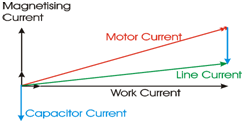
  • An inductive load requires a magnetic field to operate and in creating such a magnetic field causes the current to be out of phase with the voltage (the current lags the voltage). Power factor correction is the process of compensating for the lagging current by creating a leading current by connecting capacitors to the supply.
  • P.F (Cos Ǿ)= K.W / KVA  Or
  • P.F (Cos Ǿ)=  True Power / Apparent Power.
  • KW is Working Power (also called Actual Power or Active Power or Real Power).
  • It is the power that actually powers the equipment and performs useful work.
  • KVAR is Reactive Power.
  • It is the power that magnetic equipment (transformer, motor and relay)needs to produce the magnetizing flux.
  • KVA is Apparent Power.
  • It is the “vectorial summation” of KVAR and KW.

Displacement Power Factor Correction.

An induction motor draws current from the supply that is made up of resistive components and inductive components. The resistive components are:
1) Load current.
2)  Loss current.
And the inductive components are:
3) Leakage reactance.
4)  Magnetizing current.

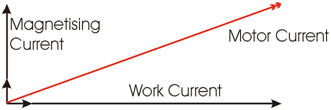
  • The current due to the leakage reactance is dependent on the total current drawn by the motor, but the magnetizing current is independent of the load on the motor. The magnetizing current will typically be between 20% and 60% of the rated full load current of the motor. The magnetizing current is the current that establishes the flux in the iron and is very necessary if the motor is going to operate.
  • The magnetizing current does not actually contribute to the actual work output of the motor. It is the catalyst that allows the motor to work properly. The magnetizing current and the leakage reactance can be considered passenger components of current that will not affect the power drawn by the motor, but will contribute to the power dissipated in the supply and distribution system.
  • Take for example a motor with a current draw of 100 Amps and a power factor of 0.75 The resistive component of the current is 75 Amps and this is what the KWh meter measures. The higher current will result in an increase in the distribution losses of (100 x 100) /(75 x 75) = 1.777  or a 78% increase in the supply losses.
  • In the interest of reducing the losses in the distribution system, power factor correction is added to neutralize a portion of the magnetizing current of the motor. Typically, the corrected power factor will be 0.92 – 0.95
  • Power factor correction is achieved by the addition of capacitors in parallel with the connected motor circuits and can be applied at the starter, or applied at the switchboard or distribution panel. The resulting capacitive current is leading current and is used to cancel the lagging inductive current flowing from the supply.

Displacement Static Correction (Static Compensation).

  • As a large proportion of the inductive or lagging current on the supply is due to the magnetizing current of induction motors, it is easy to correct each individual motor by connecting the correction capacitors to the motor starters.
  • With static correction, it is important that the capacitive current is less than the inductive magnetizing current of the induction motor. In many installations employing static power factor correction, the correction capacitors are connected directly in parallel with the motor windings.
  • When the motor is Off Line, the capacitors are also Off Line. When the motor is connected to the supply, the capacitors are also connected providing correction at all times that the motor is connected to the supply. This removes the requirement for any expensive power factor monitoring and control equipment.
  • In this situation, the capacitors remain connected to the motor terminals as the motor slows down. An induction motor, while connected to the supply, is driven by a rotating magnetic field in the stator which induces current into the rotor. When the motor is disconnected from the supply, there is for a period of time, a magnetic field associated with the rotor. As the motor decelerates, it generates voltage out its terminals at a frequency which is related to its speed.
  • The capacitors connected across the motor terminals, form a resonant circuit with the motor inductance. If the motor is critically corrected, (corrected to a power factor of 1.0) the inductive reactance equals the capacitive reactance at the line frequency and therefore the resonant frequency is equal to the line frequency. If the motor is over corrected, the resonant frequency will be below the line frequency. If the frequency of the voltage generated by the decelerating motor passes through the resonant frequency of the corrected motor, there will be high currents and voltages around the motor/capacitor circuit. This can result in severe damage to the capacitors and motor. It is imperative that motors are never over corrected or critically corrected when static correction is employed.
  • Static power factor correction should provide capacitive current equal to 80% of the magnetizing current, which is essentially the open shaft current of the motor.
  • The magnetizing current for induction motors can vary considerably. Typically, magnetizing currents for large two pole machines can be as low as 20% of the rated current of the motor while smaller low speed motors can have a magnetizing current as high as 60% of the rated full load current of the motor
  • Where the open shaft current cannot be measured, and the magnetizing current is not quoted, an approximate level for the maximum correction that can be applied can be calculated from the half load characteristics of the motor. It is dangerous to base correction on the full load characteristics of the motor as in some cases, motors can exhibit a high leakage reactance and correction to 0.95 at full load will result in over correction under no load, or disconnected conditions.
  • Static correction is commonly applied by using on e contactor to control both the motor and the capacitors. It is better practice to use two contactors, one for the motor and one for the capacitors. Where one contactor is employed, it should be up sized for the capacitive load. The use of a second contactor eliminates the problems of resonance between the motor and the capacitors.

How Capacitors Work

  • Induction motors, transformers and many other electrical loads require magnetizing current (kvar) as well as actual power (kW). By representing these components of apparent power (kVA) as the sides of a right triangle, we can determine the apparent power from the right triangle rule: kVA2 = kW2 + kVAR2.
  • To reduce the kva required for any given load, you must shorten the line that represents the kvar. This is precisely what capacitors do. By supplying kvar right at the load, the capacitors relieve the utility of the burden of carrying the extra kvar. This makes the utility transmission/distribution system more efficient, reducing cost for the utility and their customers. The ratio of actual power to apparent power is usually expressed in percentage and is called power factor.

What Causes Low Power Factor?

  • Since power factor is defined as the ratio of KW to KVA, we see that low power factor results when KW is small in relation to KVA. Inductive loads. Inductive loads (which are sources of Reactive Power) include:
  1. Transformers
  2. Induction motor
  3. Induction generators (wind mill generators)
  4. High intensity discharge (HID) lighting
  • These inductive loads constitute a major portion of the power consumed in industrial complexes.
  • Reactive power (KVAR) required by inductive loads increases the amount of apparent power (KVA) in your distribution system .This increase in reactive and apparent power results in a larger angle   (measured between KW and KVA).  Recall that, as   increases, cosine   (or power factor) decreases.

Why Should I Improve My Power Factor?

  • You want to improve your power factor for several different reasons.  Some of the benefits of improving your power factor include:

1) Lower utility fees by:

(a). Reducing peak KW billing demand:

  • Inductive loads, which require reactive power, caused your low power factor.  This increase in required reactive power (KVAR) causes an increase in required apparent power (KVA), which is what the utility is supplying. So, a facility’s low power factor causes the utility to have to increase its generation and transmission capacity in order to handle this extra demand.
  • By lowering your power factor, you use less KVAR.  This results in less KW, which equates to a dollar savings from the utility.

(b). Eliminating the power factor penalty:

  • Utilities usually charge customers an additional fee when their power factor is less than 0.95.  (In fact, some utilities are not obligated to deliver electricity to their customer at any time the customer’s power factor falls below 0.85.)  Thus, you can avoid this additional fee by increasing your power factor.

2) Increased system capacity and reduced system losses in your electrical system

  • By adding capacitors (KVAR generators) to the system, the power factor is improved and the KW capacity of the system is increased.
  • For example, a 1,000 KVA transformer with an 80% power factor provides 800 KW (600 KVAR) of power to the main bus.
  • By increasing the power factor to 90%, more KW can be supplied for the same amount of KVA.
  • 1000 KVA =            (900 KW)2  +  ( ?  KVAR)2
  • KVAR = 436
  • The KW capacity of the system increases to 900 KW and the utility supplies only 436 KVAR.
  • Uncorrected power factor causes power system losses in your distribution system.  By improving your power factor, these losses can be reduced.  With the current rise in the cost of energy, increased facility efficiency is very desirable.  And with lower system losses, you are also able to add additional load to your system.

3) Increased voltage level in your electrical system and cooler, more efficient motors

  • As mentioned above, uncorrected power factor causes power system losses in your distribution system.  As power losses increase, you may experience voltage drops.  Excessive voltage drops can cause overheating and premature failure of motors and other inductive equipment. So, by raising your power factor, you will minimize these voltage drops along feeder cables and avoid related problems.  Your motors will run cooler and be more efficient, with a slight increase in capacity and starting torque.

Automatic Power Factor Correction (APFC) Panel

Power Factor Improving:

  1. Please check if required kVAr of capacitors are installed.
  2. Check the type of capacitor installed is suitable for application or the capacitors are de rated.
  3. Check if the capacitors are permanently ‘ON’. The Capacitor are not switched off
  4. when the load is not working, under such condition the average power factor is found to be lower side.
  5. Check whether all the capacitors are operated in APFC depending upon the load operation.
  6. Check whether the APFC installed in the installation is working or not. Check the CT connection is taken from the main incomer side of transformer, after the fix compensation of transformer.
  7. Check if the load demand in the system is increased.
  8. Check if power transformer compensation is provided.

Thumb Rule if HP is known.

  • The compensation for motor should be calculated taking the details from the rating plate of motor Or
  • the capacitor should be rated for 1/3 of HP

Kvar Required For Transformer Compensation:

Transformer                                          Required Kva

  • <= 315 kVA  T.C                            =    5% of  KVA
  • 315kVA To 1000 kVA                    =    6% of  KVA
  • >= 1000 kVA                                  =   8% of  KVA

Where to connect capacitor:

  • Fix compensation should be provided to take care of power transformer. Power and distribution transformers, which work on the principle of electro-magnetic induction, consume reactive power for their own needs even when its secondary is not connected to any load. The power factor will be very low under such situation. To improve the power factor it is required to connect a fixed capacitor or capacitor bank at the LT side of the Transformer.  For approximate kVAr of capacitors required
  • If the installation is having various small loads with the mixture of large loads then the APFC should be recommended. Note that APFC should have minimum step rating of 10% as smaller step.
  • If loads are small then the capacitor should be connected parallel to load. The connection should be such that whenever the loads are switched on the capacitor also switches on along with the load.
  • Note that APFC panel can maintain the power factor on L.T side of transformer and it is necessary to provide fix compensation for Power transformer.
  • In case there is no transformer in the installation, then the C.T for sensing power factor should be provided at the incoming of main switch of the plant.

Calculation of required capacitor:

  • Suppose Actual P.F is 0.8, Required P.F is 0.98 and Total Load is 516KVA.
  • Power factor = kwh / kvah
  • kW = kVA x Power Factor
  • = 516 x 0.8 = 412.8
  • Required capacitor = kW x Multiplying Factor
  • = (0.8 x 516) x Multiplying Factor
  • = 412.8 x 0.547 (See Table to find Value according to P.F 0.8 to P.F of 0.98)
  • = 225.80 kVar

Multiplying factor for calculating kVAr

Target PF

0.6 0.9 0.91 0.92 0.93 0.94 0.95 0.96 0.97 0.98 0.99 1
0.6 0.849 0.878 0.907 0.938 0.970 1.005 1.042 1.083 1.130 1.191 1.333
0.61 0.815 0.843 0.873 0.904 0.936 0.970 1.007 1.048 1.096 1.157 1.299
0.62 0.781 0.810 0.839 0.870 0.903 0.937 0.974 1.015 1.062 1.123 1.265
0.63 0.748 0.777 0.807 0.837 0.870 0.904 0.941 0.982 1.030 1.090 1.233
0.64 0.716 0.745 0.775 0.805 0.838 0.872 0.909 0.950 0.998 1.058 1.201
0.65 0.685 0.714 0.743 0.774 0.806 0.840 0.877 0.919 0.966 1.027 1.169
0.66 0.654 0.683 0.712 0.743 0.775 0.810 0.847 0.888 0.935 0.996 1.138
0.67 0.624 0.652 0.682 0.713 0.745 0.779 0.816 0.857 0.905 0.966 1.108
0.68 0.594 0.623 0.652 0.683 0.715 0.750 0.787 0.828 0.875 0.936 1.078
0.69 0.565 0.593 0.623 0.654 0.686 0.720 0.757 0.798 0.846 0.907 1.049
0.7 0.536 0.565 0.594 0.625 0.657 0.692 0.729 0.770 0.817 0.878 1.020
0.71 0.508 0.536 0.566 0.597 0.629 0.663 0.700 0.741 0.789 0.849 0.992
0.72 0.480 0.508 0.538 0.569 0.601 0.635 0.672 0.713 0.761 0.821 0.964
0.73 0.452 0.481 0.510 0.541 0.573 0.608 0.645 0.686 0.733 0.794 0.936
0.74 0.425 0.453 0.483 0.514 0.546 0.580 0.617 0.658 0.706 0.766 0.909
0.75 0.398 0.426 0.456 0.487 0.519 0.553 0.590 0.631 0.679 0.739 0.882
0.76 0.371 0.400 0.429 0.460 0.492 0.526 0.563 0.605 0.652 0.713 0.855
0.77 0.344 0.373 0.403 0.433 0.466 0.500 0.537 0.578 0.626 0.686 0.829
0.78 0.318 0.347 0.376 0.407 0.439 0.474 0.511 0.552 0.599 0.660 0.802
0.79 0.292 0.320 0.350 0.381 0.413 0.447 0.484 0.525 0.573 0.634 0.776
0.8 0.266 0.294 0.324 0.355 0.387 0.421 0.458 0.499 0.547 0.608 0.750
0.81 0.240 0.268 0.298 0.329 0.361 0.395 0.432 0.473 0.521 0.581 0.724
0.82 0.214 0.242 0.272 0.303 0.335 0.369 0.406 0.447 0.495 0.556 0.698
0.83 0.188 0.216 0.246 0.277 0.309 0.343 0.380 0.421 0.469 0.530 0.672
0.84 0.162 0.190 0.220 0.251 0.283 0.317 0.354 0.395 0.443 0.503 0.646
0.85 0.135 0.164 0.194 0.225 0.257 0.291 0.328 0.369 0.417 0.477 0.620
0.86 0.109 0.138 0.167 0.198 0.230 0.265 0.302 0.343 0.390 0.451 0.593
0.87 0.082 0.111 0.141 0.172 0.204 0.238 0.275 0.316 0.364 0.424 0.567
0.88 0.055 0.084 0.114 0.145 0.177 0.211 0.248 0.289 0.337 0.397 0.540
0.89 0.028 0.057 0.086 0.117 0.149 0.184 0.221 0.262 0.309 0.370 0.512
0.9 0.029 0.058 0.089 0.121 0.156 0.193 0.234 0.281 0.342 0.484
0.91 0.030 0.060 0.093 0.127 0.164 0.205 0.253 0.313 0.456
0.92 0.031 0.063 0.097 0.134 0.175 0.223 0.284 0.426
0.93 0.032 0.067 0.104 0.145 0.192 0.253 0.395
0.94 0.034 0.071 0.112 0.160 0.220 0.363
0.95 0.037 0.078 0.126 0.186 0.329

Testing of Capacitor at Site:

Measurement of Voltage:

  • Check the voltage using multi meter at capacitor terminals.
  • Please note that the current output of 440 volt capacitor connected to a system of 415 volt will be lesser than rated value.
  • Table no -1 & 2give you the resultant kVAr output of the capacitor due to variation in supply            voltage.
  • The kVAr of capacitor will not be same if voltage applied to the capacitor and frequency changes. The example given below shows how to calculate capacitor current from the measured value at site.
  • Example :
  • 1. Name plate details – 15kVAr, 3 phases, 440v, and 50Hz capacitor.
  • Measured voltage – 425v , Measured frequency – 48.5Hz
  • Kvar = (fM / fR) x (VM / VR)2 x kvar
  • Kvar = (48.5/50) x (425 / 440)2 x 15
  • = 13.57kVAr.
  • 2. Name plate details – 15kVAr, 3 phases, 415v, and 50Hz capacitor.
  • Measured voltage – 425v, Measured frequency – 48.5Hz
  • Kvar = (fM / fR) x (VM / VR)2 x kVAr
  • Kvar = (48.5/50) x (425 / 415)2 x 15
  • = 15.26kVAr

Three Phase 440V Capacitor

kVAr 440V Line current 440V kVAr at 415V Line Current at 415V Measured capacitance across two terminals with third terminal open.(Micro farad) 440V
5 6.56 4.45 6.188 41.10
7.5 9.84 6.67 9.28 61.66
10 13.12 8.90 12.38 82.21
12.5 16.4 11.12 15.47 102.76
15 19.68 13,34 18.56 123.31
20 26.24 17.79 24.75 164.42
25 32.80 22.24 30.94 205,52

Three Phase 415V Capacitor

kVAr 415V Line current 415V kVAr at 440V Line Current at 415V Measured capacitance across two terminals with third terminal open.(Micro farad) 415V
5 6.55 5.62 7.38 46.21
7.5 10.43 8.43 11.06 69.31
10 13.91 11.24 14.75 92.41
12.5 17.39 14.05 18.44 116.51
15 20.87 16.86 22.13 138.62
20 27.82 22.48 29.50 184.82
25 34.78 38.10 36.88 231.03

Measurement of Current:

  • The capacitor current can be measured using Multi meter.
  • Make a record of measurement data of individual phase and other parameter.
  • Check whether the current measured is within the limit value with respect to supply voltage & data given in the name plate of capacitor Refer formulafor calculation
  • Formula for calculating rated current of capacitor with rated supply voltage and frequency.
  • l = kvar x 103 / ( 3 X V ) L L
  • Example:
  • 15kVAr, 3 phase, 440v, 50Hz capacitor.
  • l = kVAr x 103 / ( 3 X V ) L L
  • l = (15 x 1000) / (1.732 x 440) L
  • l = 19.68AMPs L
  • 15kVAr, 3 phases, 415v, 50Hz capacitor
  • l = kVAr x 103/ ( 3 X V ) L L
  • l = (15 x 1000) / (1.732 x 415) L
  • l = 20.87 Amps

Discharge of Capacitor:

  • L.T power capacitors are provided with discharge resistor to discharge the capacitor which is limited to one min. The resistor are provided as per clause No-7.1 of IS 13340-1993.
  • Switch off the supply to the capacitor and wait for 1 minute and then short the terminals of capacitor to ensure that the capacitor is completely discharged.
  • This shorting of terminals ensures the safety while handling the capacitor
  • Discharge of capacitor also becomes necessary for the safety of meter used for capacitance measurement.

Termination and Mounting:

  • Use suitable size lugs for connecting the cable to the terminals of capacitor.
  • Ensure that there is no loose connection: As loose connection may lead to failure of capacitor / insulation break down of cable.
  • Use proper tools for connection / tightening.
  • Ensure that the capacitor is mounted vertically.
  • The earthing of capacitor should be done before charging.
  • The applied voltage should not exceed more than 10%. Refer technical specification of capacitor.
  • The capacitor should be provided with the short circuit protection device as indicated in following Table
KVAr HRC Fuse Cable Amps
5 12 Amps 12 Amps
7.5 25 Amps 25 Amps
10 32 Amps 32 Amps
12.5 32 Amps 32 Amps
15 50 Amps 50 Amps
20 50 Amps 50 Amps
25 63 Amps 63 Amps
50 125 Amps 125 Amps
75 200 Amps 200 Amps
100 200 Amps 250 Amps

Use of capacitor in APFC panel

  • The capacitor should be provided with suitable designed inrush current limiting inductor coils or special capacitor duty contactors. Annexure d point no d-7.1 of IS 13340-1993
  • Once the capacitor is switched off it should not be switched on again within 60 seconds so that the capacitor is completely discharged. The switching time in the relay provided in the APFC panel should be set for 60 seconds for individual steps to discharge. Clause No-7.1 of IS 13340-1993
  • If the capacitor is switched manually or if you are switching capacitors connected in parallel with each other then “ON” delay timer (60sec) should be provided and in case of parallel operation once again point No 1 should be taken care. Clause No-7.1 of IS 13340-1993
  • The capacitor mounted in the panel should have min gap of 25-30 mm between the capacitor and 50 mm around the capacitor to the panel enclosure.
  • In case of banking a min gap of 25mm between the phase to phase and 19mm between the phases to earth should be maintained. Ensure that the banking bus bar is rated for 1.8 times rated current of bank.
  • The panel should have provision for cross ventilation, the louver / fan can be provided in the care Annexure d point No d-3.1 IS 13340-1993
  • For use of reactor and filter in the panel fan should be provided for cooling.
  • Short circuit protection device (HRC fuse / MCCB) should not exceed 1.8 x rated current of capacitor.
  • In case of detuned filter banks MCCB is recommended for short circuit protection.

Points should be verified before considering replacement

  • Supply voltage to capacitor should be checked for any over voltage. This can be verified of voltage stabilizers are connected in the installation, light fitting are regularly replaced, this indicates the over voltage.
  • It is generally found that i.c. base APFC relays are big in size as compared to microprocessor relays. These ic based relays are found to be malfunctioning. The capacitors are switched “OFF” & “ON” very fast without discharge of capacitor, leading to high current drawn by capacitors. Such operation leads to failure of capacitor.
  • Check the time set in APFC relays connected for the operation, as various make of relays are preset for 15-20 sec. This setting of time should be verified in presence of customer at panel with operation of relay. The switching of capacitor from one step to another should have min time gap of 60 second. This should be physically watched. No replacement shall be considered in such cases where in the time is set below 60sec.
  • The chattering of contactor can also lead to failure of capacitor. This chattering may happen due to low voltage or loose connection to contactor coils etc. If the capacitors are operated in manual mode using push button, check whether the on delay timer is provided in the individual steps. Verify whether the time set of 60sec or not. No replacement should be considered in such cases where in the timer is set below 60sec. or it is not provided.
  • Check whether capacitor duty contactor is provided or if the inrush limiting inductor coils are used. This becomes important in case the capacitors are switched ‘ON’ with the other capacitor connected in the same bus. Parallel switching of capacitor is generally found in capacitor panels having APFC and push buttons for switching “on” & “off”.
  • Check whether the harmonic is present. For this take a fresh capacitor, charge the capacitor and then calculate whether the current drawn by capacitor is within the limit. If the current is more, then it may be due to over voltage. If not then it is clear that the capacitor is drawing high current due to presence of harmonics.
  • The harmonics in the plant can be easily found If the plant has loads using power electronic components such as ups, drives and furnace. Loads such as are welding, cfl tubes and electronic controlled machines also generate harmonics. Note that neighboring plant connected to the grid may also affect the capacitors by importing the harmonic. (Harmonic voltage easily travels through the grid from one installation to another, the effect of such voltage leads to failure of capacitor).
  • Check other points given in installation guide line of capacitor.
  • In case the installation is having MD-XL capacitors with connected loads generating harmonics then the capacitor may be drawing additional 30% current. In such conditions the fuses may blow out cable will heat up and Temperature of capacitor will be also increased. Ensure that the fuse rating should not be increased. The switchgear and cable size should be suitably increased. The capacitor will continue to work but the life of capacitor may not be longer. This clearly indicates that the capacitor is over loaded and if required the reactor Should be provided for controlling the over current.
  • Check the short circuit protection device. Please note that you may come across the customer using fuses almost double the current rating of capacitors. This is generally found in the plants having harmonic problems and the installations having hired local electricians for maintenance.
  • Check the date of installation of capacitor and type of additional load being connected after installation of capacitors. As it is observed in certain cases that the type of capacitor was selected without considering future expansion of machineries in the plant. Some time these machines are found to be generating harmonic affecting the life of capacitor.
  • No replacement should be considered if capacitor is failed due to harmonics and customer has used normal capacitors without consulting Engineers.

Points should be verified before charging capacitor banks:

  • Capacitor voltage rating is equal to the max voltage recorded in the installation.
  • Capacitor is mounted vertically.
  • Earthing at two different points is done.
  • Proper lugs are used for termination.
  • Proper size of cable is used.
  • Ph- ph gap is 25mm and ph-earth is 19mm.
  • The bus bar used for banking is 1.8 x rated current of the bank.
  • Cross ventilation provision is provided in the installation area / in the panel.
  • The plant has the facility to trip the capacitor under over voltage conditions.(10%)
  • Capacitor is provided with suitable size of HRC fuse / MCCB rating for protection.
  • Suitable inrush current device is connected in series with contactor to limit the inrush current or capacitor duty contactor is used.
  • Capacitor is provided with suitable on delay timer to ensure that the capacitor is not switched on within 60sec. After it is switched off.
  • Capacitor is provided with insulating cover to ensure the safety.
  • Capacitor is installed in the area free from entry of dust, chemical fume and rain water.
  • APFC relay provided in the panel is set for 60 second. ‘On delay’ provided are also set for 60 second.
  • The filter banks are provided with MCCB for protection apart from above points.
  • The MCCB should be set for 1.3 x rated current of filter bank

Verify the following in the installation before commissioning harmonic filter banks.

  • Capacitor banks without reactor should not be permitted on the secondary size of transformer circuit which is having filter banks connected. Please remove capacitors without reactors from the same network (as IEC- 61642).
  • Filter rated voltage is equal to the max voltage recorded in the installation.
  • Capacitor used with reactors is always of special voltage recorded in the installation.
  • Earthing should be done at capacitors and reactors separately.
  • Proper lugs are used for termination.
  • Proper size of cable is used.
  • Ph- ph gap is 25mm and ph-earth is 19mm.
  • The bus bar used for banking is 1.8 x rated bank current.
  • Forced cross ventilation should be provided in the installation area.
  • The plant has the facility to trip the filter banks under over voltage conditions. Set for 10% over voltage.
  • Filter banks are provided with suitable size of MCCB rating for protection.
  • The MCCB is set for 1.3 x rated current of filter bank. MCCB are recommended.
  • Filter is provided with suitable ‘on delay’ timer to ensure that the capacitor is not switched on within 60sec. After it is switched off.
  • Filter is installed in the area free from entry of dust, chemical fumes and rain water.
  • APFC relay provided in the panel for switching filters is set for 60 second.