Overhead Conductors
March 20, 2011 26 Comments
Types of Overhead Conductors
Properties of Overhead Bare Conductors:
Current Carrying Capacity
- Strength
- Weight
- Diameter
- Corrosion Resistance
- Creep Rate
- Thermal Coefficient of Expansion
- Fatigue Strength
- Operating Temperature
- Short Circuit Current/Temperature
- Thermal Stability
- Cost
Categories of Overhead Conductors:
Homogeneous Conductors:
- Copper
- AAC( All Aluminum Conductor)
- AAAC (All Aluminum Alloy Conductor)
- The core consists of a single strand identical to the outer strands. Since all the strands are the same diameter, one can show that the innermost layer always consists of 6 strands, the second layer of 12 strands, etc., making conductors having 1, 7, 19, 37, 61, 91, or 128 strands.
Non Homogeneous Conductors:
- ACAR (Aluminum Conductor Alloy Reinforced)
- ACSR (Aluminum Conductor Steel Reinforced)
- ACSS (Aluminum Conductor Steel Supported)
- AACSR (Aluminum Alloy Conductor Steel Reinforced.
- the strands in the core may or may not be of the same diameter. In a 30/7
- ACSR conductor the aluminum and steel strands are of the same diameter. In a 30/19
- ACSR they are not. Within the core or within the outer layers, however, the number of strands always increases by 6 in each succeeding layer. Thus, in 26/7 ACSR, the number of layers in the inner layer of aluminum is 10 and in the outer layer 16
Categories of Overhead Conductors
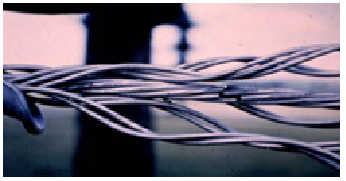
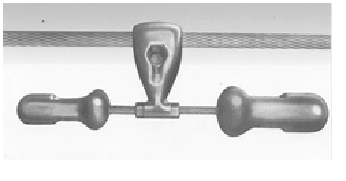
- VR (Vibration Resistance)
- Non-Specular
- ACSR / SD• (Self Damping)
Choices of overhead depend upon:
Power Delivery Requirements
- Current Carrying Capacity
- Electrical Losses
Line Design Requirements
- Distances to be Spanned
- Sag and Clearance Requirements
Environmental Considerations
- Ice and Wind Loading
- Ambient Temperatures
(1) AAC (All Aluminum Conductors)
- AAC is made up of one or more strands of hard drawn 1350 Aluminum Alloy.
- AAC has had limited use in transmission lines and rural distribution because of the long spans utilized.
- Good Conductivity -61.2% IACS
- Good Corrosion Resistance
- High Conductivity to Weight Ratio.
- Moderate Strength

Typical Application
- Short spans where maximum current transfer is required.
- The excellent corrosion resistance of aluminum has made AAC a conductor of choice in coastal areas.
- Because of its relatively poor strength-to-weight ratio, AAC has seen extensive use in urban areas where spans are usually short but high conductivity is required.
- These conductors are used in low, medium and high voltage overhead lines.
(2) AAAC (All Aluminum Alloy Conductors)
- AAAC are made out of high strength Aluminum-Magnesium-Silicon alloy.
- AAAC with different variants of electrical grade Alloys type 6101 and 6201.
- These conductors are designed to get better strength to weight ratio and offers improved electrical characteristics, excellent sag-tension characteristics and superior corrosion resistance when compared with ACSR.
- Equivalent aluminum alloy conductors have approximately the same ampacity and strength as their ACSR counterparts with a much improved strength-to-weight ratio, and also exhibit substantially better electrical loss characteristics than their equivalent single layer ACSR constructions. The thermal coefficient of expansion is greater than that of ACSR.
- As compared to conventional ACSR, lighter weight, comparable strength & current carrying capacity, lower electrical losses and superior corrosion resistance have given AAAC a wide acceptance in the distribution and transmission lines.

Features
- High strength to weight ratio
- Better sag characteristics
- Improved electrical properties
- Excellent resistance to corrosion
- Specifications
- Higher Tensile Strength
- Excellent Corrosion Resistance
- Good Strength to Weight Ratio
- Lower Electrical Losses
- Moderate Conductivity –52.5% IACS
Typical Application
- Transmission and Distribution applications in corrosive environments, ACSR replacement.
(3) ACAR (Aluminum Conductor Al. Alloy Reinforced)
- Aluminum Conductor Alloy Reinforced (ACAR) is formed by concentrically stranded Wires of Aluminum 1350 on high strength Aluminum-Magnesium-Silicon (AlMgSi) Alloy core.
- The number of wires of Aluminum 1350 & AlMgSi alloy depends on the cable design.
- Even though the general design comprises a stranded core of AlMgSi alloy strands, in certain cable constructions the wires of AlMgSi Alloy strands can be distributed in layers throughout the Aluminum 1350 strands.
- ACAR has got a better mechanical and electrical properties as compared to an equivalent conductors of ACSR,AAC or AAAC.
- A very good balance between the mechanical and electrical properties therefore makes ACAR the best choice where the ampacity , strength , and light weight are the main consideration of the line design.
- These conductors are extensively used in overhead transmission and distribution lines.

Features
- Improved strength to weight ratio
- Improved mechanical properties
- Improved electrical properties
- Excellent resistance to corrosion Specifications
- Balance of Mechanical & Electrical
- Excellent Corrosion Resistance
- Variable Strength to Weight Ratio
- Higher Conductivity than AAAC
- Custom Designed, diameter equivalent to ACSR most common.
Typical Application
- Used for both transmission and distribution circuits.
(3) AACSR – Aluminum Alloy Conductor Steel Reinforced
- AACSR is a concentrically stranded conductor composed of one or more layers of Aluminum-Magnesium-Silicon alloy wire stranded with a high-strength coated steel core.
- The core may be single wire or stranded depending on the size. Core wire for AACSR is available with Class A, B or C galvanizing; or aluminum clad (AW).
- Additional corrosion protection is available through the application of grease to the core or infusion of the complete cable with grease.

Features
- Offers optimal strength for line design
- Improved strength to weight ratio
- Ideal for extra long spans and heavy load conditions
- Excellent resistance to corrosion
(4) ACSS – Aluminum Conductors Steel Supported.
- ACSS is a composite concentric-lay stranded conductor with one or more layers of hard drawn and annealed 1350-0 aluminum wires on a central core of steel.
- In an ACSS ,under normal operating conditions, the mechanical load is mainly derived from the steel core as aluminum in fully annealed stage does not contribute much towards the mechanical strength.
- Steel core wires are protected from corrosion by selecting an appropriate coating of the wire like galvanizing, mischmetal alloy coating or aluminum clad. The type of coating is selected to suit the environment to which the conductor is exposed and operating temperature of the conductor
- ACSS are suitable for operating at high temperature without losing the mechanical properties.
- The final sag-tension performance is not affected by the long term creep of aluminum.

Features
- Improved conductivity
- High current carrying capacity
- Very low sag at high temperature
- High degree of immunity to vibration fatigue
- Better self damping property
(6) ACCC – Aluminum Conductor Composite Core
- Aluminum Conductor Composite Core (ACCC) is a concentrically stranded conductor with one or more layers of trapezoidal shaped hard drawn and annealed 1350-0 aluminum wires on a central core of high strength Carbon and glass fiber composite.
- The ACCC Conductor uses a carbon fiber core that is 25% stronger and 60% lighter than a traditional steel core.
- This allows with the help of trapezoidal shaped strands the ability to increase the conductor’s aluminum content by over 28% without increasing the conductor’s overall diameter or weight.
Features
- Excellent Sag properties
- Increased current carrying capacity
- High operating temperature
- Excellent strength to weight ratio
- Highly energy efficient.
(7) ACSR (Aluminum Conductor Steel Reinforced)
- Aluminum Conductor Steel Reinforced (ACSR) is concentrically stranded conductor with one or more layers of hard drawn 1350-H19 aluminum wire on galvanized steel wire core.
- The core can be single wire or stranded depending on the size.
- Steel wire core is available in Class A ,B or Class C galvanization for corrosion protection.
- Additional corrosion protection is available through the application of grease to the core or infusion of the complete cable with grease.
- The proportion of steel and aluminum in an ACSR conductor can be selected based on the mechanical strength and current carrying capacity demanded by each application.
- ACSR conductors are recognized for their record of economy, dependability and favorable strength / weight ratio. ACSR conductors combine the light weight and good conductivity of aluminum with the high tensile strength and ruggedness of steel.
- In line design, this can provide higher tensions, less sag, and longer span lengths than obtainable with most other types of overhead conductors.
- The steel strands are added as mechanical reinforcements.
- ACSR conductors are recognized for their record of economy, dependability and favorable strength / weight ratio.
- ACSR conductors combine the light weight and good conductivity of aluminum with the high tensile strength and ruggedness of steel.
- In line design, this can provide higher tensions, less sag, and longer span lengths than obtainable with most other types of overhead conductors.
- The steel strands are added as mechanical reinforcements.
- The cross sections above illustrate some common stranding.
- The steel core wires are protected from corrosion by galvanizing.
- The standard Class A zinc coating is usually adequate for ordinary environments.
- For greater protection, Class B and C galvanized coatings may be specified.
- The product is available with conductor corrosion resistant inhibitor treatment applied to the central steel component.

Features
- High Tensile strength
- Better sag properties
- Economic design
- Suitable for remote applications involving long spans
- Good Ampacity
- Good Thermal Characteristics
- High Strength to Weight Ratio
- Low sag
- High Tensile Strength
Typical Application
- Commonly used for both transmission and distribution circuits.
- Compact Aluminum Conductors, Steel Reinforced (ACSR) are used for overhead distribution and transmission lines.
(8) Trap Wire Constructions
- AAC/TW (Trapezoidal Shaped 1350-H19 Aluminum Strands)
- ACSR/TW (Trapezoidal Shaped 1350-H19 Aluminum Conductor -Galvanized –Zinc or AW Coated Steel Core Wires)
- ACSS/TW (Trapezoidal Shaped 1350-O Aluminum Conductor-Zinc –5% Mischmetal Aluminum Alloy or AW Coated Steel Core wires)
Comparison of ACSR/TW Type Number with Equivalent Stranding of ACSR
Type Number Conventional ACSR Stranding
3 36/1
5 42/7
6 18/1
7 45/7
8 84/19
10 22/7
13 54/7
13 54/49
13 24/7
16 26/7
- The equivalent stranding is that stranding of conventional ACSR that has the same area of aluminum and steel as a given ACSR/TW type. The ACSR/TW type number is the approximate ratio of the area of steel to the area of aluminum in percent.
(8-a) ACSR/AS – Aluminum Conductor, Aluminum Clad Steel Reinforced
- ACSR/AS or ACSR/AWare concentrically stranded conductors with one or more layers of hard drawn 1350-H19 aluminum wires on Aluminum Clad steel wire core.
- The core can be single wire or stranded depending on the size.
- The mechanical properties of ACSR/AS conductors are similar to ACSR conductors but offers improved ampacity and resistance to corrosion because of the presence of aluminum clad steel wires in the core.
- These conductors are better replacement for ACSR conductors where corrosive conditions are severe.
Features
- Good mechanical properties
- Improved electrical characteristics
- Excellent corrosion resistance
- Better Sag properties
(8-b) ACSS/AW – Aluminum Conductors –Aluminum Clad Steel Supported
- ACSS/AW or ACSS/AS is a composite concentric-lay stranded conductor with one or more layers of hard drawn and annealed 1350-0 aluminum wires on a central core of aluminum clad steel core.
- In an ACSS/AW ,under normal operating conditions, the mechanical load is mainly derived from the steel core as aluminum in fully annealed stage does not contribute much towards the mechanical strength.
- Aluminum Clad steel has got an excellent resistance towards corrosion.
- ACSS/AW are can be safely operated upto 250oC continuously without losing the mechanical properties.
- The final sag-tension performance is not affected by the long term creep of aluminum.
Features
- Improved conductivity
- High current carrying capacity
- Suitable for high temperature
- Excellent corrosion resistance
- Very low sag at high temperature
- High degree of immunity to vibration fatigue
- Better self damping property
(8-c) ACSR/TW – Trapezoidal Shaped 1350-H19 wire Aluminum Conductor, Steel-Reinforced
- Shaped Wire Compact Concentric-Lay-Stranded Aluminum Conductor, Steel-Reinforced (ACSR/TW) is a concentrically stranded conductor , made with trapezoidal shaped 1350-H19 wires over a high strength steel core.
- There are two possible design variants. In one case ACSR/TW conductors are designed to have an equal aluminum cross sectional area as that of a standard ACSR which results in a smaller conductor diameter maintaining the same ampacity level but reduced wind loading parameters.
- In the second design, diameter of the conductor is maintained to that of a standard ACSR which results in a significantly lower conductor resistance and increased current rating with the same conductor diameter.
- manufactures ACSR/TW with Galvanized steel ( in Class A, Class B & Class C), Zn-5Al mischmetal coated steel or Aluminum clad steel core.

Features
- High Tensile strength
- Better sag properties
- Reduced drag properties
- Low wind and ice loading parameters
- suitable for remote applications involving long spans
(8-d) ACSS/TW – Shaped Wire Aluminum Conductors Steel Supported
- Shaped Wire Compact Concentric-Lay-Stranded Aluminum Conductor, Steel-Supported (ACSS/TW) is a concentrically stranded conductor with one or more layers of trapezoidal shaped hard drawn and annealed 1350-0 aluminum wires on a central core of steel.
- ACSS/TW can either be designed to have an equal aluminum cross sectional area as that of a standard ACSS which results in a smaller conductor diameter maintaining the same ampacity level but reduced wind loading parameters or with diameter equal to that of a standard ACSS which results in a significantly higher aluminum area, lower conductor resistance and increased current rating.
- ACSS/TW is designed to operate continuously at elevated temperatures, it sags less under emergency electrical loadings than ACSR/TW, excellent self-damping properties, and its final sags are not affected by long-term creep of aluminum.
- ACSS/TW also provides many design possibilities in new line construction: i.e., reduced tower cost, decreased sag, increased self-damping properties, increased operating temperature and improved corrosion resistance.
- The coating of steel core is selected to suit the environment to which the conductor is exposed and operating temperature of the conductor.

Features
- High Operating temperature
- Improved current carrying capacity
- Better sag properties
- Excellent self-damping properties
- Reduced drag properties
- Low wind and ice loading parameters
Decide Number of Conductor and Layer of Conductor:
- If N: number of conductors [strands], d: Diameter of strands, ,X: number of layers.
- Usually the relation between N&X take as followed.
N= 3X2-3X+1
- If N is given we can used the above relation get X, then we can get the total Diameter of cable as
dT= (2X-1)d.
- If Total Number of Conductor (N)=19 Than 19=3×2-3x+1. So Number of Layer (x)=3
- Than Diameter of Cable dT = (2x-1)d =5d
What is the history behind the ACSS/TW Product?
- In 1974, Reynolds Metals patented the ACSS conductor design. Its original name was Steel Supported Aluminum Conductor (SSAC). The original patents have expired and the product is now known as ACSS. There are currently three major North American conductor manufacturers that offer ACSS products both round wire and trapezoidal wire (TW).
- The TW enhancement to ACSS was transferred from existing technology developed for ACSR (Aluminum Conductor Steel Reinforced) and AAC (All Aluminum Conductor) TW conductors. ACSS/TW is typically manufactured to meet the aluminum cross-sectional area of a standard round conductor, but allows the overall diameter to be reduced by approximately 10 percent. ACSS/TW can also be manufactured to meet the existing diameter of a standard conductor, incorporating 20 percent to 25 percent more aluminum cross-sectional area.
What does ACSS or ACSS/TW look like?
- From the outside, ACSS and ACSS/TW conductors look like traditional ACSR. All are manufactured with steel cores and aluminum outer strands. The key difference is that the ACSR aluminum is made from hard drawn aluminum, while ACSS uses soft aluminum (i.e. annealed, or “O” temper). In the ACSS/TW trapezoidal conductor, the aluminum strands are not round but trapezoidal shaped.
What is so special about using annealed aluminum strands?
- Both ACSR and ACSS conductors are made from two different metals-aluminum and steel. Consequently, the composite conductor behavior is determined by the combined electrical and mechanical properties of the two materials that make up the conductor. Although ACSR and ACSS are made with 1350 alloy aluminum, their electrical and mechanical properties are very different.
- Electrically, the conductivity of hard drawn aluminum in ACSR is 61.2 percent; whereas, soft aluminum has a conductivity of 63 percent relative to copper (100 percent). This means that the soft aluminum in ACSS is more efficient at transporting power. Mechanically, the tensile strength (resistance to breaking) of hard drawn aluminum in ACSR is approximately three times that of soft aluminum. This means that the aluminum in ACSS conductor contributes much less to the overall strength, and the composite conductor behaves more like steel.
What are the consequences of elevated conductor temperature on ACSR?
- When ACSR conductors are operated at temperatures in excess of approximately 93 C, the aluminum starts to anneal. The annealing weakens the conductor and can potentially cause the conductor to break under high wind or ice conditions. To prevent this from happening, utilities generally limit conductor temperatures to 75 C for an ACSR conductor.
- ACSS/TW and ACSS conductors are manufactured using soft (annealed) aluminum, where operation at higher temperatures has no further effect on the aluminum’s tensile strength. Compared to regular ACSR, predictable installation parameters can be calculated for the ACSS/TW conductors to take into consideration the sag and tension performance at the higher temperatures.
What is the temperature rating of ACSS?
- The original temperature limit of 200 C has been in existence for almost 30 years and has proven itself. This was based on a 245 C temperature limit established by steel core manufacturers for the galvanized coating of the steel. Operation of the ACSS product at higher temperature (e.g. 250 C) warrants the use of an enhanced type of galvanizing, which provides more durable high temperature endurance performance (Misch Metal-zinc/aluminum alloy coating). Another option for high temperatures is aluminum clad steel.
How high can the operating temperature realistically go?
- Theoretically, the 250 C rating would provide the ability to carry more power through transmission lines. However, the question must be asked, “Is it wise to operate an electrical system at that high of a temperature?”
- The amount of electrical current passing through the conductor combined with environmental conditions determines the operating temperature of the conductor. Electrical current causes the following:
- A) The higher the current, the hotter the conductor and the greater the power losses. Ideally, lines are designed to minimize these power losses and keep normal day-to-day power loads well below the 200 C operating temperature limits.
- B) The hotter the conductor, the more it will sag and to compensate, the use of larger and/or stronger structures would be required.
- C) Electrical current also passes through the conductor joints (splices) and end fittings (dead ends), forming “weak links” that can mechanically and electrically fail because of overheating. Conductor supports and insulators also become more susceptible to failure. To sum things up, pushing the temperature limit to 250 C remains an unproven condition.
What are the best applications for use of the ACSS and ACSS/TW products?
- System reliability issues push the need for the use of ACSS. Utilities are being pressured to demonstrate system reliability. The ACSS/TW conductor could enable a tremendous emergency load carrying capability that the utility could call upon when needed.
- Cyclic Loads and Peak Demand can be accommodated using ACSS/TW because it can operate at temperatures higher than ACSR. ACSS/TW enables utilities to plan for future situations of increased power requirements because ACSS/TW has power carrying capacity already built into the system.
- Utilities can also turn to ACSS products in situations where they need additional power capacity along existing right-of-ways, but are facing the environmental challenges of building new lines. The ACSS/TW reconductoring option may be the only solution available to upgrade lines with minimal changes along existing routes.
 JIGNESH PARMAR


 Electrical Notes & Articles
Recent Comments