Ferranti Effect


What is Ferranti Effect

  • A long transmission line draws a substantial quantity of charging current. If such a line is open circuited or very lightly loaded at the receiving end, Receiving end voltage being greater than sending end voltage in a transmission line is known as Ferranti effect. All electrical loads are inductive in nature and hence they consume lot of reactive power from the transmission lines. Hence there is voltage drop in the lines. Capacitors which supply reactive power are connected parallel to the transmission lines at the receiving end so as to compensate the reactive power consumed by the inductive loads.
  • As the inductive load increases more of the capacitors are connected parallel via electronic switching. Thus reactive power consumed by inductive loads is supplied by the capacitors thereby reducing the consumption of reactive power from transmission line. However when the inductive loads are switched off the capacitors may still be in ON condition. The reactive power supplied by the capacitors adds on to the transmission lines due to the absence of inductance. As a result voltage at the receiving end or consumer end increases and is more than the voltage at the supply end. This is known as Ferranti effect.

Why does voltage rise on a long, unloaded transmission line?

  • The Ferranti Effect occurs when current drawn by the distributed capacitance of the transmission line itself is greater than the current associated with the load at the receiving end of the line. Therefore, the Ferranti effect tends to be a bigger problem on lightly loaded lines, and especially on underground cable circuits where the shunt capacitance is greater than with a corresponding overhead line. This effect is due to the voltage drop across the line inductance (due to charging current) being in phase with the sending end voltages. As this voltage drop affects the sending end voltage, the receiving end voltage becomes greater. The Ferranti Effect will be more pronounced the longer the line and the higher the voltage applied.
  • The Ferranti Effect is not a problem with lines that are loaded because line capacitive effect is constant independent of load, while inductance will vary with load. As inductive load is added, the VAR generated by the line capacitance is consumed by the load.

How to Reduce Ferranti Effect:

Shunt Reactors and Series Capacitors:

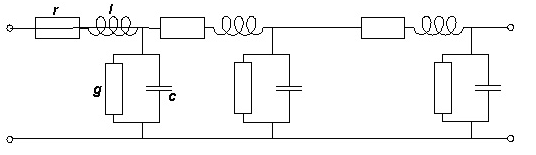
  • The need for large shunt reactors appeared when long power transmission lines for system voltage 220 kV & higher were built. The characteristic parameters of a line are the series inductance (due to the magnetic field around the conductors) & the shunt capacitance (due to the electrostatic field to earth).

  • Both the inductance & the capacitance are distributed along the length of the line. So are the series resistance and the admittance to earth. When the line is loaded, there is a voltage drop along the line due to the series inductance and the series resistance. When the line is energized but not loaded or only loaded with a small current, there is a voltage rise along the line (the Ferranti-effect)
  • In this situation, the capacitance to earth draws a current through the line, which may be capacitive. When a capacitive current flows through the line inductance there will be a voltage rise along the line.
  • To stabilize the line voltage the line inductance can be compensated by means of series capacitors and the line capacitance to earth by shunt reactors. Series capacitors are placed at different places along the line while shunt reactors are often installed in the stations at the ends of line. In this way, the voltage difference between the ends of the line is reduced both in amplitude and in phase angle.
  • Shunt reactors may also be connected to the power system at junctures where several lines meet or to tertiary windings of transformers.
  • Transmission cables have much higher capacitance to earth than overhead lines. Long submarine cables for system voltages of 100 KV and more need shunt reactors. The same goes for large urban networks to prevent excessive voltage rise when a high load suddenly falls out due to a failure.
  • Shunt reactors contain the same components as power transformers, like windings, core, tank, bushings and insulating oil and are suitable for manufacturing in transformer factories. The main difference is the reactor core limbs, which have non-magnetic gaps inserted between packets of core steel.
  • 3-phase reactors can also be made. These may have 3- or -5-limbed cores. In a 3-limbed core there is strong magnetic coupling between the three phases, while in a 5-limbed core the phases are magnetically independent due to the enclosing magnetic frame formed by the two yokes and the two unwound side-limbs.
  • The neutral of shunt reactor may be directly earthed, earthed through an Earthing-reactor or unearthed.
  • When the reactor neutral is directly earthed, the winding are normally designed with graded insulation in the earthed end. The main terminal is at the middle of the limb height, & the winding consists of two parallel-connected halves, one below & one above the main terminal. The insulation distance to the yokes can then be made relatively small. Sometimes a small extra winding for local electricity supply is inserted between the main winding & yoke.
  • When energized the gaps are exposed to large pulsation compressive forced with a frequency of twice the frequency of the system voltage. The peak value of these forces may easily amount to 106 N/m2 (100 ton /m2). For this reason the design of the core must be very solid, & the modulus of elasticity of the non-magnetic (& non-metallic) material used in gaps must be high (small compression) in order to avoid large vibration amplitudes with high sound level consequently. The material in the gaps must also be stable to avoid escalating vibration amplitudes in the end.
  • Testing of reactors requires capacitive power in the test field equal to the nominal power of the reactor while a transformer can be tested with a reactive power equal to 10 – 20% of the transformer power rating by feeding the transformer with nominal current in short –circuit condition.
  • The loss in the various parts of the reactor (12R, iron loss & additional loss) cannot be separated by measurement. It is thus preferable, in order to avoid corrections to reference temperature, to perform the loss measurement when the average temperature of the winding is practically equal to the reference temperature.

How does a phase shifting transformer help operators load and unload transmission lines?

  • Power flow between two buses can be expressed as:
  • Power Flow = (Vs*Vr / X) * Sine of the Power Angle.
  • In other words: power flow (in watts) between two buses will be equal to the voltage on the sending bus multiplied by the voltage on the receiving bus divided by the line reactance, multiplied by the sine of the power angle between the two buses.
  • This leaves grid operators with at least two options for making a path more conducive to power flow, or if desired, making a path look less conducive to power flow. The two options are to (1) adjust line reactance and (2) adjust power angle. The Phase Shifting Transformer (PST) affects the second option, i.e. adjusting power angle.
  • The physical appearance of the PST device is noteworthy, being one of the few transformer types where the physical height and construction of the primary bushings is the same as the secondary bushings. This makes sense since both bushing sets are at the same potential. Internally, the primary voltage of a PST is bussed directly to the secondary bushings, with one important addition. The primary voltage is applied to a delta-wound transformer primary that has adjustable taps that inject “opposing phase” signals. For instance the A-B primary winding has a C phase injection, the B-C winding is injected with A, and the C-A winding is injected with B. These injection points are simultaneously adjustable taps that result in an adjustable shift of power angle.
  • Since power angle is a direct contributor to the Power Flow formula provided above (in the numerator, not the denominator), changing the PST tap settings can increase power angle making the path more conducive to power flow. The PST tap settings can also decrease power angle making the path less conducive to power flow. (Remember that “power flows downhill on angle”.)
  • Why is this important? Many transmission paths naturally have less impedance by virtue of their construction and length, and these paths can carry scheduled flow as well as unscheduled flow from parallel (but higher impedance) paths. In some cases these low impedance paths become congested and PST devices and other devices and techniques may be used to relieve the congestion. This is particularly the case in regions where transmission paths are less densely developed.

What is Corona Effect


Introduction:

One of the phenomena associated with all energized electrical devices, including high-voltage transmission lines, is corona. The localized electric field near a conductor can be sufficiently concentrated to ionize air close to the conductors. This can result in a partial discharge of electrical energy called a corona discharge, or corona.

  What is Corona?

  •  Electric transmission lines can generate a small amount of sound energy as a result of corona.
  • Corona is a phenomenon associated with all transmission lines. Under certain conditions, the localized electric field near energized components and conductors can produce a tiny electric discharge or corona that causes the surrounding air molecules to ionize, or undergo a slight localized change of electric charge.
  • Utility companies try to reduce the amount of corona because in addition to the low levels of noise that result, corona is a power loss, and in extreme cases, it can damage system components over time.
  • Corona occurs on all types of transmission lines, but it becomes more noticeable at higher voltages (345 kV and higher). Under fair weather conditions, the audible noise from corona is minor and rarely noticed.
  • During wet and humid conditions, water drops collect on the conductors and increase corona activity. Under these conditions, a crackling or humming sound may be heard in the immediate vicinity of the line.
  • Corona results in a power loss. Power losses like corona result in operating inefficiencies and increase the cost of service for all ratepayers; a major concern in transmission line design is the reduction of losses.

 Source of Corona:

  • The amount of corona produced by a transmission line is a function of the voltage of the line, the diameter of the conductors, the locations of the conductors in relation to each other, the elevation of the line above sea level, the condition of the conductors and hardware, and the local weather conditions. Power flow does not affect the amount of corona produced by a transmission line.
  • The electric field gradient is greatest at the surface of the conductor. Large-diameter conductors have lower electric field gradients at the conductor surface and, hence, lower corona than smaller conductors, everything else being equal. The conductors chosen for the Calumet to the line were selected to have large diameters and to utilize a two conductor bundle. This reduces the potential to create audible noise.
  • Irregularities (such as nicks and scrapes on the conductor surface or sharp edges on suspension hardware) concentrate the electric field at these locations and thus increase the electric field gradient and the resulting corona at these spots. Similarly, foreign objects on the conductor surface, such as dust or insects, can cause irregularities on the surface that are a source for corona.
  • Corona also increases at higher elevations where the density of the atmosphere is less than at sea level. Audible noise will vary with elevation. An increase in 1000 feet of elevation will result in an increase in audible noise of approximately 1 dB (A). Audible noise at 5000 feet in elevation will 5 dB (A) higher than the same audible noise at sea level, all other things being equal. The new Calumet to Comanche 345 kV double circuit line was modeled with an elevation of 6000 feet.
  • Raindrops, snow, fog, hoarfrost, and condensation accumulated on the conductor surface are also sources of surface irregularities that can increase corona. During fair weather, the number of these condensed water droplets or ice crystals is usually small and the corona effect is also small.
  • However, during wet weather, the number of these sources increases (for instance due to rain drops standing on the conductor) and corona effects are therefore greater.
  • During wet or foul weather conditions, the conductor will produce the greatest amount of corona noise. However, during heavy rain the noise generated by the falling rain drops hitting the ground will typically be greater than the noise generated by corona and thus will mask the audible noise from the transmission line.
  • Corona produced on a transmission line can be reduced by the design of the transmission line and the selection of hardware and conductors used for the construction of the line. For instance the use of conductor hangers that have rounded rather than sharp edges and no protruding bolts with sharp edges will reduce corona. The conductors themselves can be made with larger diameters and handled so that they have smooth surfaces without nicks or burrs or scrapes in the conductor strands. The transmission lines proposed here are designed to reduce corona generation.

 TYPES OF CORONA:

There are three types of corona.

  • A glow discharge occurs at a gradient of approximately 20 kV rms/cm. Glow discharge is a light glow off sharp points that does not generate objectionable RIV/TVI or cause any audible noise.
  • At about 25 kV rms/cm, negative polarity “brush” discharges occur. So named because the appearance is similar to the round ends of a bottle brush. The audible noise associated with brush corona is generally a continuous background type of hissing or frying noise.
  • At a gradient of around 30 kVrms/cm positive polarity plume corona is generated; so named because of its general resemblance to a plume. When viewed in the dark it has a concentrated stem that branches and merges into a violet-colored, tree-like halo. The audible noise associated with plume corona is a rather intense snapping and hissing sound. Plume corona generates significant RIV/TVI.
  • These observations are based on fair weather conditions. Under wet conditions virtually all energized electrodes will be in corona of one form or another.
  • Many are under the impression that the dielectric strength of air is greater under dry conditions. That is not true. In fact, the dielectric strength of air increases with increased moisture up to the dew point when moisture begins to condense on the surface of insulators and other components of the line.

 Physical Parameters of Corona:

  • Corona is caused by the ionization of the media (air) surrounding the electrode (conductor)
  • Corona onset is a function of voltage
  • Corona onset is a function of relative air density
  • Corona onset is a function of relative humidity

1. Corona and the Electric Field

  • Corona is NOT solely a function of the Electric Field
  • Corona is a function of the electric field on the surface of the electrode (conductor)
  • Corona is also a function of the radius of curvature of the electrode (conductor)
  • Corona is also a function of the rate of decay of the electric field away from the electrode (conductor)
  • For the preceding reasons, selecting the conductor with the smallest electric field at its surface is not correct.

2. Corona and the Relative Air Density

  • Corona has an inverse relationship with air density
  • Standard line designs that perform well at sea level, may have significant corona issues if used on lines that are installed over mountainous areas

3. Corona and the Humidity

  • Corona has an inverse relationship with humidity at power frequencies
  • Fair weather corona is more prevalent in low humidity environments

 4. Corona is Dependent Surface Condition of the Conductors

  • Corona is enhanced by irregularities on the conductor surface
  • Irregularities include: dust, insects, burrs and scratches and water drops present on new conductors
  • Corona will generally be greater on new conductors and will decrease to a steady-state value over a period of approximately one year in-service
  • Corona is significantly increased in foul weather.

What’s The Fuss?

  • Corona from conductors and hardware may cause audible noise and radio noise
  • Audible noise from conductors may violate noise standards
  • Radio noise from conductors may interfere with communications or navigation
  • Corona loss may be significant when compared with resistive loss of conductors
  • Corona can cause possible damage to polymeric insulators

Methods to reduce Corona Discharge Effect:

  •  Corona can be avoided
    1.  By minimizing the voltage stress and electric field gradient.: This is accomplished by using utilizing good high voltage design practices, i.e., maximizing the distance between conductors that have large voltage differentials, using conductors with large radii, and avoiding parts that have sharp points or sharp edges.
    2. Surface Treatments: Corona inception voltage can sometimes be increased by using a surface treatment, such as a semiconductor layer, high voltage putty or corona dope.
    3. Homogenous Insulators: Use a good, homogeneous insulator. Void free solids, such as properly prepared silicone and epoxy potting materials work well.
    4. If you are limited to using air as your insulator, then you are left with geometry as the critical parameter. Finally, ensure that steps are taken to reduce or eliminate unwanted voltage transients, which can cause corona to start.
    5. Using Bundled Conductors: on our 345 kV lines, we have installed multiple conductors per phase. This is a common way of increasing the effective diameter of the conductor, which in turn results in less resistance, which in turn reduces losses.
    6. Elimination of sharp points: electric charges tend to form on sharp points; therefore when practicable we strive to eliminate sharp points on transmission line components.
    7. Using Corona rings: On certain new 345 kV structures, we are now installing corona rings. These rings have smooth round surfaces which are designed to distribute charge across a wider area, thereby reducing the electric field and the resulting corona discharges.
    8. Whether: Corona phenomena much worse in foul weather, high altitude
    9. New Conductor: New conductors can lead to poor corona performance for a while.
    10. By increasing the spacing between the conductors: Corona Discharge Effect can be reduced by increasing the clearance spacing between the phases of the transmission lines. However increase in the phase’s results in heavier metal supports. Cost and Space requirement increases.
    11. By increasing the diameter of the conductor: Diameter of the conductor can be increased to reduce the corona discharge effect. By using hollow conductors corona discharge effect can be improved.

Sources of Corona and Arcing in Polymer Insulators:

  •  Loose hardware
  • Contamination and surface tracking
  • Missing corona rings
  • Damaged or incorrectly installed corona ring
  • Damaged end fittings or end fitting seal
  • Exposed internal rod due to: Carbonized internal rod by internal discharges Split sheath due to weathering

 Electro Magnetic Inductions:

  •  EM1 field or radio noise field from high-voltage transmission lines are caused by corona, which is essentially due to the electrical breakdown of the air surrounding the conductors at higher voltage.
  •  When the conductor surface electric field exceeds the corona onset electric field, a partial electrical breakdown occurs in the surrounding air medium near the conductor surface and is called the corona discharge. The increase of conductor surface gradient takes place with increase of supply voltage. In addition, organic contamination or attachment -of water droplets also may contribute to localized field enhancement.
  • When organic particles or water droplets are attached to the conductor surface, the charge accumulation at that point increases which enhances the local electric field. The intensification of surface gradient locally leads to the corona discharge.
  • The streamer generated during corona discharge, transports electric charge into the surrounding air during the discharge cycle. These moving charges contribute directly to the noise fields. ‘They also cause currents to be induced on the transmission line conductors. Since the charge is moved by a time varying electric field, it is equivalent to a current pulse and this When a communication line passes near the corridor of a HV or EHV transmission line, if the frequency of the radiated EM signal due to corona matches with that of the transmitted signal on the communication line, then the communication signal may get distorted. To mitigate this effect, the communication line should pass at a safe distance away from the transmission line.
  • Hence there is a need to estimate the radiated EM1 signal in dB at a given distance from the HV or EHV transmission line. In this paper, radiated EM1 in dB is computed for a single conductor high voltage over headline. This theoretical result is compared with the published experimental results available in the literature. In the computational work, earth is considered as an infinitely conducting ground.

 Physical description of corona and Electro Magnetic Induction:

  •  When alternating supply voltage energizes the conductor, the conductor surface electric field exceeds the corona on set electric field of the conductor. The corona discharge occurs in both positive and negative half cycle. So the corona is divided into positive and negative corona depending upon the polarity of the supply voltage.
  • When the conductor is positive with respect to ground, an electron avalanche moves rapidly into the conductor leaving the heavy positive-ion charge cloud close to conductor, which drifts away.
  • The rapid movements of electrons and motion of positive ions gives the steep front of the pulse, while the further drift of positive ions will give slow tail of the corona pulse.
  • When conductor is negative with respect to the ground, an electron avalanche moves away from the energized conductor and the positive heavy ions move towards the conductor. Since the heavy positive ions are, moving towards the higher electric field, their motion is very rapid which gives rise to a much sharper pulse than the positive pulse. Due to rapid moment of the electrons from the conductor surface, the electric field regains its original value at conductor surface very quickly than in the case of positive polarity. Thus the negative corona pulses are lower in amplitude and lower in rise and fall times as compared to positive corona pulses. They have also higher repetition rates than the positive pulse

 Corona Detection:

  •  Light Ultraviolet radiation: Corona can be visible in the form of light, typically a purple glow, as corona generally consists of micro arcs. Darkening the environment can help to visualize the corona.
  • Sound (hissing, or cracking as caused by explosive gas expansions):  You can often hear corona hissing or cracking Sound.
  • In addition, you can sometimes smell the presence of ozone that was produced by the corona.
  • Salts, sometimes seen as white powder deposits on Conductor.
  • Mechanical erosion of surfaces by ion bombardment
  •  Heat (although generally very little, and primarily in the insulator)
  • Carbon deposits, thereby creating a path for severe arcing
  • The corona discharges in insulation systems result in voltage transients. These pulses are superimposed on the applied voltage and may be detected, which is precisely what corona detection equipment looks for. In its most basic form, the following diagram is a corona (or partial discharge) measuring system:
  • It is important that the voltage source and the coupling capacitor exhibit low noise so as not to obscure the corona. In its simplest form the pulse detection network is a resistor monitored by an oscilloscope. Don’t dismiss this simple technique as crude, as we once used this method to observe the presence of corona in an improperly terminated high voltage connector, even after a dedicated corona tester failed to find any. Commercially available corona detectors include electronic types (as above) as well as ultrasonic types.

 Corona Calculations

  •  The following corona calculations are from Dielectric Phenomena in High Voltage Engineering

1.     For Concentric Cylinders in Air:

  • Corona will not form when RO / RI < 2.718. (Arcing will occur instead when the voltage is too high.)

2.     For Parallel Wires in Air:

  • Corona will not form when X / r < 5.85. (Arcing will occur instead when the voltage is too high.)

3.     For Equal Spheres in Air:

  • Corona will not form when X / R < 2.04. (Arcing will occur instead when the voltage is too high.)
  • Arcing difficult to avoid when X / R < 8

Where

  • RO = Radius of outer concentric sphere
  • RI = Radius of inner concentric sphere
  • R = Sphere radius
  • r = wire radius
  • X = Distance between wires or between spheres

 Effects of Corona:

 (1) Audible Noise

  •  During corona activity, transmission lines (primarily those rated at 345 kV and above) can generate a small amount of sound energy. This audible noise can increase during foul weather conditions. Water drops may collect on the surface of the conductors and increase corona activity so that a crackling or humming sound may be heard near a transmission line. Transmission line audible noise is measured in decibels using a special weighting scale, the “A” scale that responds to different sound characteristics similar to the response of the human ear. Audible noise levels on typical 230 kV lines are very low and are usually not noticeable. For example, the calculated rainy weather audible noise for a 230 kV transmission line at the right-of-way edge is about 25 dBA, which is less than ambient levels in a library and much less than background noise for wind and rain.

 (2)Radios and Television Interference:

  •  Overhead transmission lines do not, as a general rule, interfere with radio or TV reception.
  • There are two potential sources for interference: corona and gap discharges. As described above, corona discharges can sometimes generate unwanted electrical signals.
  • Corona-generated electrical noise decreases with distance from a transmission line and also decreases with higher frequencies (when it is a problem, it is usually for AM radio and not the higher frequencies associated with TV signals).
  • Corona interference to radio and television reception is usually not a design problem for transmission lines rated at 230 kV and lower. Calculated radio and TV interference levels in fair weather and in rain are extremely low at the edge of the right-of-way for a 230 kV transmission line.
  • Gap discharges are different from corona. Gap discharges can develop on power lines at any voltage. They can take place at tiny electrical separations (gaps) that can develop between mechanically connected metal parts. A small electric spark discharges across the gap and can create unwanted electrical noise. The severity of gap discharge interference depends on the strength and quality of the transmitted radio or TV signal, the quality of the radio or TV set and antenna system, and the distance between the receiver and power line. (The large majority of interference complaints are found to be attributable to sources other than power lines: poor signal quality, poor antenna, door bells, and appliances such as heating pads, sewing machines, freezers, ignition systems, aquarium thermostats, fluorescent lights, etc.).
  • Gap discharges can occur on broken or poorly fitting line hardware, such as insulators, clamps, or brackets. In addition, tiny electrical arcs can develop on the surface of dirty or contaminated insulators, but this interference source is less significant than gap discharge.
  • Hardware is designed to be problem-free, but corrosion, wind motion, gunshot damage, and insufficient maintenance contribute to gap formation. Generally, interference due to gap discharges is less frequent for high-voltage transmission lines than lower-voltage lines. The reasons that transmission lines have fewer problems include: predominate use of steel structures, fewer structures, greater mechanical load on hardware, and different design and maintenance standards.
  • Gap discharge interference can be avoided or minimized by proper design of the transmission line hardware parts, use of electrical bonding where necessary, and by careful tightening of fastenings during construction. Individual sources of gap discharge noise can be readily located and corrected. Arcing on contaminated insulators can be prevented by increasing the insulation in high contamination areas and with periodic washing of insulator strings.

 (3) Gaseous Effluents

  •  Corona activity in the air can produce very tiny amounts of gaseous effluents: ozone and NOX. Ozone is a naturally occurring part of the air, with typical rural ambient levels ranging from about 10 to 30 parts per billion (ppb) at night and peaks at approximately 100 ppb. In urban areas, concentrations exceeding 100 ppb are common. After a thunderstorm, the air may contain 50 to 150 ppb of ozone, and levels of several hundred ppb have been recorded in large cities and in commercial airliners.
  • Ozone is also given off by welding equipment, copy machines, air fresheners, and many household appliances. The National Ambient Air Quality Standard for Oxidants (ozone is usually 90 to 95 percent of the oxidants in the air) is 120 ppb, not to be exceeded as a peak concentration on more than one day a year.
  •  In general, the most sensitive ozone measurement instrumentation can measure about 1 ppb. Typical calculated maximum concentrations of ozone at ground level for 230 kV transmission lines during heavy rain are far below levels that the most sensitive instruments can measure and thousands of times less than ambient levels. Therefore, the proposed transmission lines would not create any significant adverse effects in the ambient air quality of the project area.

 (4) Induced Currents

  •  Small electric currents can be induced by electric fields in metallic objects close to transmission lines. Metallic roofs, vehicles, vineyard trellises, and fences are examples of objects that can develop a small electric charge in proximity to high voltage transmission lines. Object characteristics, degree of grounding, and electric field strength affect the amount of induced charge.
  •  An electric current can flow when an object has an induced charge and a path to ground is presented. The amount of current flow is determined by the impedance of the object to ground and the voltage induced between the object and ground.
  • The amount of induced current that can flow is important to evaluate because of the potential for nuisance shocks to people and the possibility of other effects such as fuel ignition.
  • The amount of induced current can be used to evaluate the potential for harmful or other effects. As an example, when an average woman or man grips an energized conductor, the threshold for perception of an electric current is 0.73 milli ampere (mA) and 1.1 mA, respectively. If the current is gradually increased beyond a person’s perception threshold, it becomes bothersome and possibly startling.
  • However, before the current flows in a shock situation, contact must be made, and in the process of establishing contact a small arc occurs. This causes a withdrawal reaction that, in some cases, may be a hazard if the involuntary nature of the reaction causes a fall or other accident.
  • The proposed 230 kV transmission lines will have the highest electric field within the right-of-way, approximately 0.2 to 1.5 kV per meter (kV/m), and approximately 0.1 to 0.9 kV/m at the edge of the right-of-way. These fields are less than many other 230 kV transmission lines due to the use of cross-phasing on the double-circuit lines and higher clearance above ground. Induced currents have been calculated for common objects for a set of worst-case theoretical assumptions: the object is perfectly insulated from ground, located in the highest field, and touched by a perfectly grounded person. Even though the maximum electric field only occurs on a small portion of the right-of-way, and perfect insulation and grounding states are not always common, the calculated induced current values are very low therefore, in most situations, even in the highest field location, induced currents are below the threshold of perception and are far below hazardous levels.
  • Agricultural operations can occur on or near a transmission line right-of-way. Irrigation systems often incorporate long runs of metallic pipes that can be subject to magnetic field induction when located parallel and close to transmission lines. Because the irrigation pipes contact moist soil, electric field induction is generally negligible, but annoying currents could still be experienced from magnetic field coupling to the pipe. Pipe runs laid at right angles to the transmission line will minimize magnetically induced currents, although such a layout may not always be feasible. If there are induction problems, they can be mitigated by grounding and/or insulating the pipe runs. Operation of irrigation systems beneath transmission lines presents another safety concern. If the system uses a high-pressure nozzle to project a stream of water, the water may make contact with the energized transmission line conductor. Generally, the water stream consists of solid and broken portions. If the solid stream contacts an energized conductor, an electric current could flow down the water stream to someone contacting the high-pressure nozzle. Transmission line contact by the broken-up part of the water stream is unlikely to present any hazard.

 (5)  Fuel Ignition

  •  If a vehicle were to be refueled under a high-voltage transmission line, a possible safety concern could be the potential for accidental fuel ignition. The source of fuel ignition could be a spark discharge into fuel vapors collected in the filling tube near the top of the gas tank.
  • The spark discharge would be due to current induced in a vehicle (insulated from ground) by the electric field of the transmission line and discharged to ground through a metallic refueling container held by a well-grounded person. Theoretical calculations show that if a number of unlikely conditions exist simultaneously, a spark could release enough energy to ignite gasoline vapors. This could not occur if a vehicle were simply driven or parked under a transmission line. Rather, several specific conditions would need to be satisfied: A large gasoline-powered vehicle would have to be parked in an electric field of about 5 kV/m or greater. A person would have to be refueling the vehicle while standing on damp earth and while the vehicle is on dry asphalt or gravel. The fuel vapors and air would have to mix in an optimum proportion. Finally, the pouring spout must be metallic. The chances of having all the conditions necessary for fuel ignition present at the same time are extremely small.
  • Very large vehicles (necessary to collect larger amounts of electric charge) are often diesel-powered, and diesel fuel is less volatile and more difficult to ignite. The proposed 230 kV transmission line electric field levels are too low (about 0.2-1.5 kV/m on the right-of-way) for the minimum energy necessary for fuel ignition under any practical circumstances.

 (6) Cardiac Pacemakers

  •  One area of concern related to the electric and magnetic fields of transmission lines has been the possibility of interference with cardiac pacemakers. There are two general types of pacemakers: asynchronous and synchronous. The asynchronous pacemaker pulses at a predetermined rate. It is practically immune to interference because it has no sensing circuitry and is not exceptionally complex. The synchronous pacemaker, on the other hand, pulses only when its sensing circuitry determines that pacing is necessary.
  • Interference resulting from the transmission line electric or magnetic field can cause a spurious signal in the pacemaker’s sensing circuitry. However, when these pacemakers detect a spurious signal, such as a 60 hertz (Hz) signal, they are programmed to revert to an asynchronous or fixed pacing mode of operation and return to synchronous operation within a specified time after the signal is no longer detected. The potential for pacer interference depends on the manufacturer, model, and implantation method, among other factors.
  • Studies have determined thresholds for interference of the most sensitive units to be about 2,000 to 12,000 milli gauss (mG) for magnetic fields and about 1.5 to 2.0 kV/m for electric fields. The electric and magnetic fields at the right-of-way edge are below these values, and on the right-of-way, only the lower bound electric field value of 1.5 kV/m is reached. Therefore, the potential impact would not be significant.

 (7) Computer Interference

  •  Personal computer monitors can be susceptible to 60 Hz magnetic field interference. Magnetic field interference results in disturbances to the image displayed on the monitor, often described as screen distortion, “jitter,” or other visual defects. In most cases it is annoying, and at its worst, it can prevent use of the monitor. Magnetic fields occur in the normal operation of the electric power system.
  • This type of interference is a recognized problem by the video monitor industry. As a result, there are manufacturers who specialize in monitor interference solutions and shielding equipment. Possible solutions to this problem include: relocation of the monitor, use of magnetic shield enclosures, software programs, and replacement of cathode ray tube monitors with liquid crystal displays that are not susceptible to 60 Hz magnetic field interference. Because these solutions are widely available to computer users, potential impacts would be less than  significant

CORONA RING:                                                     

  • The ring, which surrounds the energized end of the transformer bushing, serves two functions.
  • It is a corona ring that is intended to electrically shield the bushing terminal and connections. It does so by reducing the voltage gradient to a level well below the ionizing gradient of the surrounding air at the maximum transformer output voltage.
  • It’s also a grading ring, which helps electrically grade the external voltage on the bushing from line to ground (at the bushing flange). The bushing is likely a condenser bushing, which contains a capacitance-graded core to grade the voltage radically from 100% at the central conductor to ground at the flange and, axially from ground to the top and bottom ends of the core.
  • Grounding the test transformer following a circuit breaker test is necessary for safety but you are grounding the entire test circuit; not just the corona ring. I suspect the corona ring just happens to be a convenient attachment point for the hook on your ground stick.
  • Die cast are usually 380, sand and permanent mold 356 or A356, and fabricated rings are usually made from 6061 thin wall tubing or pipe that is formed and welded; with appropriate brackets and other mounting provisions.
  • Corona grading ring should be designed to reduce the critical dielectric voltage gradient (typ. 20 to 30 kVrms/cm) to prevent corona effect, internal discharge and reduce E-field in live parts and fitting that cause radio/ TV interference (RIV), audio noise and losses. Corona ring could also help to smooth the voltage profile distributing the voltage more uniform along the insulator preventing concentration of over stresses.
  • For porcelain post insulators, some manufacturer recommends one corona ring and for 500 kV and above two rings. However, for composite insulator the corona ring is recommended for 220/230 kV. Most equipment manufacturer provide corona ring base on testing such surge arrester, switches, CT’s/PTs, etc.

Difference between Arcing Horn Gap and Corona Ring:

  • At transmission line voltage the arcing horns, when the breaker is closed normally have nothing except corona from the tips and arc marks, the instant the breaker begins to open an arc is established across the gap between the arc horns, when the gap is long enough the arc breaks. The plan is to keep the sliding contacts from getting arc metal removal so the contacts maintain low resistance, arcing horns are sacrificial.
  • At switchgear voltage, there are arc chutes and usually puffers to extinguish the arc during breaker opening, the arc chutes may be of a sand-crystal cast material (like space shuttle heat tiles), asbestos layers, and electrical insulating board to protect the works during an explosive event when temperatures get hotter than the sun. There is specific NFPA training for arc flash exposure.
  • Arcing horns are also commonly used to protect insulation from impulse and other overvoltages. The horn gap (distance between arcing horns) is set to ensure that flashover occurs across the gap rather than along the insulation surface thereby protecting the insulation surface and preventing arc termination and associated damage to the end terminals or line and ground end hardware. They may also be used to connect a surge arrester to protect transformers and other equipment from overvoltage surges (gapped arrester). A gapped connection is one method of preventing line lockout in the event of arrester failure
  • Corona rings are meant to distribute the electrical field and neither the hardware protected or the corona ring should have corona, the typical line voltage that corona rings are applied is 150KV and higher, altitude or high temperatures can reduce the voltage to 138KV lines. Properly designed corona rings do not have corona.
  • Corona can appear to start and stop at essentially the same voltage, there are other variables. Corona produces light (from UV thru visible and into the infrared), sound (thru all wavelengths), ozone, and nitric acid (in the presence of moisture).
  • Arcing arrestors were used long ago, some of the old-old transmission lines. They were opposing arcing fingers mounted in parallel with the insulators; the gap determined the flash-over voltage. The intent was to protect insulators from lightening surges. I don’t know if those old lines are energized anymore. You don’t see arcing fingers on modern (post WWII war) transmission lines.
  • To break an arc the voltage must be decreased below about 60% of the voltage an arc starts at, thus if a transmission line insulator arcing arrestor flashes over and maintains an arc the line is going to be shutdown. Thus arcing arrestors (without an arc extinguishing capability) decrease the reliability of a transmission line.
Harmonics and It’s Effects


What is Harmonics?.

  • Harmonics are sinusoidal voltages or currents having frequencies that are whole multiples of the frequency at which the supply system is designed to operate (e.g. 50Hz or 60 Hz).
  • Harmonics are simply a technique to analyze the current drawn by computers, electronic ballasts, variable frequency drives and other equipment which have modem “transformer-less” power supplies.
  • There are two important concepts to bear in mind with regard to power system harmonics.
  • The first is the nature of harmonic-current producing loads (non-linear loads) and the second is the way in which harmonic currents flow and how the resulting harmonic voltages develop.
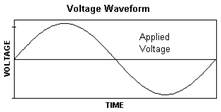
  • There is a law in electrical engineering called Ohm’s Law. This basic law states that when a voltage is applied across a resistance, current will flow. This is how all electrical equipment operates. The voltage we apply across our equipment is a sine wave which operates 60 Hertz (cycles per second).

  • To generate this voltage sine wave. It has (relatively) constant amplitude and constant frequency.
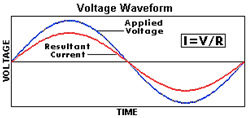
  • Once this voltage is applied to a device, Ohm’s Law kicks in. Ohm’s Law states that current equal’s voltage divided by resistance. Expressed mathematically   I=V/R
  • Expressed graphically, the current ends up being another sine wave, since the resistance is a constant number. Ohm’s Law dictates that the frequency of the current wave is also 60 Hertz. In the real world, this is true; although the two sine waves may not align perfectly (as a power factor) the current wave will indeed be a 60 Hertz sine wave.

  • Since an applied voltage sine wave will cause a sinusoidal current to be drawn, systems which exhibit this behaviour are called linear systems. Incandescent lamps, heaters and motors are linear systems.
  • Some of our modem equipment however does not fit this category. Computers, variable frequency drives, electronic ballasts and uninterruptable power supply systems are non-linear systems. In these systems, the resistance is not a constant and in fact, varies during each sine wave. This occurs because the resistance of the device is not a constant. The resistance in fact, changes during each sine wave

Linear and non-linear loads (motors, heaters and incandescent lamps):

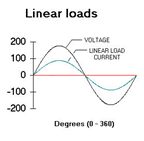
  • A linear element in a power system is a component in which the current is proportional to the voltage.
  • In general, this means that the current wave shape will be the same as the voltage (See Figure 1). Typical examples of linear loads include motors, heaters and incandescent lamps.

                                                                  Figure 1. Voltage and current waveforms for linear

Non-Linear System (Computers, VFDS, Electronic Ballasts):

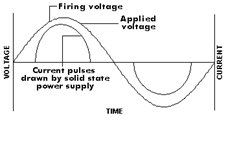
  • As in Figure As we apply a voltage to a solid state power supply, the current drawn is (approximately) zero until a critical “firing voltage” is reached on the sine wave. At this firing voltage, the transistor (or other device) gates or allows current to be conducted.
  • This current typically increases over time until the peak of the sine wave and decreases until the critical firing voltage is reached on the “downward side” of the sine wave. The device then shuts off and current goes to zero. The same thing occurs on the negative side of the sine wave with a second negative pulse of current being drawn. The current drawn then is a series of positive and negative pulses, and not the sine wave drawn by linear systems.
  • Some systems have different shaped waveforms such as square waves. These types of systems are often called non-linear systems. The power supplies which draw this type of current are called switched mode power supplies. Once these pulse currents are formed, we have a difficult time analyzing their effect. Power engineers are taught to analyze the effects of sine waves on power systems. Analyzing the effects of these pulses is much more difficult.

                                                                      Figure 2. Voltage and current waveforms for linear

  • The current drawn by non-linear loads is not sinusoidal but it is periodic, meaning that the current wave looks the same from cycle to cycle. Periodic waveforms can be described mathematically as a series of sinusoidal waveforms that have been summed together.

Figure 3. Waveform with symmetrical harmonic components

  • The sinusoidal components are integer multiples of the fundamental where the fundamental, in the United States, is 60 Hz. The only way to measure a voltage or current that contains harmonics is to use a true-RMS reading meter. If an averaging meter is used, which is the most common type, the error can be Significant.
  • Each term in the series is referred to as a harmonic of the fundamental. The third harmonic would have a frequency of three times 60 Hz or 180 Hz. Symmetrical waves contain only odd harmonics and un-symmetrical waves contain even and odd harmonics.
  • A symmetrical wave is one in which the positive portion of the wave is identical to the negative portion of the wave. An un-symmetrical wave contains a DC component (or offset) or the load is such that the positive portion of the wave is different than the negative portion. An example of un-symmetrical wave would be a half wave rectifier.
  • Most power system elements are symmetrical. They produce only odd harmonics and have no DC offset.

Harmonic current flow

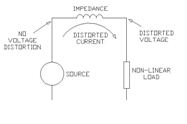
  • When a non-linear load draws current that current passes through all of the impedance that is between the load and the system source (See Figure 4). As a result of the current flow, harmonic voltages are produced by impedance in the system for each harmonic.

Figure 4 – Distorted-current induced voltage distortion

  • These voltages sum and when added to the nominal voltage produce voltage distortion. The magnitude of the voltage distortion depends on the source impedance and the harmonic voltages produced.
  • If the source impedance is low then the voltage distortion will be low. If a significant portion of the load becomes non-linear (harmonic currents increase) and/or when a resonant condition prevails (system impedance increases), the voltage can increase dramatically.

Harmonic currents can produce a number of problems:

  1. Equipment heating
  2. Equipment malfunction
  3. Equipment failure
  4. Communications interference
  5. Fuse and breaker mis-operation
  6. Process problems
  7. Conductor heating.

How harmonics are generated

  • In an ideal clean power system, the current and voltage waveforms are pure sinusoids. In practice, non-sinusoidal currents are available due to result of the current flowing in the load is not linearly related to the applied voltage.
  • In a simple circuit containing only linear circuit elements resistance, inductance and capacitance. The current which flows is proportional to the applied voltage (at a particular frequency) so that, if a sinusoidal voltage is applied, a sinusoidal current will flow. Note that where there is a reactive element there will be a phase shift between the voltage and current waveforms the power factor is reduced, but the circuit can still be linear.
  • But in The situation where the load is a simple full-wave rectifier and capacitor, such as the input stage of a typical switched mode power supply (SMPS). In this case, current flows only when the supply voltage exceeds that stored on the reservoir capacitor, i.e. close to the peak of the voltage sine wave, as shown by the shape of the load line.
  • Any cyclical waveform can be de constructed into a sinusoid at the fundamental frequency plus a number of sinusoids at harmonic frequencies. Thus the distorted current waveform in the figure can be represented by the fundamental plus a percentage of second harmonic plus a percentage of third harmonic and so on, possibly up to the thirtieth harmonic.
  • For symmetrical waveforms, i.e. where the positive and negative half cycles are the same shape and magnitude, all the even numbered harmonics is zero. Even harmonics are now relatively rare but were common when half wave rectification was widely used.
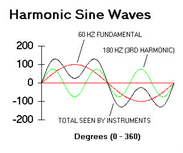
  • The frequencies we use are multiples of the fundamental frequency, 60 Hz. We call these multiple frequencies harmonics. The second harmonic is two times 60 Hertz, or 120 Hz. The third harmonic is 180 Hertz and so on. In our three phase power systems, the “even” harmonics (second, fourth, sixth, etc.) cancel, so we only need deal with the “odd” harmonics.

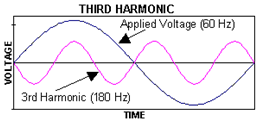
  • This figure shows the fundamental and the third harmonic. There are three cycles of the third harmonic for each single cycle of the fundamental. If we add these two waveforms, we get a non-sinusoidal waveform.
  • This resultant now starts to form the peaks that are indicative of the pulses drawn by switch mode power supplies. If we add in other harmonics, we can model any distorted periodic waveform, such as square waves generated by UPS of VFD systems. It is important to remember these harmonics are simply a mathematical model. The pulses or square waves, or other distorted waveforms are what we actually see if we were to put an oscilloscope on the building’s wiring systems.
  • These current pulses, because of Ohm’s Law, will also begin to distort the voltage waveforms in the building. This voltage distortion can cause premature failure of electronic devices.
  • On three phase systems, the three phases of the power system are 120’ out of phase. The current on phase B occurs 120 deg (1/3 cycle) after the current on A. Likewise, the current on phase C occurs 120’ after the current on phase B. Because of this, our 60 Hertz (fundamental) currents actually cancel on the neutral. If we have balanced 60 Hertz currents on our three phase conductors, our neutral current will be zero. It can be shown mathematically that the neutral current (assuming only 60 Hertz is present) will never exceed the highest loaded phase conductor. Thus, our over current protection on our phase conductors also protects the neutral conductor, even though we do not put an over current protective device in the neutral conductor. We protect the neutral by the mathematics. When harmonic currents are present, this math breaks down. The third harmonic of each of the three phase conductors is exactly in phase. When these harmonic currents come together on the neutral, rather than cancel, they actually add and we can have more current on the neutral conductor than on phase conductors. Our neutral conductors are no longer protected by mathematics!
  • These harmonic currents create heat. This heat over a period of time will raise the temperature of the neutral conductor. This rise in temperature can overheat the surrounding conductors and cause insulation failure. These currents also will overheat the transformer sources which supply the power system. This is the most obvious symptom of harmonics problems; overheating neutral conductors and transformers. Other symptoms include:
  1. Nuisance tripping of circuit breakers
  2. Malfunction of UPS systems and generator systems
  3. Metering problems
  4. Computer malfunctions
  5. Over voltage problems

Types of equipment that generate harmonics:

  • Harmonic load currents are generated by all non-linear loads. These include:
  • For Single phase loads, e.g.
  1. Switched mode power supplies (SMPS)
  2. Electronic fluorescent lighting ballasts
  3. Compact fluorescent lamps (CFL)
  4. Small uninterruptible power supplies (UPS) units
  • For Three phase loads, e.g.
  1. Variable speed drives
  2. Large UPS units

Single phase loads

(A)Switched mode power supplies (SMPS)

  • The majority of modern electronic units use switched mode power supplies (SMPS).
  • These differ from older units in that the traditional step-down transformer and rectifier is replaced by direct controlled rectification of the supply to charge a reservoir capacitor from which the direct current for the load is derived by a method appropriate to the output voltage and current required.
  • The advantage – to the equipment manufacturer – is that the size, cost and weight is significantly reduced and the power unit can be made in almost any required form factor.
  • The disadvantage – to everyone else – is that, rather than drawing continuous current from the supply, the power supply unit draws pulses of current which contain large amounts of third and higher harmonics and significant high frequency components .
  • A simple filter is fitted at the supply input to bypass the high frequency components from line and neutral to ground but it has no effect on the harmonic currents that flow back to the supply.

(B)Single phase UPS units exhibit very similar characteristics to SMPS.

  • For high power units there has been a recent trend towards so-called power factor corrected inputs.
  • The aim is to make the power supply load look like a resistive load so that the input current appears sinusoidal and in phase with the applied voltage. It is achieved by drawing input current as a high frequency triangular waveform that is averaged by the input filter to a sinusoid.
  • This extra level of sophistication is not yet readily applicable to the low-cost units that make up most of the load in commercial and industrial installations. It remains to be seen what problems the wide-scale application of this technology may involve!

(C)Fluorescent lighting ballast

  • Electronic lighting ballasts have become popular in recent years following claims for improved efficiency. Overall they are only a little more efficient than the best magnetic ballasts and in fact, most of the gain is attributable to the lamp being more efficient when driven at high frequency rather than to the electronic ballast itself.
  • Their chief advantage is that the light level can be maintained over an extended lifetime by feedback control of the running current – a practice that reduces the overall lifetime efficiency.
  • Their great disadvantage is that they generate harmonics in the supply current. So called power-factor corrected types are available at higher ratings that reduce the harmonic problems, but at a cost penalty. Smaller units are usually uncorrected.

(D)Compact fluorescent lamps (CFL)

  • CFL are now being sold as replacements for tungsten filament bulbs. A miniature electronic ballast, housed in the connector casing, controls a folded 8mm diameter fluorescent tube.
  • CFLs rated at 11 watt are sold as replacements for a 60 watt filament lamp and have a life expectancy of 8000 hours.
  • The harmonic current spectrum is shown in the figure. These lamps are being widely used to replace filament bulbs in domestic properties and especially in hotels where serious harmonic problems are suddenly becoming common.

Three phase loads

(A)Variable Speed Drives / UPS:

  • Variable speed controllers, UPS units and DC converters in general are usually based on the three-phase bridge, also known as the six-pulse bridge because there are six pulses per cycle (one per half cycle per phase) on the DC output.
  • The six pulse bridge produces harmonics at 6n +/- 1, i.e. at one more and one less than each multiple of six. In theory, the magnitude of each harmonic is the reciprocal of the harmonic number, so there would be 20% fifth harmonic and 9% eleventh harmonic, etc.
  • The magnitude of the harmonics is significantly reduced by the use of a twelve-pulse bridge. This is effectively two six-pulse bridges, fed from a star and a delta transformer winding, providing a 30 degrees phase shift between them.
  • The 6n harmonics are theoretically removed, but in practice, the amount of reduction depends on the matching of the converters and is typically by a factor between 20 and 50. The 12n harmonics remain unchanged. Not only is the total harmonic current reduced, but also those that remain are of a higher order making the design of the filter much easier.
  • Often the equipment manufacturer will have taken some steps to reduce the magnitudes of the harmonic currents, perhaps by the addition of a filter or series inductors. In the past this has led some manufacturers to claim that their equipment is ‘G5/3’ compliant. Since G5/3 is a planning standard applicable to a complete installation, it cannot be said to have been met without knowledge of every piece of equipment on the site.
  • A further increase in the number of pulses to 24, achieved by using two parallel twelve-pulse units with a phase shift of 15 degrees, reduces the total harmonic current to about 4.5%. The extra sophistication increases cost, of course, so this type of controller would be used only when absolutely necessary to comply with the electricity suppliers’ limits.

Problems caused by harmonics

  • Harmonic currents cause problems both on the supply system and within the installation.
  • The effects and the solutions are very different and need to be addressed separately; the measures that are appropriate to controlling the effects of harmonics within the installation may not necessarily reduce the distortion caused on the supply and vice versa.
  • Harmonic problems within the installation
  • Problems caused by harmonic currents:
  1. overloading of neutrals
  2. overheating of transformers
  3. nuisance tripping of circuit breakers
  4. over-stressing of power factor correction capacitors
  5. skin effect
  • Problems caused by harmonic voltages:
  1. voltage distortion
  2. induction motors
  3. zero-crossing noise
  4. Problems caused when harmonic currents reach the supply

Problems caused by harmonic currents

(1) Neutral conductor over-heating

  • In a three-phase system the voltage waveform from each phase to the neutral  so that, when each phase is equally loaded, the°star point is displaced by 120 combined current in the neutral is zero.
  • When the loads are not balanced only the net out of balance current flows in the neutral. In the past, installers (with the approval of the standards authorities) have taken advantage of this fact by installing half-sized neutral conductors. However, although the fundamental currents cancel out, the harmonic currents do not – in fact those that are an odd multiple of three times the fundamental, the ‘triple-N’ harmonics, add in the neutral.
  • The third°phase currents, are introduced at 120 harmonic of each phase is identical, being three times the frequency and one-third of a (fundamental) cycle offset.
  • The effective third harmonic neutral current is shown at the bottom. In this case, 70% third harmonic current in each phase results in 210% current in the neutral.
  • Case studies in commercial buildings generally show neutral currents between 150% and 210% of the phase currents, often in a half-sized conductor!
  • There is some confusion as to how designers should deal with this issue.
  • The simple solution, where single-cored cables are used, is to install a double sized neutral, either as two separate conductors or as one single large conductor.
  • The situation where multi-cored cables are used is not so simple. The ratings of multi-core cables (for example as given in IEC 60364–5-523 Table 52 and BS 7671 Appendix 4) assume that the load is balanced and the neutral conductor carries no current, in other words, only three of the four or five cores carry current and generate heat. Since the cable current carrying capacity is determined solely by the amount of heat that it can dissipate at the maximum permitted temperature, it follows that cables carrying triple-N currents must be de-rated.
  • In the example illustrated above, the cable is carrying five units of current – three in the phases and two in the neutral – while it was rated for three units. It should be de-rated to about 60% of the normal rating.
  • IEC 60364-5-523 Annex C (Informative) suggests a range of de-rating factors according to the triple-N harmonic current present. Figure 13 shows de-rating factor against triple-N harmonic content for the de-rating described in IEC 60364-5-523 Annex C and for the thermal method used above.

(2) Effects on transformers

  • Transformers are affected in two ways by harmonics.
  • Firstly, the eddy current losses, normally about 10% of the loss at full load, increase with the square of the harmonic number.
  • In practice, for a fully loaded transformer supplying a load comprising IT equipment the total transformer losses would be twice as high as for an equivalent linear load.
  • This results in a much higher operating temperature and a shorter life. In fact, under these circumstances the lifetime would reduce from around 40 years to more like 40 days! Fortunately, few transformers are fully loaded, but the effect must be taken into account when selecting plant.
  • The second effect concerns the triple-N harmonics. When reflected back to a delta winding they are all in phase, so the triple-N harmonic currents circulate in the winding.
  • The triple-N harmonics are effectively absorbed in the winding and do not propagate onto the supply, so delta wound transformers are useful as isolating transformers. Note that all other, non triple-N, harmonics pass through. The circulating current has to be taken into account when rating the transformer.

(3) Nuisance tripping of circuit breakers

  • Residual current circuit breakers (RCCB) operate by summing the current in the phase and neutral conductors and, if the result is not within the rated limit, disconnecting the power from the load. Nuisance tripping can occur in the presence of harmonics for two reasons.
  • Firstly, the RCCB, being an electromechanical device, may not sum the higher frequency components correctly and therefore trips erroneously.
  • Secondly, the kind of equipment that generates harmonics also generates switching noise that must be filtered at the equipment power connection. The filters normally used for this purpose have a capacitor from line and neutral to ground, and so leak a small current to earth.
  • This current is limited by standards to less than 3.5mA, and is usually much lower, but when equipment is connected to one circuit the leakage current can be sufficient to trip the RCCB. The situation is easily overcome by providing more circuits, each supplying fewer loads.
  • Nuisance tripping of miniature circuit breakers (MCB) is usually caused because the current flowing in the circuit is higher than that expected from calculation or simple measurement due to the presence of harmonic currents.
  • Most portable measuring instruments do not measure true RMS values and can underestimate non-sinusoidal currents by 40%.

(4) Over-stressing of power factor correction capacitors

  • Power-factor correction capacitors are provided in order to draw a current with a leading phase angle to offset lagging current drawn by an inductive load such as induction motors.
  • The effective equivalent circuit for a PFC capacitor with a non-linear load. The impedance of the PFC capacitor reduces as frequency rises, while the source impedance is generally inductive and increases with frequency. The capacitor is therefore likely to carry quite high harmonic currents and, unless it has been specifically designed to handle them, damage can result.
  • A potentially more serious problem is that the capacitor and the stray inductance of the supply system can resonate at or near one of the harmonic frequencies (which, of course, occur at 100 Hz intervals). When this happens very large voltages and currents can be generated, often leading to the catastrophic failure of the capacitor system.
  • Resonance can be avoided by adding an inductance in series with the capacitor such that the combination is just inductive at the lowest significant harmonic. This solution also limits the harmonic current that can flow in the capacitor. The physical size of the inductor can be a problem, especially when low order harmonics are present.

(5) Skin effect

  • Alternating current tends to flow on the outer surface of a conductor. This is known as skin effect and is more pronounced at high frequencies.
  • Skin effect is normally ignored because it has very little effect at power supply frequencies but above about 350 Hz, i.e. the seventh harmonic and above, skin effect will become significant, causing additional loss and heating. Where harmonic currents are present, designers should take skin effect into account and de-rate cables accordingly.
  • Multiple cable cores or laminated busbars can be used to help overcome this problem. Note also that the mounting systems of busbars must be designed to avoid mechanical resonance at harmonic frequencies.

Problems caused by harmonic voltages

(1) voltage distortion

  • Because the supply has source impedance, harmonic load currents give rise to harmonic voltage distortion on the voltage waveform (this is the origin of ‘flat topping’).
  • There are two elements to the impedance: that of the internal cabling from the point of common coupling (PCC), and that inherent in the supply at the PCC, e.g. the local supply transformer.
  • The distorted load current drawn by the non-linear load causes a distorted voltage drop in the cable impedance. The resultant distorted voltage waveform is applied to all other loads connected to the same circuit, causing harmonic currents to flow in them – even if they are linear loads.
  • Solution: The solution is to separate circuits supplying harmonic generating loads from those supplying loads which are sensitive to harmonics, as shown in Figure 16. Here separate circuits feed the linear and non-linear loads from the point of common coupling, so that the voltage distortion caused by the non-linear load does not affect the linear load.
  • When considering the magnitude of harmonic voltage distortion it should be remembered that when the load is transferred to a UPS or standby generator during a power failure the source impedance and the resulting voltage distortion will be much higher.
  • Where local transformers are installed, they should be selected to have sufficiently low output impedance and to have sufficient capacity to withstand the additional heating, in other words, by selecting an appropriately over sized transformer.
  • Note that it is not appropriate to select a transformer design in which the increase in capacity is achieved simply by forced cooling – such a unit will run at higher internal temperatures and have a reduced service life. Forced cooling should be reserved for emergency use only and never relied upon for normal running.

(2) Induction Motors

  • Harmonic voltage distortion causes increased eddy current losses in motors in the same way as in transformers. However, additional losses arise due to the generation of harmonic fields in the stator, each of which is trying to rotate the motor at a different speed either forwards or backwards. High frequency currents induced in the rotor further increase losses.
  • Where harmonic voltage distortion is present motors should be de-rated to take account of the additional losses.

(3) Zero-crossing noise

  • Many electronic controllers detect the point at which the supply voltage crosses zero volts to determine when loads should be turned on. This is done because switching inductive loads at zero voltage does not generate transients, so reducing electromagnetic interference (EMI) and stress on the semiconductor switching devices.
  • When harmonics or transients are present on the supply the rate of change of voltage at the crossing becomes faster and more difficult to identify, leading to erratic operation. There may in fact be several zero-crossings per half cycle.

(4)Harmonic problems affecting the supply

  • When a harmonic current is drawn from the supply it gives rise to a harmonic voltage drop proportional to the source impedance at the point of common coupling (PCC) and the current.
  • Since the supply network is generally inductive, the source impedance is higher at higher frequencies. Of course, the voltage at the PCC is already distorted by the harmonic currents drawn by other consumers and by the distortion inherent in transformers, and each consumer makes an additional contribution.

Remedies to Reduce Harmonic Problems:

(1) Over sizing Neutral Conductors

  • In three phase circuits with shared neutrals, it is common to oversize the neutral conductor up to 200% when the load served consists of non-linear loads. For example, most manufacturers of system furniture provide a 10 AWG conductor with 35 amp terminations for a neutral shared with the three 12 AWG phase conductors.
  • In feeders that have a large amount of non-linear load, the feeder neutral conductor and panel board bus bar should also be oversized.

(2) Using Separate Neutral Conductors

  • On three phase branch circuits, another philosophy is to not combine neutrals, but to run separate neutral conductors for each phase conductor. This increases the copper use by 33%. While this successfully eliminates the addition of the harmonic currents on the branch circuit neutrals, the panel board neutral bus and feeder neutral conductor still must be oversized.
  • Oversizing Transformers and Generators: The oversizing of equipment for increased thermal capacity should also be used for transformers and generators which serve harmonics-producing loads. The larger equipment contains more copper.

(3) Passive filters

  • Passive filters are used to provide a low impedance path for harmonic currents so that they flow in the filter and not the supply.
  • The filter may be designed for a single harmonic or for a broad band depending on requirements.
  • Simple series band stop filters are sometimes proposed, either in the phase or in the neutral. A series filter is intended to block harmonic currents rather than provide a controlled path for them so there is a large harmonic voltage drop across it.
  • This harmonic voltage appears across the supply on the load side. Since the supply voltage is heavily distorted it is no longer within the standards for which equipment was designed and warranted. Some equipment is relatively insensitive to this distortion, but some is very sensitive. Series filters can be useful in certain circumstances, but should be carefully applied; they cannot be recommended as a general purpose solution.

(4) Isolation transformers

  • As mentioned previously, triple-N currents circulate in the delta windings of transformers. Although this is a problem for transformer manufacturers and specifiers – the extra load has to be taken into account it is beneficial to systems designers because it isolates triple-N harmonics from the supply.
  • The same effect can be obtained by using a ‘zig-zag’ wound transformer. Zig-zag transformers are star configuration auto transformers with a particular phase relationship between the windings that are connected in shunt with the supply.

(5) Active Filters

  • The solutions mentioned so far have been suited only to particular harmonics, the isolating transformer being useful only for triple-N harmonics and passive filters only for their designed harmonic frequency. In some installations the harmonic content is less predictable.
  • In many IT installations for example, the equipment mix and location is constantly changing so that the harmonic culture is also constantly changing. A convenient solution is the active filter or active conditioner.
  • The active filter is a shunt device. A current transformer measures the harmonic content of the load current, and controls a current generator to produce an exact replica that is fed back onto the supply on the next cycle. Since the harmonic current is sourced from the active conditioner, only fundamental current is drawn from the supply. In practice, harmonic current magnitudes are reduced by 90%, and, because the source impedance at harmonic frequencies is reduced, voltage distortion is reduced.

(6) K-Rated Transformers

  • Special transformers have been developed to accommodate the additional heating caused by these harmonic currents. These types of transformers are now commonly specified for new computer rooms and computer lab facilities.

(7) Special Transformers

  • There are several special types of transformer connections which can cancel harmonics. For example, the traditional delta-wye transformer connection will trap all the triplen harmonics (third, ninth, fifteenth, twenty-first, etc.) in the delta.
  • Additional special winding connections can be used to cancel other harmonics on balanced loads. These systems also use more copper. These special transformers are often specified in computer rooms with well balanced harmonic producing loads such as multiple input mainframes or matched DASD peripherals.

(8) Filtering

  • While many filtersdo not work particularly well at this frequency range, special electronic tracking filters can work very well to eliminate harmonics.
  • These filters are presently relatively expensive but should be considered for thorough harmonic elimination.

(9) Special Metering

  • Standard clamp-on ammeters are only sensitive to 60 Hertz current, so they only tell part of the story. New “true RMS” meters will sense current up to the kilohertz range. These meters should be used to detect harmonic currents. The difference between a reading on an old style clamp-on ammeter and a true RMS ammeter will give you. an indication of the amount of harmonic current present.
  • The measures described above only solve the symptoms of the problem. To solve the problem we must specify low harmonic equipment. This is most easily done when specifying electronic ballasts. Several manufacturers make electronic ballasts which produce less than 15 % harmonics. These ballasts should be considered for any ballast retrofit or any new project. Until low harmonics computers are available, segregating these harmonic loads on different circuits, different panel boards or the use of transformers should be considered. This segregation of “dirty” and “clean” loads is fundamental to electrical design today. This equates to more branch circuits and more panel boards, thus more copper usage.